
Best Business Litigation Attorney: Compare Top Dispute Lawyers
Table of Contents
- Understanding the Role of a Business Litigation Attorney in Sacramento, California
- Fundamentals: Business Litigation vs. Corporate Law in Sacramento
- Deep Dive: Commercial Litigation and Contract Disputes in Sacramento
- Practical Guide: Choosing a Business Litigation Attorney in Sacramento, California
- Advanced Considerations: Trial-First Strategy vs. Alternative Dispute Resolution
- Frequently Asked Questions About Business Litigation Attorneys
- Making an Informed Decision for Your Business Dispute
Understanding the Role of a Business Litigation Attorney in Sacramento, California
We are a Sacramento-based firm that focuses exclusively on resolving high-stakes commercial conflicts. A business litigation attorney in Sacramento, California is a legal professional who dedicates their practice to representing companies and business owners in complex disputes, distinguishing them from a general practitioner by their deep understanding of commercial law and local court procedures.
Our firm’s trial-first mentality means we strategize every case as if it will go to verdict, which positions our clients for maximum advantage. As a dedicated business dispute lawyer, we handle a wide array of commercial matters, including contract and business disputes, partnership and shareholder conflicts, and breach of fiduciary duty claims. A skilled commercial litigation attorney from our firm will also litigate purchase and sale agreement disputes with the aggressive advocacy needed to protect your enterprise’s future. This preparation provides a crucial edge, as it demonstrates to opposing counsel that we are fully ready to present a compelling case in a Sacramento courtroom.
Our attorneys bring extensive Northern California courtroom experience to every representation. While our primary focus is resolving business conflicts, we also understand that commercial interests can intersect with other legal areas, and our team can assist with related issues such as workers compensation in California. We encourage you to schedule a consultation to discuss how our aggressive advocacy can serve your business goals.
Fundamentals: Business Litigation vs. Corporate Law in Sacramento
To better understand how we can assist with your legal needs, it helps to distinguish between two key areas of legal practice: business litigation and corporate law. When searching for a business litigation attorney in Sacramento, recognizing this difference is the first step toward finding the right advocate for your specific situation. Our firm focuses exclusively on the litigation side, bringing a trial-first mentality to every dispute we handle.
The following table highlights the fundamental differences between these two distinct practice areas.
| Aspect | Business Litigation | Corporate Law |
|---|---|---|
| Focus | Resolving disputes through the court system, trial advocacy, and negotiation under litigation pressure. | Structuring transactions, compliance, contracts, mergers, and ongoing business advice. |
| Typical Disputes | Breach of contract, partnership dissolutions, fraud, tort claims, real estate disputes. | Rarely litigated; focus is on avoiding disputes through careful drafting. |
| Attorney Role | Advocate in court, strategist for trial, motion practice, discovery. | Advisor, drafter, negotiator for transactions. |
| Outcome | Court judgment, settlement after filing, or jury verdict. | Signed contract, successful merger, ongoing compliance. |
Based on McCaslin Law expertise and California Bar Association legal guides, this comparison underscores how different each path truly is. Understanding these distinctions is essential before moving forward with legal action.
Business litigation is the process of resolving disputes through the court system, involving trial advocacy, motion practice, and discovery. A commercial litigation attorney manages disputes like real estate conflicts and tort claims, drawing on extensive courtroom experience. In contrast, corporate law focuses on structuring transactions and ensuring compliance, with corporate lawyers rarely setting foot in a courtroom. Their primary role is risk avoidance through precise drafting.
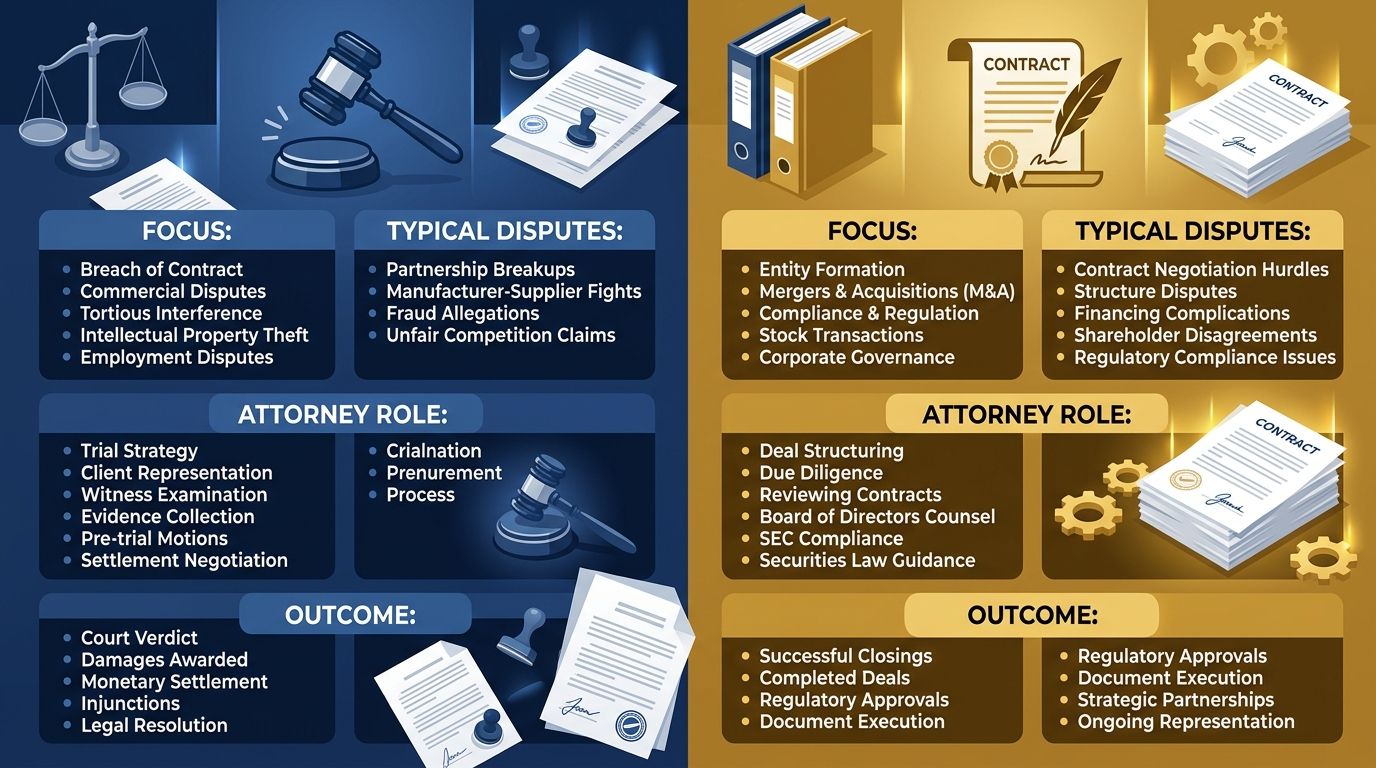
Side-by-side comparison of business litigation and corporate law differences
A business litigation attorney focuses on courtroom advocacy, representing clients in civil litigation that includes breach of contract, partnership dissolutions, and shareholder conflicts. Meanwhile, a business dispute lawyer handles partnership dissolutions and breach of contract claims, working to secure court judgments or settlements. Outcomes in litigation include jury verdicts or negotiated resolutions, while corporate law yields signed agreements and ongoing compliance.
Now that you understand the distinction, we want you to know that McCaslin Law is equipped to handle your disputes in Sacramento with aggressive advocacy and meticulous preparation. While this section focuses on business litigation fundamentals, we also represent clients in related areas such as personal injury and products liability — if you need a defective products lawyer in San Francisco, our firm has the experience to handle those claims as well.
Deep Dive: Commercial Litigation and Contract Disputes in Sacramento
Now let’s take a closer look at the specific types of litigation we handle and how we approach complex disputes. As a business litigation attorney in Sacramento, we understand that legal conflicts between companies require a fundamentally different approach than disputes involving individuals.
Commercial Litigation vs. Civil Litigation: What Sets Them Apart?
Commercial litigation involves disputes between businesses or business entities, including corporations, LLCs, and partnerships. Civil litigation is a broader category that typically involves individuals or individuals versus businesses. For example, a slip & fall attorney handles premises liability cases that fall under civil litigation rather than commercial. The distinction matters because commercial cases often involve higher stakes, larger financial exposure, and more complex discovery than standard civil litigation.
The following table illustrates the key distinctions between these two practice areas.
| Aspect | Commercial Litigation | Civil Litigation |
|---|---|---|
| Parties Involved | Businesses, corporations, LLCs, partnerships. | Individuals, individuals vs. businesses, government entities. |
| Types of Claims | Breach of contract, business torts, shareholder oppression, UCL claims. | Personal injury, employment disputes, property damage, family law. |
| Complexity | Often complex, involving multiple parties and voluminous discovery. | Ranges from simple to complex; can involve same procedural rules. |
| Potential Awards | High-value damages, lost profits, specific performance. | Compensatory damages, punitive damages in some cases. |
| Litigation Strategy | Focus on business impact, loss mitigation, and expedited resolutions. | Often more focused on individual compensation. |
While both types of cases may proceed through the same court system, the strategic considerations differ significantly. A business dispute lawyer must account for ongoing business relationships, reputational concerns, and the financial realities of the corporate client. Our Trial-first mentality means we prepare every case as though it will go to verdict, regardless of whether it is a commercial or civil matter.
Common Cases Handled by Commercial Litigation Attorneys
Our firm handles a range of disputes that a business litigation attorney in Sacramento regularly encounters. The most frequent case types include:
- Breach of contract: When one party fails to perform under the terms of a written or oral agreement, resulting in financial harm to the other party.
- Partnership and shareholder disputes: Including shareholder oppression claims where majority owners act against the interests of minority shareholders.
- Purchase and sale agreement disputes: Conflicts arising from the sale of a business, including allegations of misrepresentation or failure to disclose material information.
- Real estate litigation: Covering title, boundary, and easement disputes, as well as commercial lease disputes between landlords and tenants.
- Breach of fiduciary duty claims: When a partner, officer, or director breaches the duty of loyalty or care owed to the business or its owners.
California Civil Code and the California Business and Professions Code may apply to many of these claims, though the specific statutory framework depends on the facts of each case. Our litigation counsel evaluates every matter individually to determine the most effective strategy.
How a Commercial Litigation Attorney Approaches a Contract Dispute
When a business dispute arises, our process follows a structured path designed to maximize leverage and position the case for success. A commercial litigation attorney on our team begins with a detailed demand letter and pre-litigation negotiation, clearly outlining the client’s position and the legal basis for the claim.
If pre-litigation resolution is not possible, we proceed to filing the complaint and service of process, formally initiating the lawsuit. The discovery phase follows, including document production, interrogatories, and depositions. This stage is often the most intensive, as we uncover the evidence that will drive the case forward.
Pretrial motions and settlement conferences occur throughout the litigation, and we prepare for each with the same Trial-first mentality that defines our practice. From day one, we build each case as though it will be tried to verdict, which strengthens our position in settlement negotiations and ensures we are never caught unprepared. Trial preparation and the trial itself represent the culmination of this process, where our aggressive advocacy comes to the forefront.
Understanding the commercial litigation process is the first step; let’s explore how we handle each phase from demand letter to trial.
This website is for informational purposes only and does not constitute legal advice.
Practical Guide: Choosing a Business Litigation Attorney in Sacramento, California
This guide is for informational purposes and does not constitute legal advice.
Choosing the right business litigation attorney in Sacramento is a critical decision that can significantly influence the trajectory of a commercial dispute. For business owners and managers navigating contract breaches, partnership disagreements, or other commercial conflicts, having a skilled legal advocate is essential. This practical guide outlines the key factors to evaluate, the questions to ask, and the fee structures to understand, helping you make an informed and confident choice when selecting legal representation in Northern California.
Key Factors to Consider When Evaluating Candidates
To narrow down your choices, consider these key factors when evaluating a potential litigation counsel:
- Experience in Similar Business Litigation Cases: Look for a lawyer with a proven history in handling matters identical to yours, such as contract disputes or shareholder disagreements. A seasoned business dispute lawyer will understand the nuances of California commercial law and be better equipped to develop an effective strategy.
- Trial Track Record: We believe a trial-first mentality is crucial. An attorney’s willingness and ability to take a case to verdict often strengthens negotiation positions and can lead to more favorable resolutions, even without setting foot in a courtroom.
- Communication Style: Effective representation requires clear, consistent, and timely communication. Evaluate whether the attorney listens attentively, explains complex legal concepts in plain language, and establishes a communication protocol that keeps you informed at every stage.
- Fee Structure Transparency: A trustworthy attorney will openly discuss their billing practices. You should receive a written fee agreement that clearly outlines how you will be charged, what costs are your responsibility, and what to expect in terms of litigation expenses.
- Local Court Knowledge in Sacramento Superior Court: Familiarity with local court procedures, judicial preferences, and the Sacramento County legal community can be a distinct advantage. An attorney known and respected in the local courthouse is often better positioned to navigate your case efficiently.
Questions to Ask During Your Initial Consultation
Once you have a shortlist of candidates, ask these questions during your initial consultation to gain deeper insight into their practice and approach.
- “How many business litigation cases have you handled in Sacramento Superior Court?”
- “Will you personally handle my case or delegate significant portions to associates?” Direct attorney involvement is a cornerstone of our practice at McCaslin Law.
- “What is your trial experience?” A commercial litigation attorney with substantial trial experience can credibly project our aggressive advocacy, showing opposing counsel they are prepared for all scenarios.
- “How do you communicate case updates and strategy developments to your clients?”
- “What are your fee arrangements, and can you provide an estimated timeline of costs?”
- “Can you provide references from past clients or other professionals who can speak to your capabilities?”
Asking these targeted questions helps ensure that your chosen Sacramento business litigator aligns with your expectations for involvement, experience, and financial transparency.
Understanding Fee Structures and Cost Expectations
Finally, understand the costs involved. Business litigation attorneys typically employ several common fee structures, and the right one depends on the nature of your case. A clear agreement on fees is vital before representation begins.
Hourly: The attorney bills a set dollar amount for each hour worked on your case. This is standard for ongoing litigation where the scope of work is unpredictable.
Contingency: The attorney receives an agreed-upon percentage of the financial recovery if you win, and you pay no upfront fee. This is common when pursuing clear monetary damages.
Retainer: You deposit an upfront sum into a trust account, from which the attorney deducts fees and costs as they are incurred. This provides predictable billing against a defined fund.
Flat Fee: A single, predetermined fee covers a specific, discrete legal task, such as drafting a demand letter or conducting a contract review.
The following table summarizes the common fee arrangements for a business litigation attorney in California.
| Fee Type | How It Works | Best For | Typical Cost Range (California) |
|---|---|---|---|
| Hourly | Attorney bills for each hour worked. | Ongoing litigation where scope is uncertain. | $300–$800 per hour depending on experience and location. |
| Contingency | Attorney takes a percentage of the recovery; no upfront fee. | Cases with clear monetary recovery (e.g., contract damages). | 25%–40% of recovery plus costs. |
| Retainer | Upfront payment deposited into trust; attorney deducts from retainer. | Clients who want predictable billing. | $5,000–$50,000+ upfront depending on case complexity. |
| Flat Fee | Single fee for a defined scope of work. | Simple, discrete tasks (e.g. demand letters). | $1,500–$10,000 depending on task. |
For a deeper understanding of ethical fee practices, you can review the comprehensive legal guides in California published by the State Bar of California.
With these considerations in mind, you can confidently schedule consultations and evaluate candidates. Understanding the key factors, asking the right questions, and clarifying fee expectations are the foundational steps to securing a formidable advocate for your business.
Advanced Considerations: Trial-First Strategy vs. Alternative Dispute Resolution
For any business litigation attorney, the choice between an immediate trial preparation posture and an early settlement focus defines the entire trajectory of a case. Clients frequently ask us whether they should hire a firm that prepares for trial from day one or one that prioritizes settlement first. At McCaslin Law, PC, our trial-first mentality shapes how we approach every commercial dispute, and our experience shows that this philosophy creates significant strategic advantages for clients facing high-stakes litigation.
Trial-First Strategy: Building Leverage Through Readiness
The trial-first approach requires a commercial litigation attorney to invest substantial effort in discovery, motion practice, and trial preparation from the very beginning of representation. We prepare every case as if it will be tried to verdict, regardless of whether settlement discussions are ongoing. This methodology creates a credible trial threat that opposing parties and their counsel recognize and respect. Under California Civil Procedure Code rules governing trial readiness, early preparation ensures that procedural deadlines are met, evidence is preserved, and the factual record is developed strategically (McCaslin Law FAQ – Commercial Litigation).
When opposing counsel understands that a business dispute lawyer is genuinely ready to try a case, settlement negotiations shift markedly. The credible threat of trial—backed by completed discovery, prepared witnesses, and developed legal theories—fundamentally alters the bargaining dynamics. Our experience shows that this approach often maximizes settlement value because the defense cannot bank on procedural delays or incomplete preparation to gain leverage. While trial-first requires a higher upfront investment in discovery and trial preparation, the potential for higher net recovery frequently justifies that investment, particularly in complex commercial disputes where significant sums are at stake.
Settlement-First Approach: Efficiency with Potential Tradeoffs
A settlement-first model prioritizes early resolution through negotiation, mediation, or informal settlement discussions. In many traditional firms, this approach means that junior associates handle the bulk of case work, with partners stepping in only for settlement conferences or mediation. This structure can reduce immediate legal costs and may result in faster resolution for straightforward claims. However, business dispute counsel operating under this model may find themselves in a weaker negotiating position precisely because the opposing party perceives no credible trial threat.
The primary risk of a settlement-first strategy lies in leaving value on the table. Without the leverage that comes from demonstrated trial readiness, clients may accept settlement offers below what their claims could yield at trial. For smaller claims or parties seeking quick resolution with less cost exposure, this tradeoff may be acceptable. For complex, high-stakes commercial disputes, however, the settlement-first approach carries real strategic cost—the inability to project credible trial readiness can permanently cap settlement negotiations at suboptimal levels.
Understanding these strategic differences helps clients evaluate which approach best serves their specific circumstances. The trial-first strategy that we employ aligns with the needs of clients facing complex disputes where the stakes justify rigorous preparation and where demonstrating genuine willingness to go to trial can transform settlement dynamics. Next, we explore how these strategic principles apply across specific case types and practice areas.
Frequently Asked Questions About Business Litigation Attorneys
Below are answers to common questions about working with a business litigation attorney.
What does a business litigation attorney do? A business litigation attorney resolves disputes that arise in a commercial context, guiding clients through negotiation, mediation, and, when necessary, courtroom trials. As your commercial litigation counsel, we handle breaches of contract, protect shareholder rights, and pursue tort claims with a Trial-first mentality from the very first filing.
When should I hire a business dispute lawyer? You should consult a business dispute lawyer the moment a commercial conflict threatens your company’s operations or reputation in Northern California. Early intervention by an experienced business dispute attorney in Northern California allows us to secure evidence, define your legal position, and often resolve matters favorably before the cost of litigation escalates.
How does McCaslin Law, PC approach these cases? We bring aggressive advocacy to every dispute, preparing each case as if it will be tried to a jury. This strategic, trial-ready posture, backed by more than 25 years of experience, creates leverage that insurance companies and opposing counsel cannot ignore and frequently leads to stronger settlements for our clients.
This website is for informational purposes only and does not constitute legal advice.
Making an Informed Decision for Your Business Dispute
Selecting the right legal advocate is one of the most critical decisions a business owner will make. At McCaslin Law, PC, we are a business litigation attorney with over 25 years of trial experience serving Sacramento businesses. Our trial-first mentality strengthens your negotiating position from the outset—opposing parties know we prepare every case as if it will go to verdict. As your business dispute lawyer, you work directly with John C. McCaslin, not a team of junior associates. Our extensive Northern California courtroom experience gives your case added credibility during settlement discussions. We invite you to schedule a confidential consultation to discuss your situation and strategy. Contacting us does not create an attorney-client relationship.
Resources
- Get Legal Guidance on California Workers' Compensation
- Find Expert Defective Products Lawyer in San Francisco
- Get Top-Rated Slip & Fall Attorney in Sacramento
- Learn Truck Accident Claim Deadlines in California
- Get Essential Bus Accident Guidance for Oakland
- Discover Exemptions from California Workers' Compensation
- Understand Pure Comparative Negligence for Motorcycle Accidents
- Find Free Legal Guide Pamphlets from State Bar
