
Best Insurance Bad Faith Attorney in Sacramento: Proven Results
Table of Contents
- Insurance Bad Faith Claims in Sacramento: What Policyholders Should Know
- Understanding Insurance Bad Faith in Sacramento: Proof and Legal Standards
- Building a Strong Bad Faith Insurance Case in Sacramento
- How to File a Bad Faith Insurance Claim in Sacramento
- Damages and Statute of Limitations for Bad Faith Insurance Claims in Sacramento
- Common Questions About Insurance Bad Faith Claims in Sacramento
- The Path Forward: Retaining an Insurance Bad Faith Attorney in Sacramento
Insurance Bad Faith Claims in Sacramento: What Policyholders Should Know
California law imposes a legal duty on regulators to treat their policyholders fairly. When an insurance company unreasonably denies a valid claim, fails to conduct a proper investigation, or drags out payment without justification, it may be acting in bad faith—a breach of the implied covenant of good faith and fair dealing. If you suspect unfair treatment, speaking with an experienced insurance bad faith attorney in Sacramento is critical to protecting your rights.
Common examples of insurer misconduct include issuing unreasonably low settlement offers, ignoring key evidence, or simply delaying a decision without explanation. A skilled bad faith insurance claims attorney can evaluate whether the carrier’s actions cross the line from routine delay into actionable misconduct. These situations are more than frustrating—they can cause serious financial and emotional harm, and California law allows policyholders to pursue remedies for both.
Policyholders who have been wronged may sue for breach of contract and, in appropriate cases, recover tort damages that include emotional distress. Consulting an insurance claim denial attorney in Sacramento helps determine whether the facts support a bad faith claim and what the next steps should be. Local court procedures matter, and having counsel who understands Sacramento’s legal landscape is a meaningful advantage.
If you believe your insurer is acting unfairly, gather your policy documents, claim correspondence, and any written denials, then seek legal review promptly. While this section focuses on insurance bad faith, our firm also handles other complex litigation, including work as a medical malpractice attorney in Northern California. Contacting McCaslin Law, PC does not create an attorney-client relationship, and prior results do not guarantee similar outcomes.
Understanding Insurance Bad Faith in Sacramento: Proof and Legal Standards
Insurance bad faith occurs when an insurer breaches the implied covenant of good faith and fair dealing by acting unreasonably or without proper cause in handling a policyholder’s claim. For Sacramento residents, proving such conduct requires a clear understanding of the legal standards under California law. Our firm helps policyholders hold insurers accountable, and the need for an insurance bad faith attorney often arises when an insurer delays, denies, or undercuts a legitimate claim without justification.
The following table highlights some of the most common bad faith practices policyholders encounter:
| Type of Bad Faith | Example | Legal Impact |
|---|---|---|
| Unreasonable Denial of Claim | Insurer denies covered claim without investigation | May constitute statutory bad faith under Cal. Ins. Code § 790.03(h) |
| Unreasonable Delay in Payment | Insurer postpones payment beyond reasonable time | Exposes insurer to extracontractual damages, including emotional distress |
| Inadequate Settlement Offer | Lowball offer ignoring evidence of loss | Can lead to punitive damages if acting with malice or fraud |
These examples illustrate how insurers can violate their duty to policyholders. Whether a claim involves unreasonable denial, protracted delay, or a deliberately low settlement offer, the legal impact can be significant. As explained in our firm’s FAQ resource, bad faith is not merely an inconvenience — it is a serious breach of legal obligations that can expose insurers to liability beyond the original policy limits.
To establish bad faith, the insured must demonstrate that the insurer acted unreasonably or without proper cause and that the conduct was intentional or reckless. California law also requires proof of actual damages caused by the bad faith conduct, which can include economic loss, emotional distress, and, in egregious cases, punitive damages. Under California Civil Code § 3294, punitive damages require clear and convincing evidence of malice, oppression, or fraud. This high burden underscores why policyholders benefit from an insurance claim denial attorney who understands the nuanced proof requirements.
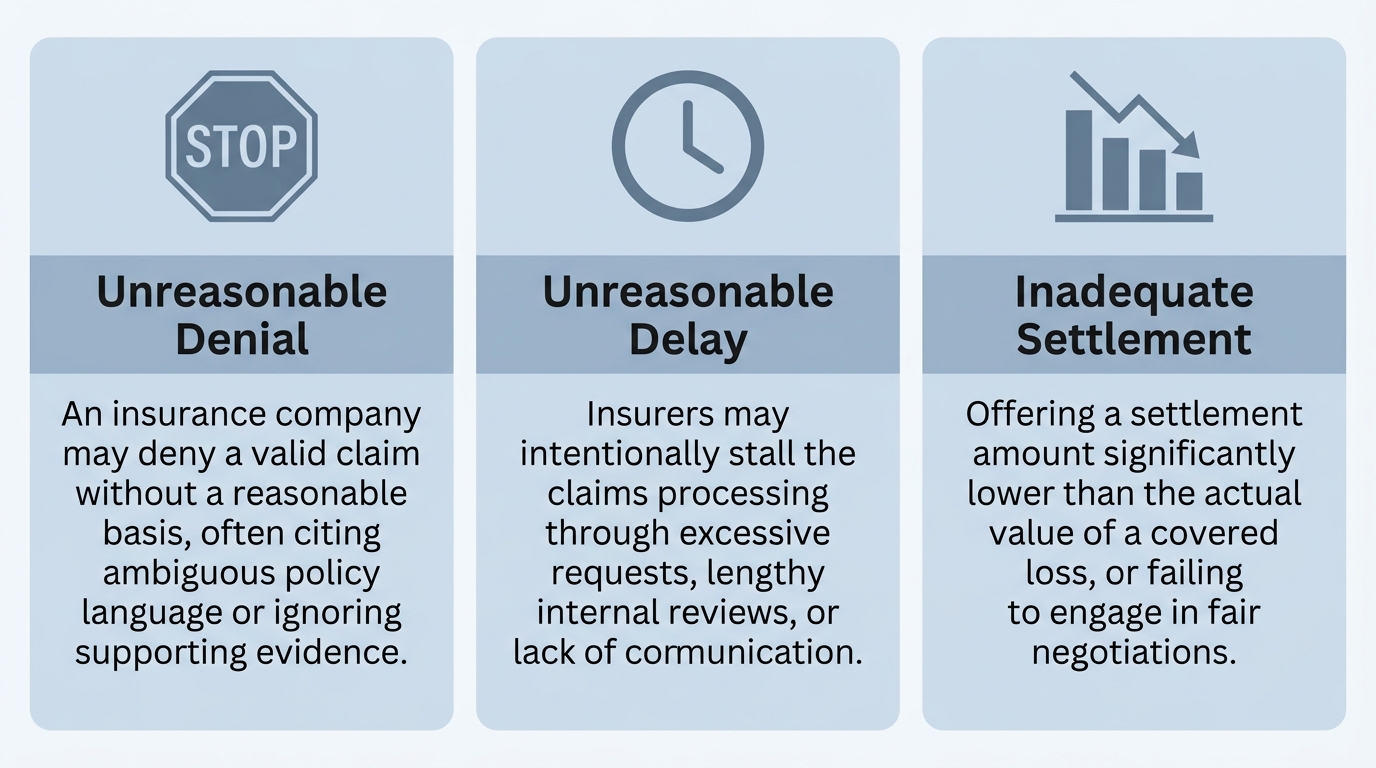
Three common insurance bad faith practices illustrated
Meeting these legal standards demands thorough investigation, expert analysis, and meticulous litigation preparation. Our firm’s trial-first mentality ensures we are prepared to meet the strict proof requirements of a bad faith claim in Sacramento and throughout Northern California. When insurers refuse to honor their commitments, working with a bad faith insurance claims attorney who is ready to take a case to trial sends a powerful signal that the policyholder is serious about pursuing full accountability.
Our experience handling complex bad faith claims for individuals and businesses across the region gives us the insight needed to identify insurer misconduct and build compelling cases. For instance, we also serve as a medical malpractice attorney for Sacramento clients, and that broader litigation background strengthens our ability to handle the expert-driven proof required in bad faith insurance disputes.
Understanding these legal standards is the first step. In the next section, we explain the remedies available to policyholders when insurers act in bad faith.
This information is for informational purposes only and does not constitute legal advice. Every case is unique. Contacting McCaslin Law, PC does not create an attorney-client relationship.
Building a Strong Bad Faith Insurance Case in Sacramento
Pursuing a claim against an insurer requires more than frustration over a denied claim—it demands a strategic approach grounded in California law. As an insurance bad faith attorney in Sacramento, McCaslin Law combines decades of trial experience with meticulous preparation to hold insurers accountable. Our trial-first mentality ensures every case is built to win at trial from day one.
California Bad Faith Law: Defining Unreasonable Conduct
California law imposes an implied covenant of good faith and fair dealing on every insurance contract. This means an insurer must fairly consider the interests of its policyholders when evaluating claims, and cannot prioritize its own profits over legitimate coverage obligations. The California Supreme Court articulated this duty in Egan v. Mutual of Omaha, holding that insurers must provide their insureds with a defense and coverage that serves the insured’s interests, not merely their own.
It is important to distinguish between a simple breach of contract and bad faith. A breach occurs when an insurer fails to pay benefits owed under a policy, but bad faith involves unreasonable conduct—denying a claim without a reasonable basis, failing to conduct a prompt and thorough investigation, misleading policyholders about policy terms, or unreasonably delaying payment for months without justification. In Sacramento bad faith cases, demonstrating that the insurer’s actions went beyond a contractual dispute and into the realm of unreasonable behavior is key to recovering policy benefits, legal interest, and additional damages available under California law. Understanding the types of evidence that illustrate this unreasonable conduct is essential.
The following table summarizes the critical evidence types we rely on when building a bad faith case:
| Type of Bad Faith | Example | Legal Impact |
|---|---|---|
| Unreasonable Denial of Claim | Insurer denies covered claim without investigation | May constitute statutory bad faith under Cal. Ins. Code § 790.03(h) |
| Unreasonable Delay in Payment | Insurer postpones payment beyond reasonable time | Exposes insurer to extracontractual damages, including emotional distress |
| Inadequate Settlement Offer | Lowball offer ignoring evidence of loss | Can lead to punitive damages if acting with malice or fraud |
Documentary evidence frequently carries the greatest weight because internal claim notes and correspondence can reveal the precise reasoning—or lack thereof—behind a denial. According to internal guidance from McCaslin Law, the bad faith claim process hinges on uncovering this paper trail to demonstrate that benefits were withheld without proper basis. A bad faith insurance claims attorney will methodically collect and analyze every document the insurer generated during the claim lifecycle to identify deviations from standard industry practice. Equally powerful is expert analysis, where a seasoned insurance professional can explain to a Sacramento court exactly how the insurer’s conduct fell below accepted standards of care.
Gathering Evidence for Your Bad Faith Claim
Thorough documentation is the backbone of any strong bad faith case, and at McCaslin Law our aggressive advocacy begins with exhaustive evidence gathering. When you suspect your insurer is acting unreasonably, organizing and preserving the following materials can significantly strengthen your position:
- Insurance policy language: The full policy, including declarations pages, endorsements, and exclusions, establishes the scope of coverage the insurer owed you.
- Claim forms and denial letters: These documents show what you told the insurer and their stated reasons for denying or limiting benefits.
- Claim notes and adjuster correspondence: Internal notes, emails, and letters from the adjuster often contain statements that undermine the claimed basis for denial.
- Communications with the insurer: Save all emails, text messages, and records of phone calls, including dates, times, and the individuals involved.
An insurance claim denial attorney reviewing this evidence can identify inconsistencies between what the insurer told you and what its own records reveal. In our experience serving clients throughout Northern California, the difference between a dismissed case and one that compels a favorable settlement often lies in the quality of the documentary record. We work alongside clients to ensure that no relevant communication falls through the cracks, because when we present a bad faith case in Sacramento courts, we want the insurer’s entire claim file to speak for itself.
The Role of Expert Witnesses in Bad Faith Litigation
Expert testimony is frequently the linchpin that translates volumes of documents into a compelling narrative for a judge or jury. In bad faith litigation, insurance industry experts provide opinion testimony on whether the insurer’s claims handling met the standard of care. These professionals—often retired claims adjusters or insurance executives with decades of experience—review the claim file and explain precisely where the insurer’s investigation was inadequate, why a denial lacked reasonable basis, or how an unreasonable delay caused measurable harm.
Economists and forensic accountants can serve a complementary role by quantifying the damages that flowed from the insurer’s misconduct, including lost business income, extra-contractual costs, and emotional distress where recoverable under California law. McCaslin Law regularly collaborates with a network of respected experts to ensure that every deviation from industry standards is clearly articulated for Sacramento courts. Our internal resources confirm that pairing factual documentary evidence with credible expert analysis gives your case the force needed to confront even the most well-funded defense teams.
While this section focuses on bad faith insurance, McCaslin Law also represents clients in other complex civil disputes—including serving as a medical malpractice attorney for healthcare-related claims. Across every practice area, our commitment remains the same: Boutique Litigation. Formidable Results.
How to File a Bad Faith Insurance Claim in Sacramento
Once you suspect bad faith, here is how to take action. When an insurance company unreasonably denies, delays, or underpays a valid claim, California law provides policyholders with powerful remedies. If you need an insurance bad faith attorney in Sacramento, understanding the practical steps for filing a claim is your first line of defense. The process involves careful documentation, regulatory complaints, and ultimately, if necessary, formal litigation.
Documenting the Insurance Company’s Conduct
Building a strong bad faith case begins with meticulous documentation. We guide clients through preserving every piece of evidence that demonstrates the insurer’s misconduct. This is a critical phase where professional legal guidance ensures you’re not missing vital information that could make or break your claim.
The following table contrasts the documentation process with and without attorney guidance:
| Evidence Type | Examples | Weight in Court |
|---|---|---|
| Documentary Evidence | Policy language, claim forms, denial letters, internal notes | High – directly shows insurer’s conduct |
| Testimonial Evidence | Witness statements, policyholder testimony | Moderate – credibility dependent |
| Expert Analysis | Insurance industry expert report | High – helps establish industry standards and deviation |
Based on our firm’s experience, attorney guidance significantly improves the quality of evidence collection and the strength of regulatory complaints. A bad faith insurance claims attorney can immediately identify what specific records and communications are needed to prove your case.
To start building your file, you should save every piece of correspondence with the insurer. This includes:
- All letters and emails, especially those containing denials or requests for duplicative information
- A detailed log of every phone call, noting the date, time, representative’s name, and a summary of what was discussed
- Your complete insurance policy and any amendments or endorsements
- Records of all medical bills, repair estimates, or other costs related to your claim
- Notes documenting unreasonable delays and any misleading statements made by adjusters
Filing a Complaint with the California Department of Insurance
The California Department of Insurance (DOI) is a powerful ally for policyholders. Filing a regulatory complaint is a no-cost step that can pressure the insurer to act. For more information on typical fee structures, consult the California State Bar attorney fee information. The DOI investigates allegations of unfair claims practices and may compel the insurer to provide a response, creating an official record that can later be used in a private lawsuit.
We help clients draft comprehensive DOI complaints that clearly articulate the insurer’s violations. A strong complaint identifies the specific policy provisions at issue, details the timeline of communications, and explains how the insurer’s conduct violated California’s bad faith laws. While you can file a complaint on your own, working with an insurance claim denial attorney in Sacramento ensures the submission is strategically framed to maximize its impact and support future litigation.
Taking Legal Action: Filing a Bad Faith Lawsuit
If the DOI complaint does not resolve the dispute, we prepare to take the case to court. A bad faith lawsuit in California generally begins with a formal demand letter to the insurance company, outlining your legal claims and the damages you are seeking. We then file a complaint in the appropriate venue, such as the Sacramento County Superior Court, initiating the formal litigation process.
From there, the case enters the discovery phase, where both sides exchange evidence and conduct depositions. With our trial-first mentality and aggressive advocacy, we prepare every case as though it will go to verdict, which often leads to more favorable settlements. We handle every phase, from taking depositions to engaging expert witnesses, while you focus on your recovery. If the case proceeds to trial, McCaslin Law is ready to hold the insurer accountable.
Disclaimer: This website is for informational purposes only and does not constitute legal advice. Contacting McCaslin Law, PC does not create an attorney-client relationship. Prior results do not guarantee similar outcomes.
Damages and Statute of Limitations for Bad Faith Insurance Claims in Sacramento
When an insurer acts in bad faith, California law allows the policyholder to seek various remedies. Understanding both the types of recoverable damages and the strict time limits is critical to protecting your rights. The following information is for general educational purposes and does not constitute legal advice. When working with an insurance bad faith attorney, it’s important to recognize that the potential recovery in these cases extends well beyond the original policy benefits.
The table below summarizes the types of damages a policyholder may recover in a bad faith lawsuit in California.
| Step | With Attorney | Without Attorney |
|---|---|---|
| Documentation | Attorney guides comprehensive evidence collection | Policyholder may miss critical evidence |
| DOI Complaint | Attorney drafts strong complaint | Policyholder submits basic form |
| Lawsuit Filing | Strategic pleading and discovery | Self-representation challenging |
Compensatory damages represent the baseline recovery, equaling the policy benefits the insurer wrongfully withheld plus any loss of use, such as interest. Your bad faith insurance claims attorney will evaluate whether the insurer’s delay caused additional, foreseeable harm. Consequential damages for an insurance claim denial can include business interruption losses or extra living expenses, but they are recoverable only if these losses were a foreseeable result of the breach at the time the policy was signed. A bad faith insurance claims attorney can help quantify these economic ripple effects to build a comprehensive demand.
Punitive damages require clear and convincing evidence of oppression, fraud, or malice by the insurer, as set forth in California Civil Code section 3294. For a comprehensive understanding of the standards for awarding punitive damages, litigators often rely on American Bar Association litigation section resources. Our firm’s trial-first mentality means we prepare every case as if it will go to verdict, a posture that often compels insurers to account for these exemplary damages. Additionally, under the Brandt v. Superior Court ruling, policyholders can recover attorney fees incurred not just to obtain the policy benefits, but to pursue the bad faith claim itself.
The California statute of limitations for a bad faith claim is a critical filing deadline. A claim for tortious bad faith is generally subject to a two-year statute of limitations from the discovery of the insurer’s bad faith conduct, while a breach of contract claim typically must be filed within four years of the breach. Because the applicable deadline depends on the specific facts, you should consult an attorney promptly to preserve your rights. In the next section, we outline the evidence needed to demonstrate bad faith and the process for filing a lawsuit. To discuss how these damage types apply to your case, contact our firm for a consultation.
Common Questions About Insurance Bad Faith Claims in Sacramento
Now, let’s answer some common questions about insurance bad faith claims in Sacramento.
What is insurance bad faith in California?
Insurance bad faith occurs when an insurer unreasonably denies, delays, or underpays a valid claim, breaching the covenant of good faith and fair dealing under California law.
What is the statute of limitations for a bad faith claim in Sacramento?
For tort actions, the statute of limitations for bad faith insurance claims in California is generally two years under Code of Civil Procedure section 335.1, as noted by McCaslin Law, PC.
How do I file a bad faith insurance claim?
The process involves a thorough investigation and documentation of the insurer’s actions, followed by a formal demand, and often litigation, as outlined in our firm’s filing guide.
What evidence do I need to prove bad faith?
Key evidence includes claim denial letters, records of delayed responses, and documentation showing a lack of reasonable investigation by the carrier.
When should I contact a bad faith insurance claims attorney in Sacramento?
You should contact an insurance bad faith attorney in Sacramento as soon as you suspect unfair treatment. An insurance claim denial attorney can protect your rights immediately. We approach each claim with a trial-first mentality to maximize your recovery. This information is for informational purposes only and does not constitute legal advice.
The Path Forward: Retaining an Insurance Bad Faith Attorney in Sacramento
If you believe your insurance company has acted in bad faith, the path forward begins with a conversation with an experienced insurance bad faith attorney in Sacramento. We offer a confidential, no-obligation consultation to review your claim and explain your options.
During this meeting, a bad faith insurance claims attorney will examine your policy and denial letters while we outline how our trial-first mentality and aggressive advocacy distinguish our approach. Contacting McCaslin Law, PC does not create an attorney-client relationship. We are committed to pursuing justice for policyholders at every stage of the process.
Resources
- Find a Trial-Focused Medical Malpractice Attorney
- Get Aggressive Medical Malpractice Representation in Sacramento
- Use Structured Guide to Choose Malpractice Attorney
- Learn How a Malpractice Attorney Evaluates Your Case
- Follow Essential Steps After an Oakland Motorcycle Accident
- Understand Bad Faith Insurance Claims in California
- Learn About Contingency Fees for Motorcycle Accident Lawyers
- Access California State Bar Legal Resources and Referrals
- Explore ABA Litigation Section Resources for Litigators
