Northern California Civil & Real Estate Litigation | McCaslin Law

Category: Partition Actions

  • Top 5 Partition Action Lawyers Sacramento for 2026

    Top 5 Partition Action Lawyers Sacramento for 2026

    Table of Contents

    Partition Action Lawyer in Sacramento, California: Protecting Your Property Rights

    When co-owners of real estate cannot agree on the future of their property, a partition action becomes the legal remedy to resolve the impasse. As experienced partition action lawyers in Sacramento, we provide aggressive advocacy to protect your financial interests and bring these disputes to a decisive conclusion. We are a firm of real estate litigation attorney in Sacramento professionals who understand that property represents more than an asset—it is often your most significant investment.

    A partition action is a court-ordered proceeding to divide or force the sale of jointly owned real estate. In California, this occurs through one of two methods: partition in kind, where the property is physically divided among co-owners, or partition by sale, which is far more common. Under a forced sale of jointly owned property California proceeding, the court typically appoints a neutral partition referee California to market and sell the home or land, then distribute the net proceeds according to each owner’s interest. Common disputes leading to partition actions include inherited family homes where siblings disagree, or investment properties where business partners have irreconcilable differences.

    We approach every partition dispute with a trial-first mentality, preparing each case as though it will proceed to verdict. This rigorous preparation, combined with our extensive Northern California courtroom experience, positions our clients for favorable resolutions. Our Sacramento partition action attorney works directly with you at every stage, ensuring you understand your rights and the path forward.

    If you are ready to resolve a co-ownership dispute, contact our office to schedule a consultation. Please note that contacting McCaslin Law, PC does not create an attorney-client relationship. This website is for informational purposes only and does not constitute legal advice. Prior results do not guarantee similar outcomes.

    Understanding Partition Actions in the Sacramento Real Estate Market

    When co-ownership disputes in Sacramento real estate become intractable, a partition action provides the legal pathway forward. As California court resources for partition explain, this remedy allows co-owners to petition the court for resolution when they cannot agree on the use or disposition of jointly held property. For those seeking partition action lawyers in Sacramento, understanding the two primary forms of partition is essential before pursuing a claim.

    Partition by sale is the more common remedy in Sacramento disputes. The property is sold on the open market, and the net proceeds are divided among the co-owners according to their respective ownership interests. This approach is typically ordered when the property cannot be physically divided — think single-family homes or condominiums — or when division would significantly diminish its market value. A forced sale of jointly owned property in California is a statutory right, and courts routinely appoint a partition referee to manage the listing, sale, and distribution of funds under court supervision.

    Partition in kind, by contrast, involves physically dividing the property among the co-owners. This remedy is reserved for situations where the property can be split without substantial loss of value, such as large undeveloped parcels or certain multi-unit structures. The partition referee in California may still play a role here, particularly when appraisals or surveys are required, though the process can be straightforward enough to proceed without one.

    The following table compares these two approaches as they apply to Sacramento real estate disputes:

    Comparing Partition Action Types for Sacramento Properties
    ConsiderationPartition by SalePartition in Kind
    OutcomeProperty sold, proceeds divided among co-ownersPhysical division of property among co-owners
    Best ForWhen co-owners cannot agree on property use or divisionWhen property can be divided without losing value
    ComplexityModerate; involves listing, sale, and distributionHigh; requires appraisal and physical division
    Role of RefereeCourt-appointed referee oversees sale processMay not require referee if division is straightforward

    Choosing between these options depends on several Sacramento-specific factors — property type, market conditions, and the nature of the co-owners’ relationship all influence which approach a court is likely to endorse. We help property owners evaluate these variables and pursue the remedy best suited to their needs.
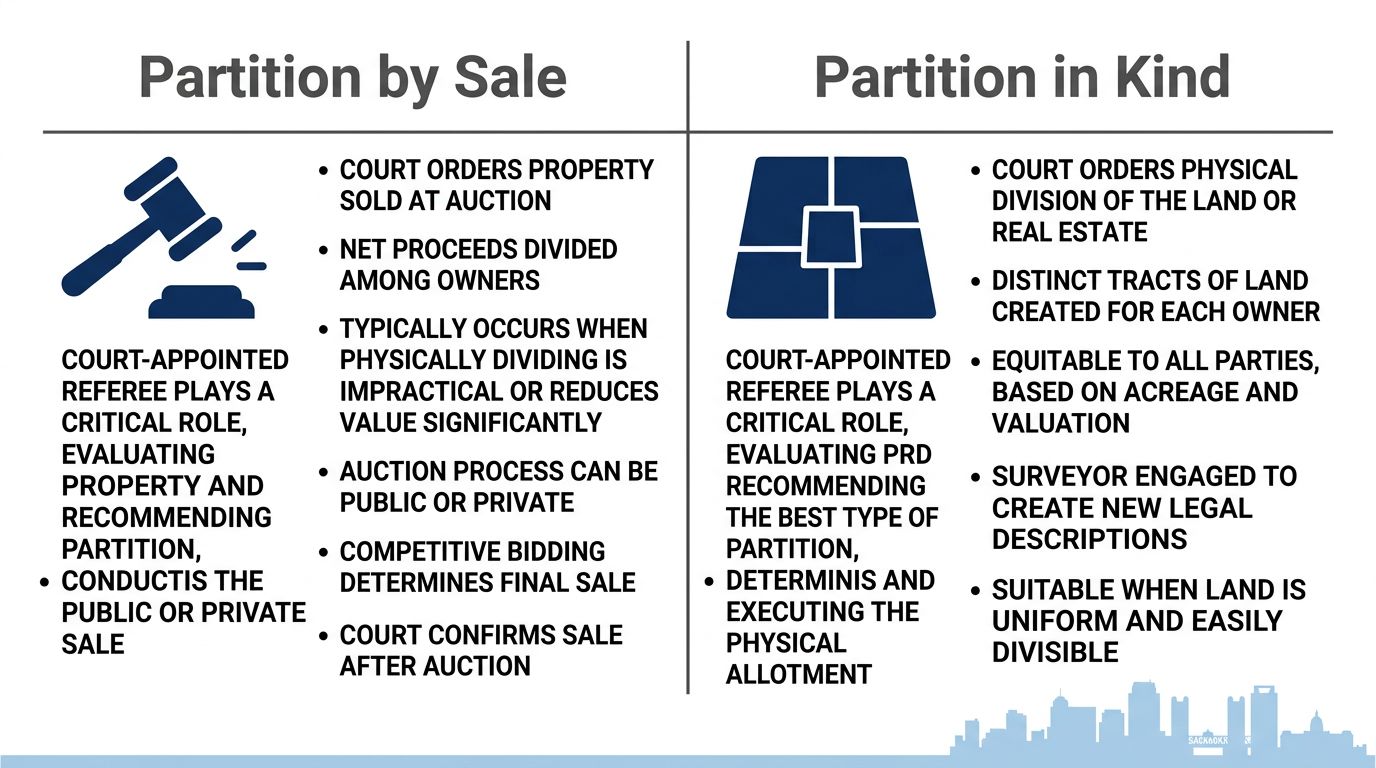
    Infographic comparing partition by sale and partition in kind in the Sacramento real estate market
    Comparison of partition by sale and partition in kind actions

    In our experience, most Sacramento partition lawsuits conclude with a sale, particularly for residential properties where physical division is impractical. The court-appointed referee serves as a neutral third party who handles the practicalities — from engaging a real estate broker to approving the final sale terms — ensuring that the process remains fair and transparent for all co-owners. Once the partition action concludes, the focus shifts to executing the court’s order, a process we guide clients through at every stage.

    For property owners seeking partition action lawyers in Sacramento, McCaslin Law, PC provides aggressive representation in the Sacramento County Superior Court. A partition action is a legal mechanism that allows co-owners of real property to force the division or sale of the asset when they cannot agree on its disposition. We prepare every case with a trial-first mentality, ensuring that our clients are positioned for a favorable outcome from the outset.

    Under California law, a partition may be sought either in kind, where the property is physically divided among the owners, or by sale, which is more common when division is impractical. We handle both residential and commercial disputes, guiding clients through the complexities of a forced sale of jointly owned property in California. Our team manages all phases of litigation, from initial demand letters through trial, so that co-owners can resolve deadlocks efficiently.

    When a court orders a partition by sale, it typically appoints a partition referee to oversee the marketing and sale of the property. We assist clients in selecting a qualified partition referee lawyer in California through services such as the State Bar referral program. Because the referee’s role is critical to achieving a fair sales price, we aggressively advocate for our client’s interests at every hearing and negotiation. This approach reflects our core belief in excellence in litigation, relentless in pursuit, resolute in defense.

    Key Local Factors in Sacramento Partition Lawsuits

    For co-owners facing a deadlock over real estate, partition action lawyers in Sacramento understand that local market conditions heavily influence case strategy. High property values throughout the region often make a forced sale of jointly owned property California’s most practical remedy, as physical division of a single-family home or commercial building is rarely feasible. When a negotiated buyout fails, our firm moves decisively to file in Sacramento Superior Court, where judges typically appoint a partition referee California law empowers to manage the property’s appraisal, marketing, and sale under court supervision. Common disputes leading to these actions include siblings inheriting a family home, estranged spouses dividing rental investments, or business partners dissolving a real estate holding. Property damage can further complicate matters, especially when an insurer acts unreasonably—understanding california bad faith insurance claims becomes critical when claim delays stall a partition sale. Understanding these local factors helps explain why choosing a partition action lawyer familiar with Sacramento’s courts and real estate market is crucial for an efficient resolution.

    Steps to Begin Your Partition Action Case with McCaslin Law

    When a co-ownership dispute becomes intractable, reaching out to experienced partition action lawyers in Sacramento is the essential first step. McCaslin Law brings a Boutique Litigation. Formidable Results. approach to each case, and our attorneys are licensed and regulated by the State Bar of California.

    • Initial consultation: Contact us to schedule a free, confidential discussion. Meanwhile, assemble your title, deed, co-ownership agreements, and correspondence so we can begin evaluating your situation efficiently.
    • Strategy session: We determine whether a forced sale of jointly owned property in California or a partition in kind makes sense, and then outline the legal path ahead.
    • Complaint filing: Once you retain us, we draft and file the partition complaint in the proper California superior court. Our trial-first mentality drives preparation from day one.
    • Referee oversight: When the court appoints a partition referee in California, our aggressive advocacy ensures the sale or division is fair — because we are Excellence in Litigation. Relentless in Pursuit. Resolute in Defense.

    Our firm also handles personal injury claims — see our slip & fall attorney FAQ page for a sample.

    Contact McCaslin Law to start. The information here is general; visiting our website does not create an attorney-client relationship. Reach out to discuss your unique case.

    Secure Your Property Interests with Experienced Counsel

    For partition action lawyers Sacramento, the protection of your ownership stake begins with strategic legal planning. We guide clients through the complexities of a forced sale of jointly owned property in California, ensuring your financial interests remain the primary focus.

    A court-appointed partition referee in California oversees the division or sale, but our team’s Trial-first mentality ensures every preparation is made for a decisive outcome. We deliver Aggressive advocacy to secure favorable terms, though contacting us does not create an attorney-client relationship and prior results do not guarantee similar outcomes.

    Now let’s examine how these strategies are applied in real-world disputes.

    Resources

  • California Partition Law 2026 Reforms: Key Buyout Rights Explained

    California Partition Law 2026 Reforms: Key Buyout Rights Explained

    Table of Contents

    What the 2026 California Partition Law Reforms Mean for Co-Owners

    The 2026 California partition law reforms, enacted through the Partition of Real Property Act (AB 2038), grant co-owners new statutory buyout rights. Co-owners can now demand a buyout before a partition action proceeds, potentially streamlining resolution. The law’s mandatory appraisal requirement for partition actions in California mandates that a qualified appraisal establish fair market value before any buyout is finalized. These changes take effect for all partition actions filed after January 1, 2026, covering both residential and commercial properties. According to the California Courts website, the core right to partition is unchanged, but the added procedural steps may affect timing and overall costs. At McCaslin Law, PC, we are prepared to guide co-owners through these new partition procedures. Co-owners should consult with a skilled litigation attorney to understand how the reforms apply to their specific situation. While the reforms create opportunities for early resolution, they also introduce appraisal costs that parties must anticipate. For those assessing potential legal expenses, a commercial litigation lawyer hourly rate may provide useful cost insights. We emphasize that this overview is for informational purposes only and does not constitute legal advice or create an attorney-client relationship.

    Key Requirements Under the 2026 California Partition Law

    The california partition law 2026 reforms introduce several key requirements designed to modernize how co-owned real estate is divided in California. These changes, which took effect on January 1, 2026, establish a mandatory appraisal process and expand buyout rights for co-owners before a court can order a forced sale. At McCaslin Law, we have closely analyzed these legislative updates to provide clarity on what property owners can expect. Central to the new framework are the provisions of the partition of real property act buyout rights, which fundamentally shift the balance of power among co-owners.

    The law mandates several critical procedural steps. First, a formal, court-approved appraisal is required before any partition action can proceed, establishing the property’s fair market value as the foundation for all subsequent negotiations. This mandatory appraisal partition action california requirement ensures that any division or sale is grounded in objective market data. Second, a co-owner now has the right to purchase another co-owner’s interest at this appraised value, an option that can prevent a forced sale entirely. Third, the law applies to all actions filed on or after January 1, 2026. The single statutory exception to the mandatory appraisal exists when all co-owners unanimously agree to waive it. While the law is designed to promote equitable division and prevent unfair forced sales, it does not guarantee a specific outcome, and our firm notes that procedural requirements, including formal notice to all co-owners, must be strictly followed.

    These procedural and substantive changes require careful navigation. In many cases, understanding these new rights early can lead to a more efficient and less adversarial resolution for all parties involved.

    These partition law reforms are part of the broader commercial litigation trends 2026, which emphasize increased transparency in property disputes. For answers to specific questions about the new law, we have prepared detailed FAQs that explore the mandatory appraisal process, buyout rights, and procedural steps. However, this content is for informational purposes only and does not constitute legal advice. Contacting McCaslin Law, PC does not create an attorney-client relationship.

    How the Right of First Refusal Works in 2026 Partition Sales

    The California partition law 2026 reforms provide a clear statutory framework for the right of first refusal (ROFR), a pivotal protection for co-owners facing a partition action. Under the Partition of Real Property Act, buyout rights permit a co-owner to acquire another’s interest at the court-appraised fair market value before any public sale occurs. This statutory remedy arises only after a court orders a formal partition sale and an independent appraisal has been completed, ensuring all parties have a verified valuation before a buyout can proceed.

    Once the mandatory appraisal in a California partition action is finalized, co-owners typically receive 30 to 90 days to review the appraised value and decide whether to exercise the ROFR and consult with counsel as needed. During this window, a co-owner must submit a formal buyout notice and arrange payment at the USPAP-compliant fair market value. If no co-owner steps forward within the court-determined period, the property proceeds to a public auction, often subject to a court-set minimum bid. Co-owners facing a partition sale often need to budget for a commercial litigation lawyer hourly rate that covers court filings and negotiation; our firm’s trial-first mentality ensures every statutory deadline and procedural requirement is met with meticulous preparation. As we explain in our partition action resources, after the ROFR period closes the court schedules a confirmation hearing to finalize the sale process, which may include approving the sale to the highest qualified bidder.

    It is important to distinguish the court-ordered ROFR from private buyout agreements: the statutory right is mandated by law and cannot be waived without court approval. With the ROFR process now outlined, understanding how the mandatory appraisal establishes the buyout price is essential for any co-owner navigating a partition action.

    This website is for informational purposes only and does not constitute legal advice. Contacting McCaslin Law PC does not create an attorney-client relationship.

    Mandatory Mediation Timelines for California Property Disputes in 2026

    Under the california partition law 2026 reforms, new mandatory mediation rules take effect for property co-owners seeking a court-ordered division. These changes require parties to attempt resolution through mediation before proceeding with certain court motions. We break down the timeline requirements below.

    • Effective Date: The mandatory mediation requirement applies to partition actions filed on or after January 1, 2026.
    • Mediation Completion: Mediation must be completed within 90 days of filing the partition action, unless the court grants an extension or the parties mutually agree to a longer period.
    • Consequences of Non-Compliance: If mediation is not completed within the required window, the court may dismiss the action or postpone any motion for partition by sale or partition by appraisal. Mediation is a prerequisite to filing those motions.

    This mandatory timeline applies to all partition actions—whether the mediation is court-ordered or voluntary—but only court-ordered mediation triggers the official 90-day clock. Separately, the partition of real property act buyout rights allow a party to purchase another’s interest, but exercising buyout rights does not exempt a case from the mediation timeline; the two procedures operate independently. In the same way, the mandatory appraisal partition action california framework that a court may employ also requires satisfaction of the mediation prerequisite before an appraisal-based sale can move forward.

    For mediation to be meaningful, parties must engage in good-faith negotiations. Once the mandatory mediation is completed, the court may consider motions to sell or appraise the property. After the mediation timeline expires and the requirement is satisfied, parties can move to the valuation and sale phases discussed in the next section. For a list of qualified mediators or to locate an attorney, consult the State Bar of California.

    The timelines discussed are grounded in official guidance. According to California Courts (the state’s judicial branch) and supplemented by practical resources like McCaslin Law’s litigation guides, the 90-day mediation window is a critical procedural step. However, the rules are subject to change, and parties should verify current requirements directly with the California Courts website.

    This website is for informational purposes only and does not constitute legal advice. Contacting McCaslin Law, PC does not create an attorney-client relationship. Prior results do not guarantee similar outcomes.

    How a Lawyer Can Stop a Predatory Forced Sale of Inherited Property

    When a co-owner of inherited California real estate is confronted with a predatory forced sale, legal intervention can quickly shift the balance. The California court system provides the framework for partition actions, and with evolving California partition law 2026 reforms being discussed, it is vital to understand the protections that an experienced attorney can deploy. At McCaslin Law, we work closely with clients to block undervalued sales and preserve their rightful inheritance.

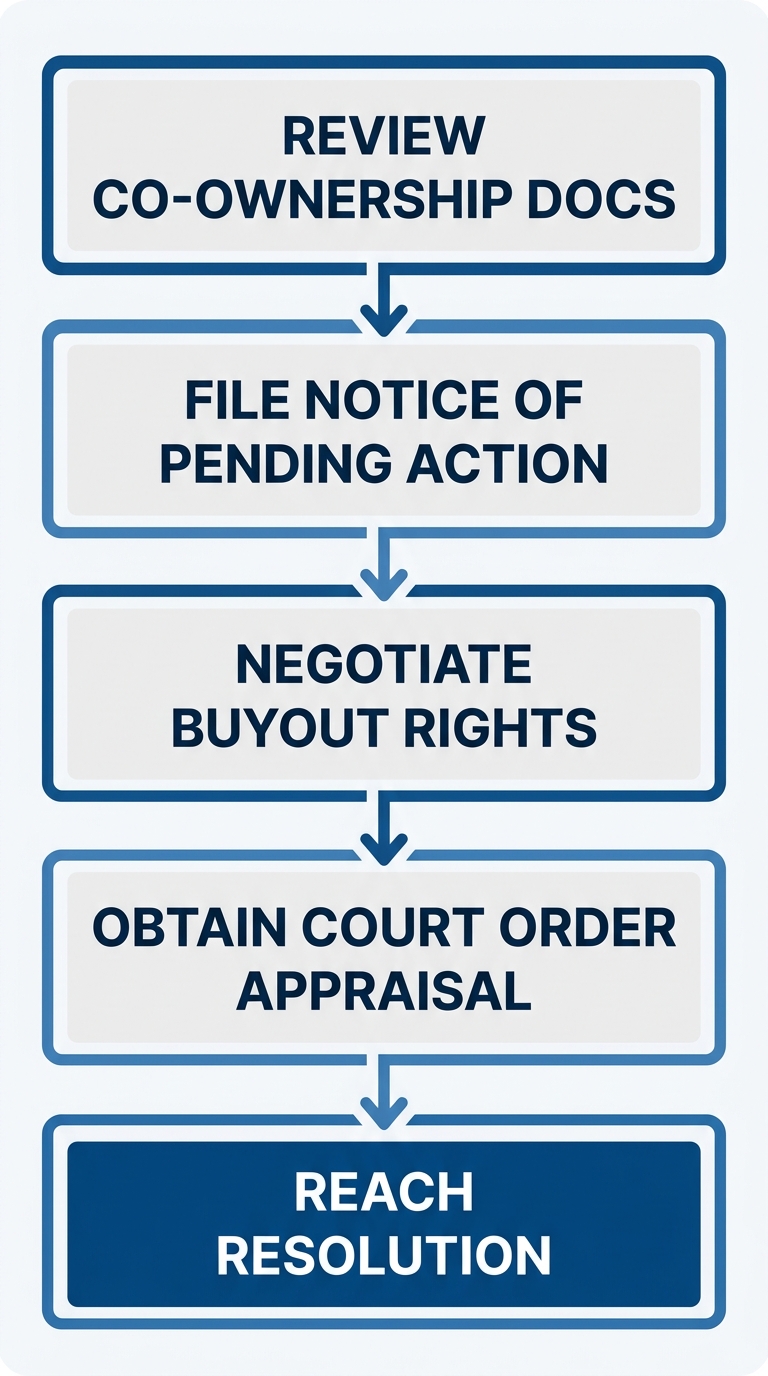
    Vertical process flow diagram showing five steps a lawyer takes to stop a predatory forced sale of inherited property in California, with stages including Review Co-Ownership Documents, File Notice of Pending Action, Negotiate Buyout Rights, Obtain Court-Ordered Appraisal, and Reach Resolution.

    Legal process to stop predatory forced sale of inherited property

    One of the most effective immediate measures is serving a notice of pending action, commonly known as a lis pendens. As detailed in our firm’s guides, this recorded document warns any prospective buyer that the property is tied up in litigation, making a quick, below-market sale far less likely. Working in tandem with this, California statute grants co-owners valuable leverage through the partition of real property act buyout rights. Under these buyout provisions, a co-owner may request the court to permit the purchase of the other fractional interests at an independently determined fair value, effectively bypassing the need for an open-market forced sale. This mechanism is particularly powerful against investors who try to orchestrate a low-ball transaction.

    Before any partition sale can be finalized, the court must also satisfy the mandatory appraisal partition action California requirement. The court appoints a qualified appraiser to produce a report on the property’s true market worth, preventing any party from manipulating the valuation to their advantage. This impartial appraisal forms the basis for all subsequent negotiations and buyout calculations, ensuring the interests of every co-owner are protected.

    Beyond these procedural defenses, an experienced real estate litigation attorney can directly engage with other co-owners or third-party investors to negotiate a voluntary buyout or settlement. By stepping in early—before a predatory sale gains irreversible momentum—the lawyer can present the court-ordered appraisal and assert the statutory buyout rights, often resolving the entire dispute without a forced court-ordered sale. Our trial-first mentality means McCaslin Law stands ready to litigate if necessary, but our primary focus remains on achieving a resolution that safeguards the client’s inheritance.

    Disclaimer: This website is for informational purposes only and does not constitute legal advice.

    Updated Appraisal Rules and Buyout Rights Under the 2026 Reforms

    The latest California partition law 2026 reforms introduce mandatory appraisal rules and expanded buyout rights for co-owners in California. At McCaslin Law, we stay at the forefront of these developments to aggressively advocate for our clients’ interests throughout Northern California.

    The reforms introduce a mandatory appraisal partition action california requirement, meaning a court must order an appraisal before any buyout can proceed. This appraisal must be conducted by a qualified independent appraiser to determine the property’s fair market value. The costs of the appraisal are typically shared among the parties, as the 2026 reforms aim to promote transparency and fairness. If the co-owners cannot agree on an appraiser, the court has the authority to select one, ensuring the process moves forward efficiently.

    The partition of real property act buyout rights are expanded to allow co-tenants to purchase the interest of a co-owner who files for partition. This mechanism can prevent a court-ordered sale of the entire property, preserving its use and potentially reducing litigation costs. At McCaslin Law, we guide clients through exercising their buyout rights, helping them comply with all procedural requirements and base the buyout price on the court-approved appraisal value. The reforms emphasize voluntary resolution, but they do not eliminate the option of partition by sale if the parties cannot reach an agreement.

    These updates aim to streamline partition actions in California by offering a structured alternative to litigation, potentially saving time and money for all parties involved. However, it is crucial to seek legal advice to navigate the complexities of these new rules. While the reforms encourage voluntary resolution, each case is unique and outcomes cannot be guaranteed. Our firm can help you understand your rights and pursue the most favorable outcome under the new law. This website is for informational purposes only and does not constitute legal advice. Contacting McCaslin Law, PC does not create an attorney-client relationship.

    Preparing for the 2026 California Partition Law Changes

    As California co-ownership disputes evolve, staying informed about the California partition law 2026 reforms is essential for property owners. At McCaslin Law, PC, we are closely monitoring these developments, codified under the Partition of Real Property Act, which take effect on January 1, 2026, according to California Courts guidance. These amendments aim to streamline the partition process, introducing a mandatory appraisal partition action California courts will require before a partition action—a lawsuit to divide or sell jointly-owned real property—can proceed unless all co-owners formally waive this step.

    Crucially, the reforms establish new partition of real property act buyout rights. After the mandatory appraisal, a co-owner wishing to retain the property may now buy out the other co-owners at the appraised value. We recommend that any property co-owner begin preparing now by reviewing existing tenancy agreements, gathering deeds and title reports, and consulting an experienced real estate attorney to understand how these procedural shifts apply to their unique situation.

    Disclaimer: This website is for informational purposes only and does not constitute legal advice.

    Resources