
Expert Commercial Lease Enforcement Sacramento for Landlords

Table of Contents
- Commercial Lease Enforcement in Sacramento, California
- The Commercial Lease Enforcement Landscape in Sacramento
- Commercial Lease Enforcement Services for Sacramento Property Owners
- Local Legal Considerations for Commercial Lease Disputes in Sacramento
- Begin Your Commercial Lease Enforcement Case with McCaslin Law
- Protect Your Property Investment with Aggressive Lease Enforcement
Commercial Lease Enforcement in Sacramento, California
When a tenant fails to pay rent, holds over past the lease term, or otherwise violates a lease covenant, pursuing commercial lease enforcement in Sacramento becomes necessary to protect your property rights and income stream. The primary legal mechanism for regaining possession is a commercial unlawful detainer action — a summary proceeding filed in Sacramento County Superior Court that is governed by California-specific statutes and accelerated timelines designed to resolve possession disputes more quickly than a standard civil case.
Beyond eviction, a landlord’s available breach of commercial lease remedies in California include claims for past-due rent, recovery of the leased premises through a judgment for possession, early lease termination, and monetary damages for harm caused by the breach. The American Bar Association emphasizes that exploring early negotiation or alternative dispute resolution can often preserve business relationships when a commercial tenancy falters. Because a commercial unlawful detainer in Sacramento demands strict compliance with notice requirements and court rules, we encourage you to speak with a dedicated commercial litigation attorney in Sacramento who can guide your enforcement strategy. Our firm approaches every dispute with aggressive advocacy and a trial-first mentality, preparing each matter as if it will be tried to verdict. This overview is provided for general information and does not constitute legal advice; contacting McCaslin Law, PC does not create an attorney-client relationship. Learn how we put that philosophy to work in commercial lease conflicts by continuing below.
The Commercial Lease Enforcement Landscape in Sacramento
For Sacramento landlords, a commercial lease breach demands swift action. The commercial lease enforcement sacramento landscape includes powerful legal remedies to recover possession, unpaid rent, and enforce lease terms. At McCaslin Law, we bring a Trial-first mentality and Aggressive advocacy, preparing each case for trial. The table below outlines each method.
| Method | Description | Timeline | Best For |
|---|---|---|---|
| Unlawful Detainer Lawsuit | Court action to evict tenant and recover possession. | Typically 4-8 weeks if uncontested. | Clear-cut non-payment or holdover cases. |
| Breach of Lease Lawsuit | Suit for damages or specific performance. | Months to a year depending on complexity. | Non-monetary violations or complex disputes. |
| Arbitration | Private dispute resolution per lease terms. | Varies; often faster than litigation. | Parties seeking confidentiality and efficiency. |
| Negotiation / Demand Letter | Pre-litigation demand to resolve without court. | Days to weeks. | Early-stage disputes or cooperative tenants. |
The unlawful detainer lawsuit handles eviction for non-payment or holdover, with the California Courts noting a timeline of 4-8 weeks if uncontested, known as a commercial unlawful detainer sacramento action. For non-monetary breaches, a breach of lease lawsuit may seek breach of commercial lease remedies california like damages or specific performance, though litigation can take months. Arbitration and demand letters provide faster, private alternatives; consult a real estate litigation attorney in Sacramento to determine the best path.
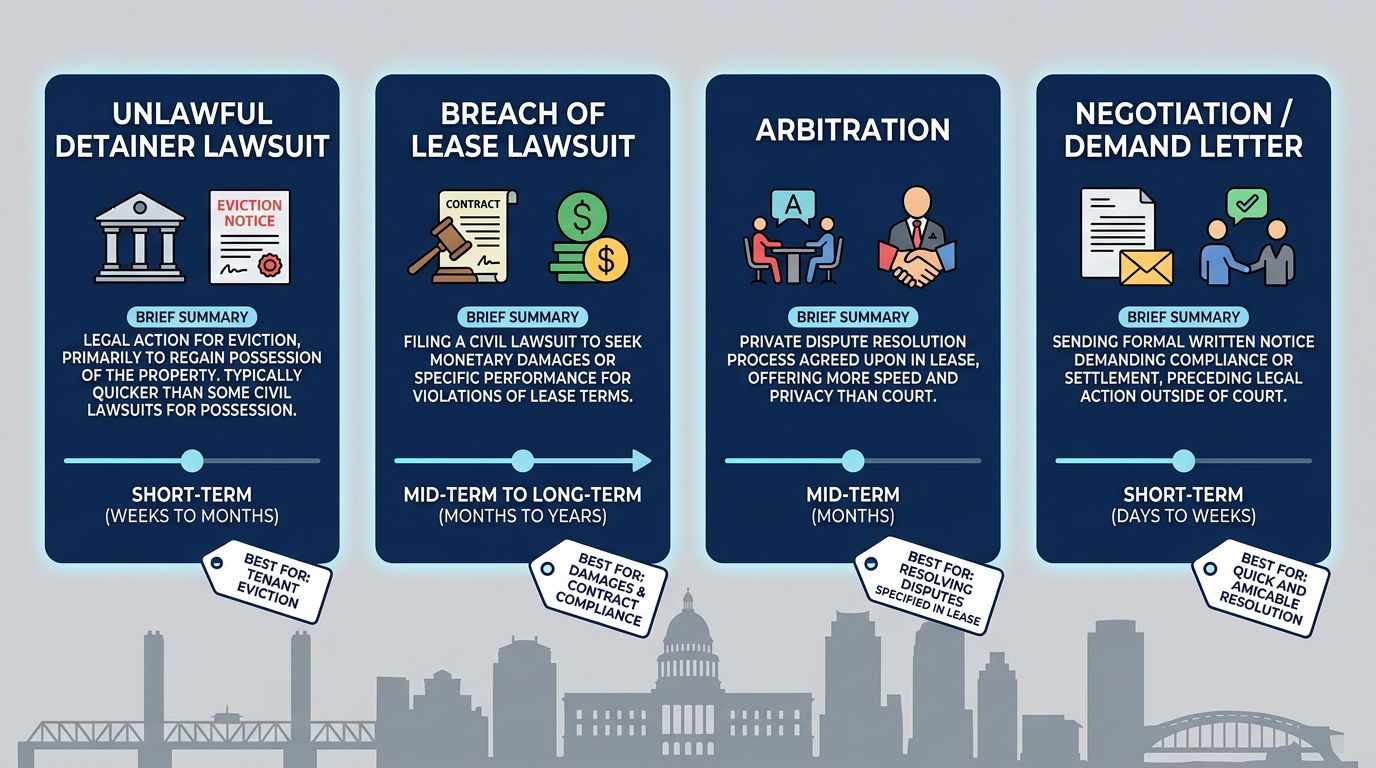
Qualitative comparison of lease enforcement methods for Sacramento commercial tenants and landlords.
Understanding the full commercial lease enforcement sacramento landscape is essential; contact us to discuss your dispute.
Commercial Lease Enforcement Services for Sacramento Property Owners
When a commercial tenant breaches a lease in California, time and revenue are at stake. Our firm provides decisive commercial lease enforcement in Sacramento that helps property owners regain control of their premises and recover what is owed. We represent landlords in disputes ranging from non-payment of rent to unauthorized property alterations and holdover tenancies.
For the most urgent cases, we rely on the commercial unlawful detainer process. This fast-track proceeding under California law allows us to quickly restore possession of the property when a tenant refuses to pay rent or otherwise substantially violates the lease. Unlike a general eviction procedure, a well-prepared unlawful detainer action in Sacramento can move from filing to a court hearing in weeks rather than months.
Beyond eviction, we pursue a full range of breach of commercial lease remedies in California to protect your investment:
- Monetary damages covering unpaid rent, repair costs, and lost profits
- Injunctive relief to stop harmful or unauthorized conduct
- Recovery of attorney’s fees when the lease permits
What sets our approach apart is our trial-first mentality. Every matter is prepared as if it will be tried to verdict, which means we enter negotiations from a position of strength. Our experienced litigators handle every stage directly, whether through aggressive pre-litigation negotiation or formal proceedings in state and federal court. You can learn more by visiting our FAQ pages on commercial and real estate litigation. To confirm our credentials, use the California State Bar attorney search for your own due diligence.
Please remember: this website is for informational purposes only and does not constitute legal advice. Contacting McCaslin Law, PC does not create an attorney-client relationship. Prior results do not guarantee similar outcomes.
Local Legal Considerations for Commercial Lease Disputes in Sacramento
The landscape of commercial lease enforcement Sacramento demands a clear understanding of local legal procedures and remedies. For commercial landlords and tenants operating in and around California’s capital city, the primary statutory mechanism for resolving lease-based conflicts is the unlawful detainer process, a specialized eviction lawsuit governed by the California court unlawful detainer process. Codified in California Code of Civil Procedure Sections 1159 through 1179a, this action is designed to restore possession of the premises to the rightful party. At McCaslin Law, we bring a trial-first mentality to these matters, ensuring every procedural step in Sacramento County Superior Court is handled with precision and strategic foresight.
A commercial unlawful detainer Sacramento action proceeds rapidly, with the statutory timeline typically bringing a case from initial filing to a judgment within 30 to 45 days, according to California Courts. This expedited process contrasts sharply with standard civil litigation but does not offer commercial tenants the protections commonly associated with residential rent control in California. The legal remedies available for a breach of commercial lease remedies California are generally limited to three core options: termination of the lease, monetary damages to compensate for losses incurred, and specific performance—a court order compelling a party to fulfill the terms of the agreement, as framed by industry standards from the American Bar Association.
Understanding these Sacramento-specific legal frameworks is critical for navigating a dispute effectively. The procedural rules and swift timeline require a firm that is prepared to act decisively. This information is provided for general educational purposes only and does not constitute legal advice; contacting McCaslin Law, PC does not create an attorney-client relationship.
This content is for informational purposes only and does not constitute legal advice. Contacting McCaslin Law, PC does not create an attorney-client relationship. Prior results do not guarantee similar outcomes.
Begin Your Commercial Lease Enforcement Case with McCaslin Law
A breached commercial lease demands immediate action. For commercial lease enforcement Sacramento clients trust, McCaslin Law brings a trial-first mentality and aggressive advocacy to every dispute. We handle commercial unlawful detainer Sacramento filings and pursue every breach of commercial lease remedies California allows, with direct attorney involvement at every stage.
In many Sacramento commercial lease disputes, we first explore alternative resolution. American Bar Association lease dispute arbitration offers a structured process that can save time and cost when both sides are willing to negotiate. But when negotiation fails, our firm is prepared to litigate for the fullest possible remedies for lease breach.
To begin your case, please gather your lease, any breach notices, and correspondence, then contact us:
- Call (916) 330-4147 to schedule a free initial consultation
- Provide details about the lease, the alleged breach and any prior communication with the other party
- We will evaluate your situation and outline a strategy tailored to your objectives
This website is for informational purposes only and does not constitute legal advice. Contacting McCaslin Law, PC does not create an attorney-client relationship. Prior results do not guarantee similar outcomes.
Protect Your Property Investment with Aggressive Lease Enforcement
Effective commercial lease enforcement in Sacramento safeguards your property investment. The breach of commercial lease remedies California law authorizes can stop losses quickly. Common breaches include:
- Non-payment of rent
- Lease violations
- Holdover tenancies
Our trial-first strategy deters further misconduct. If a premises defect injures a tenant, consult a slip & fall attorney. For a commercial unlawful detainer in Sacramento, we pursue swift resolution. Contact us.
This website is for informational purposes only and does not constitute legal advice. Contacting McCaslin Law, PC does not create an attorney-client relationship. Prior results do not guarantee similar outcomes.
Resources
- Find Expert Real Estate Litigation Attorney in Sacramento
- Get Prompt Legal Counsel for Slip and Fall Claims
- Find a Trial-First Commercial Litigation Lawyer in Sacramento
- Learn the Statutes for California Bad Faith Insurance Claims
- Understand Property Boundary Litigation Steps in Sacramento
- Learn How to Prove Bad Faith Insurance Claims in California
- Follow a Five-Step Process for Business Contract Disputes
- Find Licensed Attorneys Through California State Bar Website
- Find Self-Help Resources on California Courts Website
- Explore the American Bar Association for Legal Resources
