Table of Contents
The Four Essential Elements of a Breach of Contract in California
Contracts form the backbone of business and personal dealings in California, and when a party fails to uphold their obligations, a breach of contract claim may arise. As explained by McCaslin Law, PC, to succeed in such a claim, you must prove the four elements of breach of contract california required under California law.
First, there must be a valid contract between the parties. This means one party made an offer, the other accepted, and there was consideration — something of value exchanged, like money or services.
Second, the defendant must have breached the contract, meaning they failed to perform a material term without a valid legal excuse.
Third, the breach must have caused the plaintiff’s injury. The plaintiff must show that the harm they suffered directly resulted from the defendant’s failure to perform.
Fourth, the plaintiff must have suffered actual damages as a consequence of the breach. Without measurable harm, a breach of contract claim generally cannot succeed.
All four elements must be proven by a preponderance of the evidence in the California court system, and our firm’s trial-first mentality means we understand how to build strong evidence for each element.
While these elements form the foundation of breach of contract litigation California, it’s also crucial to consider the statute of limitations breach of contract california, which limits how long you have to file a lawsuit.
Disclaimer: This website is for informational purposes only and does not constitute legal advice. Contacting McCaslin Law, PC does not create an attorney-client relationship.
Building Blocks of a Breach of Contract Claim Under California Law
The elements of breach of contract california law requires rest on four essential prerequisites that a plaintiff must prove to prevail in a claim. First, the plaintiff must demonstrate the existence of a valid and enforceable contract. Second, the plaintiff must show that they performed their obligations under the contract or had a legally recognized excuse for not performing. Third, the plaintiff must establish that the defendant failed to perform, or breached, one or more material terms of the agreement. Fourth, the plaintiff must prove they suffered measurable damages as a direct result of that breach. Each of these components of a claim serves a distinct purpose, and understanding them is the foundation for any successful breach of contract litigation california businesses and individuals pursue.
Contracts in California can be written, oral, or implied by the conduct of the parties, but the form of the agreement significantly impacts how a dispute unfolds. Written contracts provide the most straightforward path to enforcement because the terms, obligations, and any conditions are clearly documented. When a written agreement exists, the court’s role is primarily to interpret the language and determine whether a breach occurred. Oral contracts, while equally valid under California law, present unique challenges because the parties’ exact commitments must be reconstructed from memory, communications, and surrounding circumstances. The following table summarizes the key distinctions between these two contract types.
Written vs. Oral Contracts Under California Law
| Contract Type | Enforceability | Statute of Limitations | Best Evidence |
| Written Contract | Fully enforceable; written terms establish clear contractual obligations. | 4 years from the date of breach (California Code of Civil Procedure Section 337). | The written agreement itself; extrinsic evidence admissible to interpret ambiguous terms. |
| Oral Contract | Enforceable under California law but more difficult to prove without written documentation. | 2 years from the date of breach (California Code of Civil Procedure Section 339). | Witness testimony, course of dealing, invoices, emails, or other corroborating evidence. |
The differences highlighted above have practical consequences that we address early in every case evaluation. The statute of limitations breach of contract california law imposes means that a party who waits too long to sue may lose the right to recover, and the deadline arrives much sooner for oral contracts. We routinely guide clients through this analysis because miscalculating the limitations period can be fatal to an otherwise strong claim.
Proving the existence of an oral contract requires more than one party’s word against another’s. California courts look for corroborating evidence that confirms a meeting of the minds occurred, such as contemporaneous emails, text messages, invoices showing partial performance, or testimony from neutral witnesses who observed the parties’ course of dealing. For written contracts, the document itself is typically the best evidence of the parties’ obligations, though we also examine the factual context when a term is ambiguous or when a party asserts that fraud or mistake altered the agreement’s meaning. Under California law, every contract also requires consideration — something of value exchanged between the parties — and without it, no enforceable obligation exists.
These building blocks form the analytical framework we use when a client presents a potential breach claim. While this section covers contract breach, our firm also handles fiduciary duty breach litigation involving partnership or shareholder disputes. Understanding what must be proven is the necessary first step toward assessing liability, calculating damages, and deciding whether litigation or settlement best serves our client’s interests.
Understanding the foundational elements of a breach of contract claim is essential for anyone considering legal action in California. When a business deal falls apart or an agreement is not honored, it is critical to know what must be proven to prevail. At McCaslin Law, PC, we help clients navigate these complex disputes, whether you are also seeking an abogados de accidentes de trabajo en San Jose or need aggressive representation in a commercial contract dispute. This section breaks down the three essential components: establishing a valid contract, proving your own performance, and demonstrating the other party’s material breach.
Establishing a Valid Contract: Offer, Acceptance, and Consideration
The first step in any breach of contract litigation California case is proving that a legally enforceable contract existed. A valid agreement is more than a handshake; it is a meeting of the minds supported by specific elements of breach of contract California law requires. We must demonstrate a clear offer, an unequivocal acceptance, and mutual consideration. The offer must be communicated in a way that a reasonable person would understand it to be a serious proposal. Acceptance cannot introduce new terms; it must mirror the offer exactly under the “mirror image rule.” Finally, consideration—the bargained-for exchange of value—must flow between the parties. This can be money paid, services performed, or even a promise to refrain from doing something. Without these California breach of contract elements, a court will find no contract was formed in the first place.
After establishing the contract, the burden shifts to the plaintiff to prove they did everything the contract required, or that they had a legally valid reason for not doing so. To succeed in a breach of contract litigation California claim, you must first show your own side of the bargain was honored. Performance means fulfilling all contractual duties exactly as specified. If a party has substantially performed, completing all major aspects of the contract but for minor, technical details, this generally satisfies the requirement. Alternatively, a plaintiff can be legally excused from performance. Valid excuses under California law include circumstances where the other party’s actions prevented performance, where performance was waived, or where a supervening event made the contract’s purpose impossible to achieve. At McCaslin Law, PC, we meticulously document our client’s compliance to build an unassailable foundation for the claim.
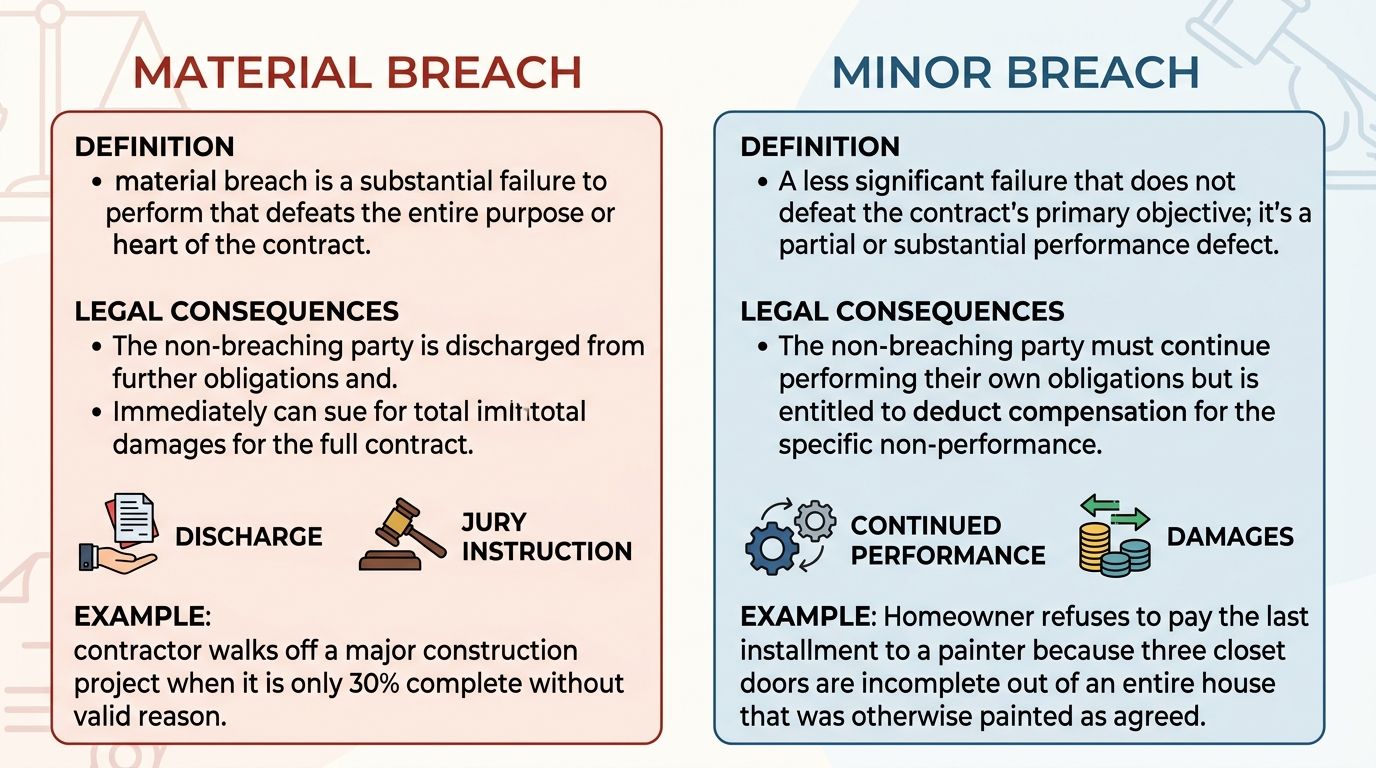
Side-by-side comparison of material breach versus minor breach under California contract law
Understanding Material Breach Under California Law and CACI 303
The final and most heavily litigated element is proving that the defendant’s failure to perform was more than a minor slip-up; it was a material breach. A material breach is a substantial failure that goes to the heart of the contract, effectively depriving the non-breaching party of the benefit of their bargain. This determination is fact-specific. California courts consider factors such as the extent of the benefit deprived, the adequacy of compensation for that loss, and the likelihood of the breaching party curing the failure. The pivotal CACI 303 jury instruction guides the fact-finder on this very question. According to CACI 303, sourced from the California Courts, the jury must decide whether a failure was so important that it constitutes a material breach, excusing the other party’s performance. It is not a question of a simple failure, but a failure of such consequence that it destroys the essential purpose of the contract.
To further clarify these distinct legal concepts and their consequences in litigation, the table below provides a side-by-side comparison.
| Aspect |
Material Breach |
Minor Breach |
| Definition |
A breach that goes to the essence of the contract and deprives the non-breaching party of the benefit of the bargain. |
A breach that does not go to the root of the contract; the non-breaching party still receives substantial performance. |
| Legal Consequence |
Non-breaching party may suspend performance and is discharged from further obligations under the contract. |
Non-breaching party must still perform but may sue for damages caused by the breach. |
| CACI 303 Application |
Jury must find materiality has been proven to justify discharge of duties. |
CACI 303’s materiality requirement is not triggered; focus is on damages only. |
| Example |
Failure to deliver goods required under a sales contract where time is of the essence. |
Delivering goods one day late but no time-is-of-the-essence clause. |
The distinction is outcome-determinative. A finding of material breach by a jury under CACI 303 discharges the injured party from their own obligations, a powerful remedy in a breach of contract litigation California dispute. Conversely, a minor breach still requires the non-breaching party to perform, though they retain the right to sue for any monetary losses suffered. As McCaslin Law, PC explains in our analysis of material breach, this legal standard is the fulcrum of most contract disputes. Successfully demonstrating or defending against a material breach claim is often the deciding factor in trial, which is why our aggressive advocacy and trial-first mentality are focused on dominating this critical legal battleground. The information provided here is for educational purposes only and does not constitute legal advice. Contacting our firm does not create an attorney-client relationship, and prior results do not guarantee a similar outcome.
Proving Causation and Recovering Damages for Breach of Contract in California
When evaluating the elements of breach of contract in California, proving causation is the step that transforms a broken promise into a compensable claim. As we explain in our overview of breach of contract claims, a plaintiff must establish four elements: existence of a valid contract, the plaintiff’s performance (or valid excuse), the defendant’s material breach, and damages directly caused by that breach. This section narrows the focus to causation and the types of monetary relief available once that link is proven.
Proving Causation: Connecting the Breach to Resulting Damages
To recover damages in a California contract dispute, the plaintiff must demonstrate both actual cause and proximate cause. Actual cause—often framed as the “but-for” test—asks whether the plaintiff’s losses would have occurred absent the defendant’s breach. Proximate cause, in turn, limits recovery to harms that were a reasonably foreseeable result of the breach at the time the contract was formed. California courts apply these principles strictly. Even a clear breach yields no recovery if the plaintiff cannot trace the claimed injury directly to the defendant’s failure to perform.
Establishing causation requires a tight factual narrative supported by documentary and testimonial evidence. We work with clients to map the precise chain of events, distinguishing between losses that flow directly from the breach and those attributable to independent market forces or third-party actions. This approach aligns with the guidance provided by McCaslin Law, PC on the foundational elements of a breach claim—performance, breach, causation, and damage—each of which must be independently proven.
Categories of Recoverable Damages in California Contract Cases
Once causation is established, the next question is what damages can be recovered. California law recognizes several distinct categories, each with its own pleading and proof standards. Compensatory damages—also called general damages—serve as the primary measure under California Civil Code Section 3300. They are designed to place the non-breaching party in the position they would have occupied had the contract been performed as agreed. Consequential damages go further, compensating for indirect losses that were within the contemplation of the parties at contract formation. Because these damages are not presumed, they must be specifically pleaded and proven to have been foreseeable at the outset of the agreement. Reliance damages offer an alternative route: instead of seeking lost profits, the plaintiff recovers out-of-pocket expenditures made in reasonable reliance on the contract. Finally, liquidated damages—a fixed sum specified in the contract—are enforceable in California only when the amount constitutes a reasonable estimate of actual harm and does not operate as a penalty, as required by California Civil Code Section 1671.
Understanding these categories is essential because the choice of damage theory dictates the evidence needed at trial and influences the overall litigation strategy. The table below summarizes how each type functions in California contract litigation.
| Damage Type |
Definition |
Recoverable in CA Contracts? |
Example |
| Compensatory (General) Damages |
Damages that place the non-breaching party in the position they would have been in had the contract been performed. |
Yes – the primary measure of contract damages under California Civil Code Section 3300. |
Lost profits from a breached business deal. |
| Consequential (Special) Damages |
Damages that flow indirectly from the breach but were foreseeable by the parties at the time of contracting. |
Yes, if specifically pleaded and proven to have been within the contemplation of the parties. |
Lost business opportunities caused by delayed delivery of essential equipment. |
| Reliance Damages |
Damages that reimburse the non-breaching party for expenses incurred in reliance on the contract. |
Yes, as an alternative to expectancy damages in certain circumstances. |
Costs incurred preparing to perform under the contract. |
| Liquidated Damages |
A specific sum agreed upon by the parties in the contract as compensation for breach. |
Yes, if the amount is reasonable and not a penalty under California Civil Code Section 1671. |
$100 per day late fee specified in a construction contract. |
All damage types are available but each has specific pleading and proof requirements. Selecting the appropriate theory early shapes how we build the evidentiary record and frame the prayer for relief.
Legal Grounds for Filing a Breach of Contract Lawsuit in California
Breach of contract litigation in California rests on the same four-element foundation discussed above but requires a strategic decision about when and how to file. A plaintiff must be prepared to plead and prove a valid contract, the plaintiff’s full performance (or a legally recognized excuse), the defendant’s material breach, and resulting damages connected by adequate causation. Without a cohesive narrative linking these elements, even a strong case can face early dismissal or an adverse summary judgment ruling.
Our trial-first mentality and aggressive advocacy mean we evaluate every potential claim through the lens of a courtroom presentation. We examine whether the contract’s terms give rise to an unambiguous obligation, whether the defendant’s conduct departed from those terms in a material way, and whether documentary evidence and witness testimony will support each required element. In many instances, fiduciary duty claims arise alongside contract claims, but as noted in McCaslin Law, PC’s analysis of fiduciary breach litigation, these theories carry distinct standards—causation must be separately proven for each cause of action. With contract claims, the focus remains squarely on the express and implied terms of the agreement and the foreseeable consequences of breaching them.
These legal grounds form the backbone of any breach of contract lawsuit and directly inform the litigation choices discussed in the next section—from forum selection to the framing of the complaint. For information in Spanish on workplace accident attorneys in San Jose, visit our dedicated page on abogados de accidentes de trabajo en San Jose. This website is for informational purposes only and does not constitute legal advice. Contacting McCaslin Law, PC does not create an attorney-client relationship. Prior results do not guarantee similar outcomes.
Statute of Limitations and Strategic Timing for Breach of Contract Claims
After establishing what constitutes a breach, the next critical question is when to file a claim. In California, the statute of limitations for a written contract is generally four years under Code of Civil Procedure section 337. This deadline for contract claims—often called the statute of limitations breach of contract California—sets a firm limit on bringing suit. Understanding this timeline is essential for anyone considering breach of contract litigation in California.
The period starts from the date of the breach, not from discovery, unless fraud or concealment is involved. The clock starts immediately upon the failure to perform, making delay costly. A clear grasp of the California breach of contract statute of limitations helps clients decide when to file, especially for damages or specific performance.
Strategic timing is crucial because evidence and witnesses can fade. Filing before documents disappear or witnesses become unavailable preserves a strong case. The statute of limitations guides early action; we encourage clients to seek prompt assessment. Proactive timing can prevent dismissal of an otherwise valid claim.
The elements of breach of contract California law requires—such as a valid contract, performance or excuse, breach, and resulting damages—are closely tied to the statute of limitations. Under CACI jury instructions, a plaintiff must also prove that the claim was timely filed. This adds a procedural layer to the substantive elements of breach of contract claims. McCaslin Law’s trial-first mentality emphasizes early preparation for tactical advantage. By investigating and preserving evidence immediately, we position our clients to meet critical deadlines and strengthen their litigation posture. This strategic approach aligns with our philosophy of aggressive advocacy, ensuring that clients are never caught off guard by a looming statute of limitations breach of contract California deadline. Understanding these timing nuances informs our strategic choices, including the pursuit of damages and specific performance—topics we will explore next.
Frequently Asked Questions About Breach of Contract in California
After reviewing the remedies available for a breach, many people have procedural questions about their case. Below we answer the most common questions we hear from clients.
What constitutes a breach of contract in California?
A breach occurs when one party fails to perform a duty under a legally enforceable agreement without a valid excuse. The elements of breach of contract in California require proving a valid contract, your performance or excuse for non-performance, the other party’s failure to perform, and resulting damages. The specific facts of your situation will determine whether you have a viable claim.
What is the statute of limitations for breach of contract in California?
The statute of limitations breach of contract California is four years for written contracts and two years for oral contracts, according to McCaslin Law’s litigation FAQ. This means you must file a lawsuit within that window or your claim may be permanently barred. The clock typically starts running on the date the breach occurred, not when you signed the agreement.
Can the statute of limitations be tolled in a California breach of contract case?
Yes, certain tolling exceptions may pause the limitations period under California law. Common examples include situations involving fraud, where the defendant concealed the breach, or cases where the plaintiff is under a legal disability. These exceptions are highly fact-specific, which is why breach of contract litigation California requires careful analysis of your unique timeline.
What should I do if someone breaches a contract with me in California?
First, document the breach thoroughly and preserve all related communications. Then, speak with an experienced litigation attorney who can evaluate the viability of your claim and explain your legal options. At McCaslin Law, PC, we offer consultations to discuss your matter and provide an honest assessment. Contacting us does not create an attorney-client relationship, and this FAQ is for informational purposes only and does not constitute legal advice.
Building a Strong Breach of Contract Case with Experienced Legal Counsel
Proving a California contract claim demands four elements of a breach of contract in California: valid contract, performance, breach, and damages. Under our firm’s internal guidance, in breach of contract litigation in California we gather written agreements, emails, and performance records to prove each element. We assess material versus minor breach and remember the statute of limitations for breach of contract in California is four years for written contracts. With trial-first preparation and aggressive advocacy, we build a robust case against well-funded defense teams. Contact us to evaluate your claim.
Boutique Litigation. Formidable Results.
This website is for informational purposes only and does not constitute legal advice. Contacting McCaslin Law, PC does not create an attorney-client relationship.
Resources