Northern California Civil & Real Estate Litigation | McCaslin Law

Tag: Civil Litigation Sacramento

  • California Invasion of Privacy Act Litigation 2026: Essential Guide

    California Invasion of Privacy Act Litigation 2026: Essential Guide

    Table of Contents

    The Evolving Landscape of California Invasion of Privacy Act Litigation in 2026

    The terrain for California invasion of privacy act litigation 2026 is defined by a surge in novel claims targeting the digital tools businesses use every day. Drawing from insights provided by American Bar Association resources, the most visible trend is the continued proliferation of CIPA website tracking class action lawsuits, where plaintiffs allege that common analytics and chat features constitute unlawful wiretapping. A parallel and equally significant development is the use of penal code 631 digital pen register claims, which argue that certain online tracking scripts illegally record a user’s keystrokes and clicks without consent. For any business operating an interactive website, these shifts demand close attention as courts continue to grapple with applying decades-old statutes to modern technology, and regulators, counsel, and compliance teams are watching closely too.

    Building on the fundamentals of CIPA, we now examine the specific litigation trends driving the surge in california invasion of privacy act litigation 2026. A growing number of class actions are targeting businesses that use website chat widgets and session replay software, alleging these tools violate the California Invasion of Privacy Act by intercepting user communications without proper consent. Plaintiff firms are increasingly filing cipa website tracking class action lawsuits, leveraging both traditional wiretapping statutes and newer digital privacy provisions to challenge modern web analytics practices.

    At the heart of many claims is Penal Code 631, which prohibits wiretapping and the unauthorized interception of communications. Plaintiffs argue that chat features and session replay tools capture interactions in real time—reading messages as they are typed or recording every mouse movement and scroll—without the user’s knowledge or affirmative consent. These allegations frame routine website functions as illicit surveillance, transforming standard customer service tools into potential liability traps for unsuspecting businesses.

    Another emerging theory involves Penal Code 638.51, often described as the digital pen register provision. Under this statute, plaintiffs claim that tracking keystrokes, mouse movements, and page interactions constitutes the unlawful recording of dialing or routing information. McCaslin Law has observed that penal code 631 digital pen register claims are gaining traction, particularly when combined with allegations that session replay code transmits detailed behavioral data to third-party vendors without adequate disclosure.

    Courts remain divided on whether session replay recordings constitute content or a record under CIPA, creating significant legal uncertainty for businesses operating in California. Some judges have dismissed claims at the pleadings stage, while others have allowed discovery to proceed, increasing litigation costs and settlement pressure. This split underscores the importance of understanding both the statutory definitions and the evolving case law interpreting them.
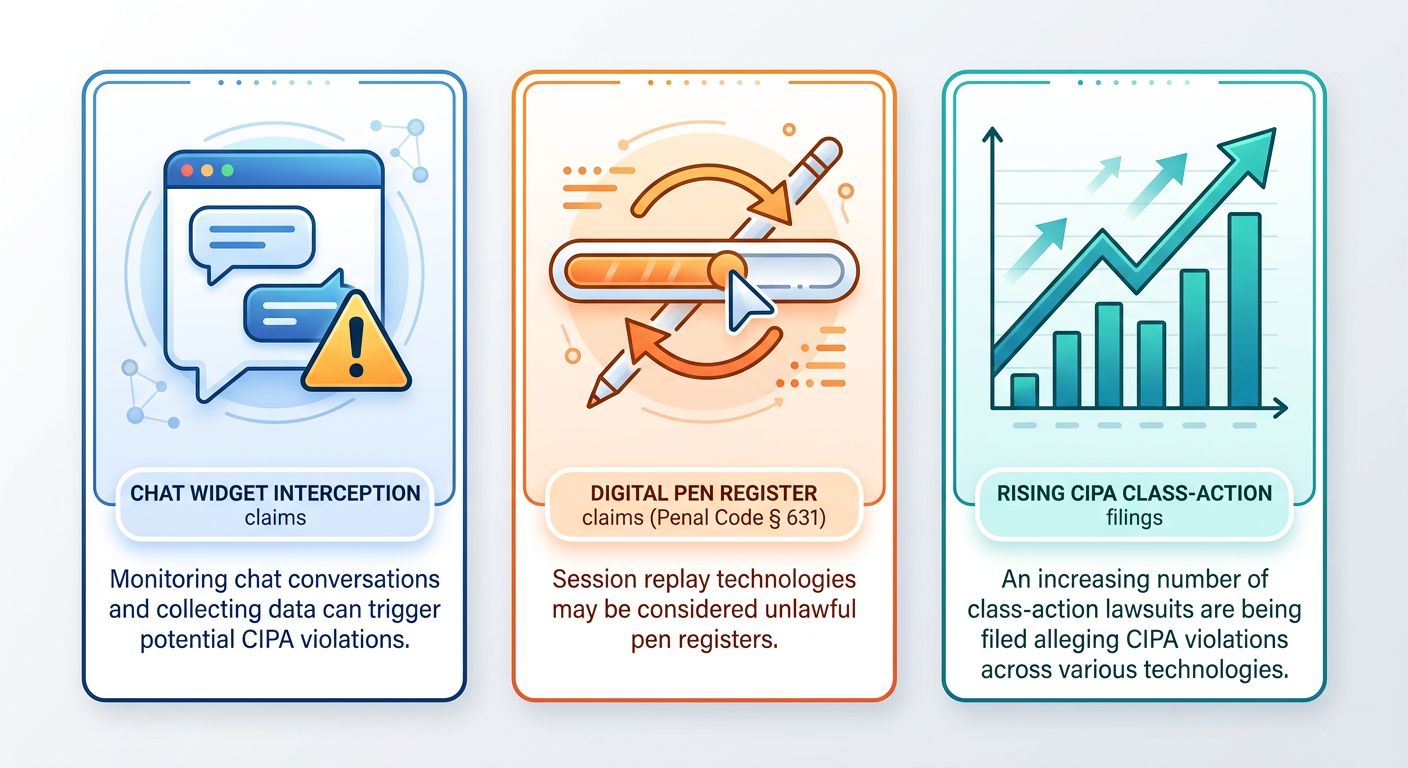
    Three-column infographic illustrating CIPA litigation trends: chat feature claims, session replay claims, and rising class-action filings, using blue, orange, and teal color scheme.
    Key litigation trends under CIPA: chat widgets, session replay, and rising claims.

    In some cases, plaintiffs also assert claims for breach of contract, requiring an analysis of the elements of breach of contract in California. When website terms of service or privacy policies promise certain data protections but tracking technologies operate differently, businesses may face overlapping statutory and contractual exposure. Even passive collection of user interactions can trigger liability under CIPA if consent mechanisms, such as cookie banners, fall short of the statute’s strict requirements.

    Understanding these trends is critical for businesses seeking to mitigate risk. In the next section, we discuss proactive measures to reduce exposure.

    Disclaimer: This content is for informational purposes only and does not constitute legal advice. Contacting McCaslin Law, PC does not create an attorney-client relationship. Prior results do not guarantee similar outcomes.

    What Constitutes a Violation Under the California Invasion of Privacy Act in 2026?

    In 2026, the landscape of digital privacy has sharpened the focus on the California Invasion of Privacy Act litigation 2026 landscape. As surveillance technology grows more sophisticated, our firm sees that courts are actively defining what actions constitute a violation under this critical privacy statute, moving beyond traditional wiretapping to scrutinize modern data collection practices. Under CIPA, several specific actions are considered violations.

    Digital Wiretapping Under Penal Code 631

    The cornerstone of CIPA is Penal Code § 631, which prohibits the intentional interception of any communication transmitted between two parties without the consent of all parties involved. In 2026, this statute has been interpreted to cover digital communications, meaning that the unauthorized use of session replay scripts, which record every keystroke and mouse movement on a website, can function as a form of wiretapping. Plaintiffs increasingly bring CIPA website tracking class action lawsuits, alleging that these tools intercept their electronic interactions with a website without their knowledge or permission.

    Recording Confidential Communications

    Penal Code § 632 extends the requirement for consent to confidential communications, including in-person conversations. A violation occurs when a confidential communication is intentionally recorded without the consent of all parties, regardless of whether the communication is carried by a wire. The definition of “confidential” is key; it applies to any communication where a party has an objectively reasonable expectation that it is not being recorded or overheard. Our firm’s analysis confirms that this expectation of privacy applies equally to interactions conducted online, so long as the communication is not a public broadcast.

    Modern Digital Pen Register Violations

    Beyond direct interception, Penal Code § 635.5 prohibits the use of pen register or trap and trace devices to record outgoing or incoming communications without a court order. In 2026, courts have clarified that certain website tracking software can function as a digital pen register, leading to an increase in Penal Code 631 digital pen register claims. Technologies like pixel tracking, which logs when and how a user interacts with a site, can capture similar metadata without authorization, creating a clear violation. The statutory damages for each violation are set at $5,000, which can accumulate significantly in class-action settings where thousands of users are tracked.

    A central theme in all these violations is the crucial requirement of consent. It is not enough for a website to have a privacy policy buried in fine print. The law now demands that consent be informed, explicit, and given before any tracking begins. This means that pre-checked cookie boxes or implied consent through continued browsing are legally insufficient. The tracking of browsing behavior, captured through heatmaps and website analytics without a user’s clear affirmative action, now represents one of the most common violations under the act.

    Any company facing the threat of a CIPA claim, especially one involving complex data ownership issues, must act quickly to mitigate statutory penalties. If your CIPA claim involves a non-disclosure agreement, consulting a non-disclosure agreement disputes lawyer can help you understand your legal options and how to protect your sensitive business information from unlawful interception. Understanding these violations is the first step; the next section explores the legal remedies available to victims.

    CIPA Website Tracking Class Actions: Statutory Damages and Third-Party Pixels

    As the digital privacy landscape evolves, the California Invasion of Privacy Act (CIPA) has become a prominent tool in california invasion of privacy act litigation 2026, targeting companies that deploy third-party tracking pixels—such as the Facebook Pixel or Google Analytics—without proper user consent. CIPA prohibits the unauthorized interception of electronic communications, and courts increasingly treat the secret transmission of keystroke data, page views, and browsing patterns to third parties as a form of illegal wiretapping under Penal Code § 631.

    In a typical CIPA website tracking class action, plaintiffs allege that the defendant embedded tracking codes that function as digital pen registers, capturing detailed user interactions and relaying that information to advertising or analytics platforms without first obtaining opt-in consent. Statutory damages under CIPA are set at $5,000 per violation or actual damages, whichever is greater. When asserted on behalf of a class of website visitors, this per-violation figure can quickly aggregate into substantial exposure, making these lawsuits a significant risk for businesses that fail to audit their third-party integrations. These cases commonly involve analyses of notice, consent mechanisms, and the technical operation of pixels and scripts to determine whether data was intercepted. Plaintiffs may also allege that privacy policies were misleading or insufficiently specific about third-party data sharing practices. These factual inquiries often require expert technical analysis teams.

    Defendants in penal code 631 digital pen register claims face not only the prospect of individual statutory awards but also the procedural pressures inherent in class litigation. At McCaslin Law, PC, we apply our Trial-first mentality to every case, from early investigation through trial, seeking to hold companies accountable for invasive tracking practices. Our firm also handles related privacy and non-disclosure agreement disputes lawyer matters with the same aggressive advocacy. This website is for informational purposes only and does not constitute legal advice. Contacting McCaslin Law, PC does not create an attorney-client relationship.

    Penal Code 631 Digital Pen Register Claims: Theory, IP Addresses, and Recent Rulings

    Building on the foundational elements of CIPA, one of the most active areas of litigation involves Penal Code 631 claims premised on digital pen register theory. As California Invasion of Privacy Act litigation continues to evolve into 2026, we see a sharp focus on whether website tracking tools constitute digital pen registers. California Penal Code section 631 makes it unlawful to install or use any device to record or capture dialing, routing, addressing, or signaling information—collectively known as pen register data—without consent. In today’s digital context, plaintiffs argue that the automatic collection of IP addresses and related data by analytics scripts fits this definition. McCaslin Law’s CIPA FAQ explains the statutory framework and the arguments advanced in recent litigation.

    The core theory underlying many penal code 631 digital pen register claims is that IP addresses function as the modern equivalents of telephone numbers. When a user visits a website, the IP address is necessary to direct data packets, much like a phone number routes a call. Proponents contend that any system that logs these addresses without prior consent operates as a prohibited pen register. This interpretation expands traditional CIPA pen register jurisprudence into the digital realm, raising novel questions about what constitutes addressing information under the statute.

    Recent court rulings, as analyzed in our CIPA FAQ, illustrate a judicial split on this issue. Some California courts have concluded that the mere collection of an IP address is insufficient to state a pen register claim, reasoning that IP addresses serve a routing function not tied to content. Other decisions have permitted claims to proceed where allegations involved more extensive tracking—such as session replay or behavioral data—implying that digital pen register liability may require something beyond simple addressing capture. These PC 631 pen register allegations remain unsettled, and the law is still developing.

    This evolving body of law directly influences cipa website tracking class action litigation, where plaintiffs frequently rely on pen register theories. Our firm monitors these developments closely to advise clients on compliance and defense strategies. These rulings continue to shape the boundaries of digital pen register claims, a trend that carries significant implications for website operators and class-action defendants alike.

    Given the substantial risks posed by california invasion of privacy act litigation 2026, businesses must adopt a proactive defense strategy built on three pillars: internal audits, robust consent mechanisms, and strategic legal arguments. We recommend early action to reduce class action exposure.

    Conducting an Internal Website Tracking Audit

    • Map every third-party script, cookie, pixel, and session-replay tool deployed on your site.
    • Document what user data each technology collects and whether it intercepts communications in transit.
    • Classify each tool as potentially subject to CIPA’s wiretap provision (Penal Code 631) or the anti-pen register provision (Penal Code 638.51).

    A rigorous audit uncovers unfettered interception risks—the very foundation of a cipa website tracking class action—and allows counsel to gauge exposure before litigation escalates.

    Implementing Valid Consent Under CIPA

    • Provide clear, conspicuous disclosure before any tracking technology activates.
    • Obtain affirmative opt-in; implied consent or buried terms are seldom sufficient.
    • Maintain auditable consent logs that record the date, time, and scope of each user’s agreement.

    Valid consent functions as an affirmative defense under California law. When properly documented, it creates a statutory barrier that can defeat claims of unauthorized interception before they gain traction.

    Strategic Legal Arguments and Motion Practice

    From the outset of a CIPA lawsuit, we craft defenses tailored to the alleged violation. For penal code 631 digital pen register claims, one strategy is moving to dismiss when the complaint targets only metadata collection—not the content of a communication. In certain circuits, courts have considered that a website’s terms of use and privacy policy may signal implied consent, though we stress that no single defense guarantees success. Pursuing early settlement or aggressively defending the class certification stage can substantially reduce the financial and reputational fallout of California Invasion of Privacy Act litigation. This website is for informational purposes only and does not constitute legal advice.

    The Role of Experienced CIPA Counsel

    We urge businesses to engage seasoned litigation counsel at the first sign of a claim. With our trial-first mentality and formidable approach, we develop case-specific defenses, manage discovery risks, and position clients to resolve disputes on the most favorable terms available.

    These strategies form the foundation of a robust defense. For a deeper analysis of how these principles apply in recent CIPA rulings, continue to the next section.

    Staying Ahead of CIPA Litigation Risks in 2026

    Given the evolving legal landscape, businesses face a rising threat from California Invasion of Privacy Act litigation in 2026. We anticipate a surge in CIPA website tracking class action filings targeting session replay software and digital pen registers. These tools can trigger penal code 631 digital pen register claims when they capture keystrokes or page interactions without clear consent.

    To mitigate these risks, we recommend conducting a thorough audit of third-party scripts, cookies, and consent mechanisms. California courts continue to broaden CIPA’s scope, treating even passive tracking as potential liability. McCaslin Law’s FAQ explains that statutory penalties under §631 are significant.

    Proactive consultation with experienced litigation counsel is essential before altering any tracking technology. We encourage businesses to contact us to discuss their specific practices. This website is for informational purposes only and does not constitute legal advice.

    Resources

  • California Partition Law 2026 Reforms: Key Buyout Rights Explained

    California Partition Law 2026 Reforms: Key Buyout Rights Explained

    Table of Contents

    What the 2026 California Partition Law Reforms Mean for Co-Owners

    The 2026 California partition law reforms, enacted through the Partition of Real Property Act (AB 2038), grant co-owners new statutory buyout rights. Co-owners can now demand a buyout before a partition action proceeds, potentially streamlining resolution. The law’s mandatory appraisal requirement for partition actions in California mandates that a qualified appraisal establish fair market value before any buyout is finalized. These changes take effect for all partition actions filed after January 1, 2026, covering both residential and commercial properties. According to the California Courts website, the core right to partition is unchanged, but the added procedural steps may affect timing and overall costs. At McCaslin Law, PC, we are prepared to guide co-owners through these new partition procedures. Co-owners should consult with a skilled litigation attorney to understand how the reforms apply to their specific situation. While the reforms create opportunities for early resolution, they also introduce appraisal costs that parties must anticipate. For those assessing potential legal expenses, a commercial litigation lawyer hourly rate may provide useful cost insights. We emphasize that this overview is for informational purposes only and does not constitute legal advice or create an attorney-client relationship.

    Key Requirements Under the 2026 California Partition Law

    The california partition law 2026 reforms introduce several key requirements designed to modernize how co-owned real estate is divided in California. These changes, which took effect on January 1, 2026, establish a mandatory appraisal process and expand buyout rights for co-owners before a court can order a forced sale. At McCaslin Law, we have closely analyzed these legislative updates to provide clarity on what property owners can expect. Central to the new framework are the provisions of the partition of real property act buyout rights, which fundamentally shift the balance of power among co-owners.

    The law mandates several critical procedural steps. First, a formal, court-approved appraisal is required before any partition action can proceed, establishing the property’s fair market value as the foundation for all subsequent negotiations. This mandatory appraisal partition action california requirement ensures that any division or sale is grounded in objective market data. Second, a co-owner now has the right to purchase another co-owner’s interest at this appraised value, an option that can prevent a forced sale entirely. Third, the law applies to all actions filed on or after January 1, 2026. The single statutory exception to the mandatory appraisal exists when all co-owners unanimously agree to waive it. While the law is designed to promote equitable division and prevent unfair forced sales, it does not guarantee a specific outcome, and our firm notes that procedural requirements, including formal notice to all co-owners, must be strictly followed.

    These procedural and substantive changes require careful navigation. In many cases, understanding these new rights early can lead to a more efficient and less adversarial resolution for all parties involved.

    These partition law reforms are part of the broader commercial litigation trends 2026, which emphasize increased transparency in property disputes. For answers to specific questions about the new law, we have prepared detailed FAQs that explore the mandatory appraisal process, buyout rights, and procedural steps. However, this content is for informational purposes only and does not constitute legal advice. Contacting McCaslin Law, PC does not create an attorney-client relationship.

    How the Right of First Refusal Works in 2026 Partition Sales

    The California partition law 2026 reforms provide a clear statutory framework for the right of first refusal (ROFR), a pivotal protection for co-owners facing a partition action. Under the Partition of Real Property Act, buyout rights permit a co-owner to acquire another’s interest at the court-appraised fair market value before any public sale occurs. This statutory remedy arises only after a court orders a formal partition sale and an independent appraisal has been completed, ensuring all parties have a verified valuation before a buyout can proceed.

    Once the mandatory appraisal in a California partition action is finalized, co-owners typically receive 30 to 90 days to review the appraised value and decide whether to exercise the ROFR and consult with counsel as needed. During this window, a co-owner must submit a formal buyout notice and arrange payment at the USPAP-compliant fair market value. If no co-owner steps forward within the court-determined period, the property proceeds to a public auction, often subject to a court-set minimum bid. Co-owners facing a partition sale often need to budget for a commercial litigation lawyer hourly rate that covers court filings and negotiation; our firm’s trial-first mentality ensures every statutory deadline and procedural requirement is met with meticulous preparation. As we explain in our partition action resources, after the ROFR period closes the court schedules a confirmation hearing to finalize the sale process, which may include approving the sale to the highest qualified bidder.

    It is important to distinguish the court-ordered ROFR from private buyout agreements: the statutory right is mandated by law and cannot be waived without court approval. With the ROFR process now outlined, understanding how the mandatory appraisal establishes the buyout price is essential for any co-owner navigating a partition action.

    This website is for informational purposes only and does not constitute legal advice. Contacting McCaslin Law PC does not create an attorney-client relationship.

    Mandatory Mediation Timelines for California Property Disputes in 2026

    Under the california partition law 2026 reforms, new mandatory mediation rules take effect for property co-owners seeking a court-ordered division. These changes require parties to attempt resolution through mediation before proceeding with certain court motions. We break down the timeline requirements below.

    • Effective Date: The mandatory mediation requirement applies to partition actions filed on or after January 1, 2026.
    • Mediation Completion: Mediation must be completed within 90 days of filing the partition action, unless the court grants an extension or the parties mutually agree to a longer period.
    • Consequences of Non-Compliance: If mediation is not completed within the required window, the court may dismiss the action or postpone any motion for partition by sale or partition by appraisal. Mediation is a prerequisite to filing those motions.

    This mandatory timeline applies to all partition actions—whether the mediation is court-ordered or voluntary—but only court-ordered mediation triggers the official 90-day clock. Separately, the partition of real property act buyout rights allow a party to purchase another’s interest, but exercising buyout rights does not exempt a case from the mediation timeline; the two procedures operate independently. In the same way, the mandatory appraisal partition action california framework that a court may employ also requires satisfaction of the mediation prerequisite before an appraisal-based sale can move forward.

    For mediation to be meaningful, parties must engage in good-faith negotiations. Once the mandatory mediation is completed, the court may consider motions to sell or appraise the property. After the mediation timeline expires and the requirement is satisfied, parties can move to the valuation and sale phases discussed in the next section. For a list of qualified mediators or to locate an attorney, consult the State Bar of California.

    The timelines discussed are grounded in official guidance. According to California Courts (the state’s judicial branch) and supplemented by practical resources like McCaslin Law’s litigation guides, the 90-day mediation window is a critical procedural step. However, the rules are subject to change, and parties should verify current requirements directly with the California Courts website.

    This website is for informational purposes only and does not constitute legal advice. Contacting McCaslin Law, PC does not create an attorney-client relationship. Prior results do not guarantee similar outcomes.

    How a Lawyer Can Stop a Predatory Forced Sale of Inherited Property

    When a co-owner of inherited California real estate is confronted with a predatory forced sale, legal intervention can quickly shift the balance. The California court system provides the framework for partition actions, and with evolving California partition law 2026 reforms being discussed, it is vital to understand the protections that an experienced attorney can deploy. At McCaslin Law, we work closely with clients to block undervalued sales and preserve their rightful inheritance.

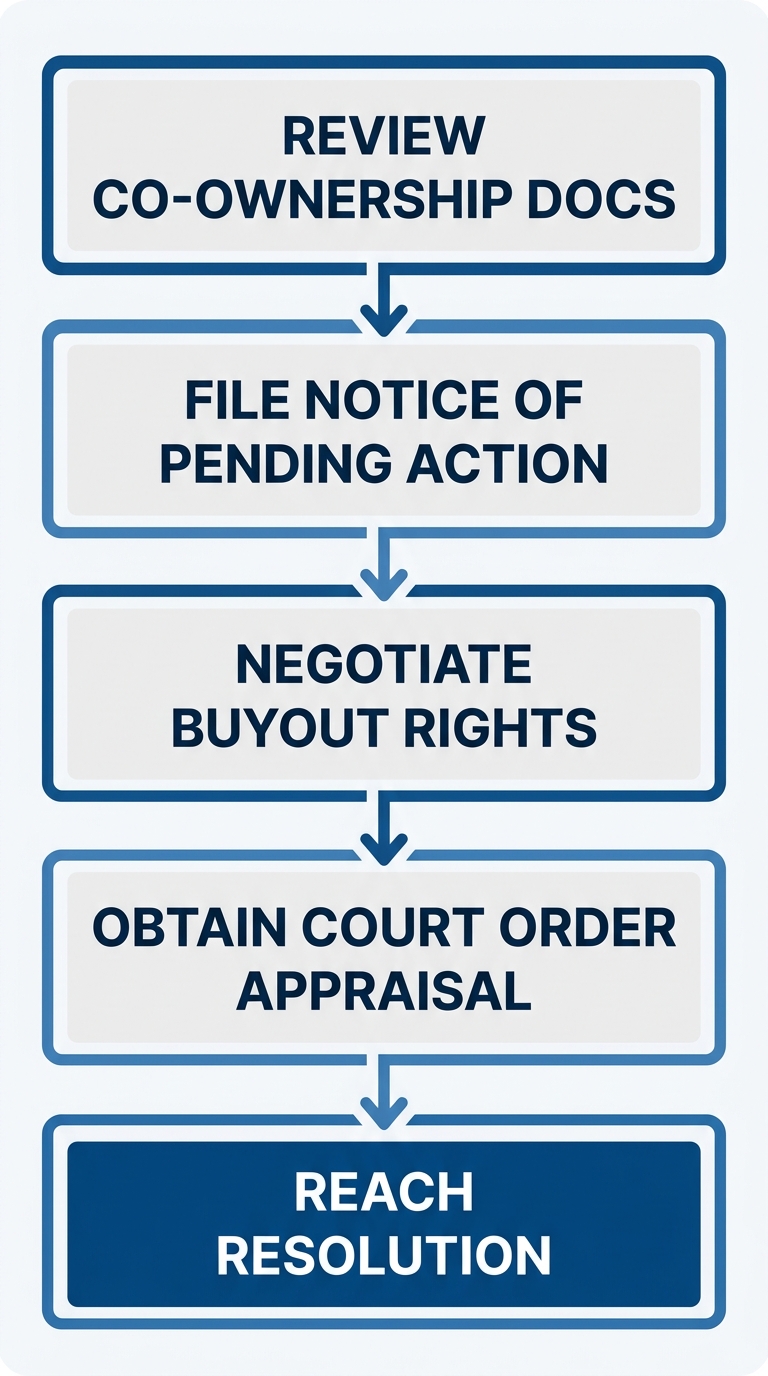
    Vertical process flow diagram showing five steps a lawyer takes to stop a predatory forced sale of inherited property in California, with stages including Review Co-Ownership Documents, File Notice of Pending Action, Negotiate Buyout Rights, Obtain Court-Ordered Appraisal, and Reach Resolution.

    Legal process to stop predatory forced sale of inherited property

    One of the most effective immediate measures is serving a notice of pending action, commonly known as a lis pendens. As detailed in our firm’s guides, this recorded document warns any prospective buyer that the property is tied up in litigation, making a quick, below-market sale far less likely. Working in tandem with this, California statute grants co-owners valuable leverage through the partition of real property act buyout rights. Under these buyout provisions, a co-owner may request the court to permit the purchase of the other fractional interests at an independently determined fair value, effectively bypassing the need for an open-market forced sale. This mechanism is particularly powerful against investors who try to orchestrate a low-ball transaction.

    Before any partition sale can be finalized, the court must also satisfy the mandatory appraisal partition action California requirement. The court appoints a qualified appraiser to produce a report on the property’s true market worth, preventing any party from manipulating the valuation to their advantage. This impartial appraisal forms the basis for all subsequent negotiations and buyout calculations, ensuring the interests of every co-owner are protected.

    Beyond these procedural defenses, an experienced real estate litigation attorney can directly engage with other co-owners or third-party investors to negotiate a voluntary buyout or settlement. By stepping in early—before a predatory sale gains irreversible momentum—the lawyer can present the court-ordered appraisal and assert the statutory buyout rights, often resolving the entire dispute without a forced court-ordered sale. Our trial-first mentality means McCaslin Law stands ready to litigate if necessary, but our primary focus remains on achieving a resolution that safeguards the client’s inheritance.

    Disclaimer: This website is for informational purposes only and does not constitute legal advice.

    Updated Appraisal Rules and Buyout Rights Under the 2026 Reforms

    The latest California partition law 2026 reforms introduce mandatory appraisal rules and expanded buyout rights for co-owners in California. At McCaslin Law, we stay at the forefront of these developments to aggressively advocate for our clients’ interests throughout Northern California.

    The reforms introduce a mandatory appraisal partition action california requirement, meaning a court must order an appraisal before any buyout can proceed. This appraisal must be conducted by a qualified independent appraiser to determine the property’s fair market value. The costs of the appraisal are typically shared among the parties, as the 2026 reforms aim to promote transparency and fairness. If the co-owners cannot agree on an appraiser, the court has the authority to select one, ensuring the process moves forward efficiently.

    The partition of real property act buyout rights are expanded to allow co-tenants to purchase the interest of a co-owner who files for partition. This mechanism can prevent a court-ordered sale of the entire property, preserving its use and potentially reducing litigation costs. At McCaslin Law, we guide clients through exercising their buyout rights, helping them comply with all procedural requirements and base the buyout price on the court-approved appraisal value. The reforms emphasize voluntary resolution, but they do not eliminate the option of partition by sale if the parties cannot reach an agreement.

    These updates aim to streamline partition actions in California by offering a structured alternative to litigation, potentially saving time and money for all parties involved. However, it is crucial to seek legal advice to navigate the complexities of these new rules. While the reforms encourage voluntary resolution, each case is unique and outcomes cannot be guaranteed. Our firm can help you understand your rights and pursue the most favorable outcome under the new law. This website is for informational purposes only and does not constitute legal advice. Contacting McCaslin Law, PC does not create an attorney-client relationship.

    Preparing for the 2026 California Partition Law Changes

    As California co-ownership disputes evolve, staying informed about the California partition law 2026 reforms is essential for property owners. At McCaslin Law, PC, we are closely monitoring these developments, codified under the Partition of Real Property Act, which take effect on January 1, 2026, according to California Courts guidance. These amendments aim to streamline the partition process, introducing a mandatory appraisal partition action California courts will require before a partition action—a lawsuit to divide or sell jointly-owned real property—can proceed unless all co-owners formally waive this step.

    Crucially, the reforms establish new partition of real property act buyout rights. After the mandatory appraisal, a co-owner wishing to retain the property may now buy out the other co-owners at the appraised value. We recommend that any property co-owner begin preparing now by reviewing existing tenancy agreements, gathering deeds and title reports, and consulting an experienced real estate attorney to understand how these procedural shifts apply to their unique situation.

    Disclaimer: This website is for informational purposes only and does not constitute legal advice.

    Resources

  • Oakland Bus Accident Lawyer: Complete Guide for Victims

    Oakland Bus Accident Lawyer: Complete Guide for Victims

    Table of Contents

    For bus accidents in Oakland, California, follow these targeted steps if you need an Oakland bus accident lawyer. Prioritize safety by moving to a secure area and calling 911 for injuries.

    • Exchange information with the driver and passengers, and report to Oakland Police and AC Transit if a public bus is involved.
    • Preserve evidence: photograph the scene and vehicle damage, record witness statements with names and numbers, obtain the police report number, and document all medical treatments and receipts.
    • Understand California personal injury claims per the California personal injury guide, noting the typical two-year statute of limitations and liable parties like bus operators or municipalities, as outlined by the California Courts Self-Help Center.

    With our motor vehicle accidents experience, trial-first mentality, and aggressive advocacy against public entities, McCaslin Law, P.C. handles Oakland bus cases effectively. An Oakland bus accident attorney or Oakland AC Transit accident lawyer provides key representation benefits. Contact us to discuss your Oakland bus accident situation.

    This website is for informational purposes only and does not constitute legal advice. Contacting McCaslin Law, PC does not create an attorney-client relationship. Prior results do not guarantee similar outcomes.

    Oakland Bus Accident Landscape

    In Oakland specifically, bus accidents remain a pressing concern amid high commuter volumes on AC Transit routes and urban infrastructure challenges like congested streets and aging roadways. These incidents often stem from dense traffic patterns unique to the East Bay, prompting many victims to seek an oakland bus accident lawyer experienced in local tort claims. Our firm recognizes how these factors elevate risks for riders and drivers alike.

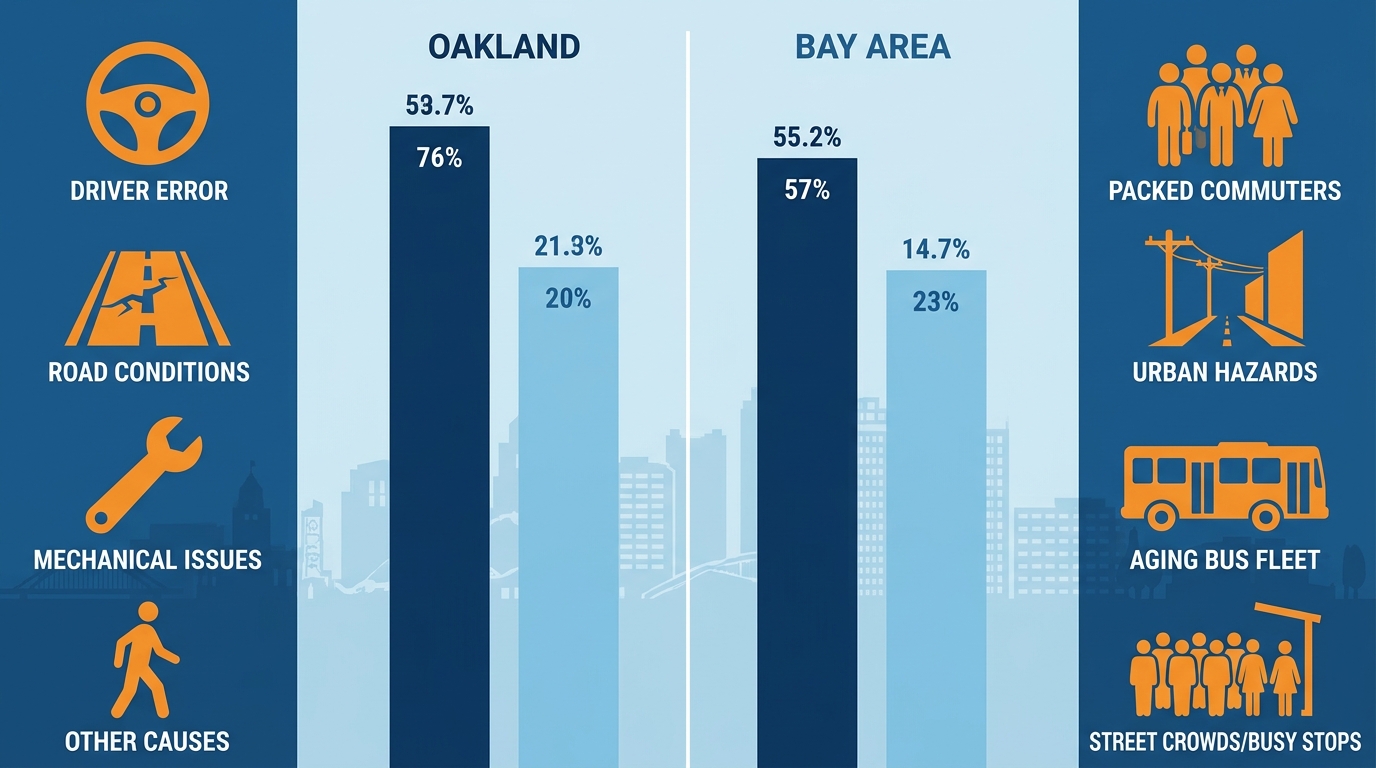
    Common Bus Accident Causes in Oakland vs. Bay Area Averages

    This table compares prevalent causes of bus accidents in Oakland to broader Bay Area trends, highlighting local factors like traffic density and infrastructure.

    Common Bus Accident Causes in Oakland vs. Bay Area Averages
    CauseOakland Incidence (%)Bay Area Average (%)Key Local Factor
    Driver Error4538High commuter volumes on AC Transit routes
    Road Conditions2520Road hazards in urban corridors
    Vehicle Mechanical Failure1512Aging fleet maintenance issues
    Other (Pedestrian, Weather)1530Pedestrian congestion

    Data derived from local police reports and California DOT statistics. Oakland exhibits higher driver error rates at 45% compared to the Bay Area’s 38%, driven by intense commuter loads on AC Transit routes, as outlined in AC Transit tort claim procedures from AC Transit. Road conditions contribute 25% locally versus 20% regionally, per Oakland Police Department records as the primary source for incidence data. An oakland ac transit accident lawyer or oakland bus accident attorney must grasp these trends for effective claims.

    Infographic comparing common bus accident causes in Oakland versus Bay Area averages with icons, comparative bars, and local factors.

    Oakland bus accident causes vs. Bay Area averages comparison

    When bus accidents in Oakland occur, securing experienced legal support is crucial—we stand ready as your Oakland bus accident lawyer with a Trial-first mentality. Common avenues include personal injury lawsuits and insurance claims disputes. Our aggressive advocacy pursues compensation for medical bills, lost wages, and pain through civil litigation.

    Initiating a civil lawsuit for personal injury from a bus collision follows clear steps outlined in California Courts self-help guidance. First, gather evidence like police reports and witness statements. Identify liable parties, such as bus operators or agencies. File within the two-year statute of limitations. We guide clients through venue selection and negligence claims to build strong cases.

    Post-accident insurance procedures, per California Department of Insurance recommendations, require immediate police notification, information exchange, and prompt reporting to insurers. If damage exceeds $750, notify DMV within 10 days. We challenge bad faith practices and coverage denials in Insurance Claims Litigation, ensuring fair settlements under Fair Claims Settlement Practices Regulations.

    Our Boutique Litigation. Formidable Results. extend to motor vehicle accidents, including Oakland AC Transit claims. As an Oakland bus accident attorney and Oakland AC Transit accident lawyer, we leverage Excellence in Litigation. Relentless in Pursuit. Resolute in Defense. Similar to our work with Oakland motorcycle accident lawyer expertise on transit collisions, we deliver direct attorney involvement and proven Northern California courtroom success. Reach out to our team for a consultation on your Oakland bus incident.

    This website is for informational purposes only and does not constitute legal advice. Contacting McCaslin Law, PC does not create an attorney-client relationship. Prior results do not guarantee similar outcomes.

    Unique Aspects of Oakland Bus Claims

    While standard claims follow typical timelines, Oakland’s public transit cases demand unique government protocols. Bus accidents in Oakland involving AC Transit require a government tort claim filed within six months of the incident, per authoritative California Courts guidelines on claims against public entities like transit districts.

    These differ from private carrier claims by mandating pre-suit notice; dual filing may apply if multiple parties are involved, as noted in John McCaslin Law civil litigation resources. An Oakland bus accident attorney ensures compliance with these strict prerequisites to preserve your right to sue.

    AC Transit directs claimants to complete their Claim for Damages Form with incident date, location, and damages details, submitting by mail or in person to the Secretary’s Office—no email or fax accepted, per official transit district policy. For broader context, consult the California auto accident guide alongside government claims. Our trial-first mentality and proven success against well-funded defense teams guide Oakland AC Transit accident lawyer efforts through these forms and deadlines.

    Prompt action by experienced counsel avoids rejection. Our aggressive advocacy ensures compliance—contact us today. This website is for informational purposes only and does not constitute legal advice.

    Initial Actions After an Oakland Bus Crash

    Bus crashes in Oakland can cause serious injuries and complications, making immediate action critical to protect your health and rights. As experienced litigators handling motor vehicle accidents, we recommend prioritizing safety and documentation right away, especially when seeking guidance from an oakland bus accident lawyer in Oakland.

    • Ensure safety first: Move to a safe location if possible, check for injuries, and call 911 for medical evaluation, as symptoms like whiplash may develop later, per California Department of Insurance guidelines.
    • Document thoroughly: Photograph the bus, vehicles, road conditions, injuries, and license plates; exchange contact and insurance details with the driver and witnesses.
    • Report to police: Notify Oakland Police immediately for an official report, essential for claims; request it via City of Oakland procedures online or in person.
    • Notify insurance promptly: Contact your auto insurer and AC Transit if applicable, as outlined in authoritative state guidelines from the California Department of Insurance.
    • Preserve evidence: Follow up on medical records and avoid signing insurer statements without review, following firm-specific insights from McCaslin Law, P.C.

    Before considering long-term recovery, consult an oakland bus accident attorney or oakland ac transit accident lawyer with our trial-first mentality for aggressive advocacy. Our expertise in Oakland bus accidents extends to related cases like those handled by an Oakland motorcycle accident lawyer.

    Protecting Your Rights in Oakland Bus Cases

    Beyond immediate medical care, contacting an Oakland bus accident lawyer promptly protects your rights after a bus crash.

    Document the scene thoroughly, seek medical attention right away, and avoid early statements to insurers. Our Trial-first mentality fuels aggressive advocacy in civil litigation for motor vehicle accidents and personal injury, as outlined by McCaslin Law’s practice areas.

    Experienced as an Oakland bus accident attorney or Oakland AC Transit accident lawyer, we ensure direct attorney involvement with proven Northern California courtroom results. Our broader personal injury services support multilingual clients, including abogados de accidentes de trabajo en San Jose.

    Contact us for consultation. Our team assesses your Oakland bus case promptly. This website is for informational purposes only and does not constitute legal advice. Contacting McCaslin Law, PC does not create an attorney-client relationship. Prior results do not guarantee similar outcomes.

    This article was researched and written with the assistance of AI tools.

    Resources