

Table of Contents
- The California Invasion of Privacy Act Litigation Landscape in 2026
- Understanding the California Invasion of Privacy Act and Its 2026 Applications
- Website Tracking and Pixel Lawsuits Under CIPA
- Digital Pen Register Claims and Penal Code 631
- Effective Defenses Against CIPA Claims for California Businesses
- CIPA Litigation Trends and What Lies Ahead in 2026
- Key Takeaways on CIPA Litigation for Businesses in 2026
The Evolving Landscape of California Invasion of Privacy Act Litigation in 2026
The terrain for California invasion of privacy act litigation 2026 is defined by a surge in novel claims targeting the digital tools businesses use every day. Drawing from insights provided by American Bar Association resources, the most visible trend is the continued proliferation of CIPA website tracking class action lawsuits, where plaintiffs allege that common analytics and chat features constitute unlawful wiretapping. A parallel and equally significant development is the use of penal code 631 digital pen register claims, which argue that certain online tracking scripts illegally record a user’s keystrokes and clicks without consent. For any business operating an interactive website, these shifts demand close attention as courts continue to grapple with applying decades-old statutes to modern technology, and regulators, counsel, and compliance teams are watching closely too.
CIPA Litigation Trends: Chat Features, Session Replay, and Rising Claims
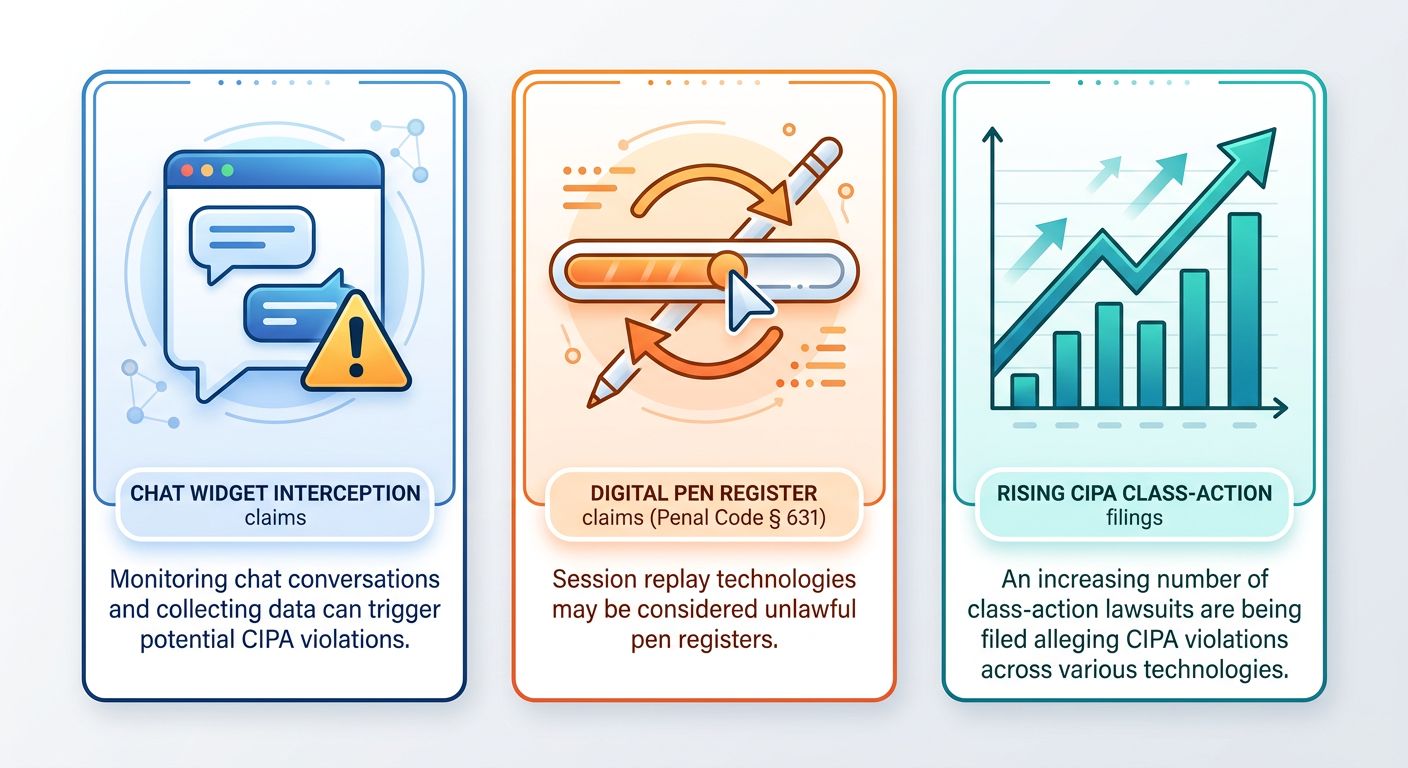
Building on the fundamentals of CIPA, we now examine the specific litigation trends driving the surge in california invasion of privacy act litigation 2026. A growing number of class actions are targeting businesses that use website chat widgets and session replay software, alleging these tools violate the California Invasion of Privacy Act by intercepting user communications without proper consent. Plaintiff firms are increasingly filing cipa website tracking class action lawsuits, leveraging both traditional wiretapping statutes and newer digital privacy provisions to challenge modern web analytics practices.
At the heart of many claims is Penal Code 631, which prohibits wiretapping and the unauthorized interception of communications. Plaintiffs argue that chat features and session replay tools capture interactions in real time—reading messages as they are typed or recording every mouse movement and scroll—without the user’s knowledge or affirmative consent. These allegations frame routine website functions as illicit surveillance, transforming standard customer service tools into potential liability traps for unsuspecting businesses.
Another emerging theory involves Penal Code 638.51, often described as the digital pen register provision. Under this statute, plaintiffs claim that tracking keystrokes, mouse movements, and page interactions constitutes the unlawful recording of dialing or routing information. McCaslin Law has observed that penal code 631 digital pen register claims are gaining traction, particularly when combined with allegations that session replay code transmits detailed behavioral data to third-party vendors without adequate disclosure.
Courts remain divided on whether session replay recordings constitute “content” or a “record” under CIPA, creating significant legal uncertainty for businesses operating in California. Some judges have dismissed claims at the pleadings stage, while others have allowed discovery to proceed, increasing litigation costs and settlement pressure. This split underscores the importance of understanding both the statutory definitions and the evolving case law interpreting them.
In some cases, plaintiffs also assert claims for breach of contract, requiring an analysis of the elements of breach of contract in California. When website terms of service or privacy policies promise certain data protections but tracking technologies operate differently, businesses may face overlapping statutory and contractual exposure. Even passive collection of user interactions can trigger liability under CIPA if consent mechanisms, such as cookie banners, fall short of the statute’s strict requirements.
Understanding these trends is critical for businesses seeking to mitigate risk. In the next section, we discuss proactive measures to reduce exposure.
Disclaimer: This content is for informational purposes only and does not constitute legal advice. Contacting McCaslin Law, PC does not create an attorney-client relationship. Prior results do not guarantee similar outcomes.
What Constitutes a Violation Under the California Invasion of Privacy Act in 2026?
In 2026, the landscape of digital privacy has sharpened the focus on the California Invasion of Privacy Act litigation 2026 landscape. As surveillance technology grows more sophisticated, our firm sees that courts are actively defining what actions constitute a violation under this critical privacy statute, moving beyond traditional wiretapping to scrutinize modern data collection practices. Under CIPA, several specific actions are considered violations.
Digital Wiretapping Under Penal Code 631
The cornerstone of CIPA is Penal Code § 631, which prohibits the intentional interception of any communication transmitted between two parties without the consent of all parties involved. In 2026, this statute has been interpreted to cover digital communications, meaning that the unauthorized use of session replay scripts, which record every keystroke and mouse movement on a website, can function as a form of wiretapping. Plaintiffs increasingly bring CIPA website tracking class action lawsuits, alleging that these tools intercept their electronic interactions with a website without their knowledge or permission.
Recording Confidential Communications
Penal Code § 632 extends the requirement for consent to confidential communications, including in-person conversations. A violation occurs when a confidential communication is intentionally recorded without the consent of all parties, regardless of whether the communication is carried by a wire. The definition of “confidential” is key; it applies to any communication where a party has an objectively reasonable expectation that it is not being recorded or overheard. Our firm’s analysis confirms that this expectation of privacy applies equally to interactions conducted online, so long as the communication is not a public broadcast.
Modern Digital Pen Register Violations
Beyond direct interception, Penal Code § 635.5 prohibits the use of pen register or trap and trace devices to record outgoing or incoming communications without a court order. In 2026, courts have clarified that certain website tracking software can function as a digital pen register, leading to an increase in Penal Code 631 digital pen register claims. Technologies like pixel tracking, which logs when and how a user interacts with a site, can capture similar metadata without authorization, creating a clear violation. The statutory damages for each violation are set at $5,000, which can accumulate significantly in class-action settings where thousands of users are tracked.
The Standard for Consent in a Digital Age
A central theme in all these violations is the crucial requirement of consent. It is not enough for a website to have a privacy policy buried in fine print. The law now demands that consent be informed, explicit, and given before any tracking begins. This means that pre-checked cookie boxes or implied consent through continued browsing are legally insufficient. The tracking of browsing behavior, captured through heatmaps and website analytics without a user’s clear affirmative action, now represents one of the most common violations under the act.
Any company facing the threat of a CIPA claim, especially one involving complex data ownership issues, must act quickly to mitigate statutory penalties. If your CIPA claim involves a non-disclosure agreement, consulting a non-disclosure agreement disputes lawyer can help you understand your legal options and how to protect your sensitive business information from unlawful interception. Understanding these violations is the first step; the next section explores the legal remedies available to victims.
CIPA Website Tracking Class Actions: Statutory Damages and Third-Party Pixels
As the digital privacy landscape evolves, the California Invasion of Privacy Act (CIPA) has become a prominent tool in california invasion of privacy act litigation 2026, targeting companies that deploy third-party tracking pixels—such as the Facebook Pixel or Google Analytics—without proper user consent. CIPA prohibits the unauthorized interception of electronic communications, and courts increasingly treat the secret transmission of keystroke data, page views, and browsing patterns to third parties as a form of illegal wiretapping under Penal Code § 631.
In a typical CIPA website tracking class action, plaintiffs allege that the defendant embedded tracking codes that function as digital pen registers, capturing detailed user interactions and relaying that information to advertising or analytics platforms without first obtaining opt-in consent. Statutory damages under CIPA are set at $5,000 per violation or actual damages, whichever is greater. When asserted on behalf of a class of website visitors, this per-violation figure can quickly aggregate into substantial exposure, making these lawsuits a significant risk for businesses that fail to audit their third-party integrations. These cases commonly involve analyses of notice, consent mechanisms, and the technical operation of pixels and scripts to determine whether data was intercepted. Plaintiffs may also allege that privacy policies were misleading or insufficiently specific about third-party data sharing practices. These factual inquiries often require expert technical analysis teams.
Defendants in penal code 631 digital pen register claims face not only the prospect of individual statutory awards but also the procedural pressures inherent in class litigation. At McCaslin Law, PC, we apply our Trial-first mentality to every case, from early investigation through trial, seeking to hold companies accountable for invasive tracking practices. Our firm also handles related privacy and non-disclosure agreement disputes lawyer matters with the same aggressive advocacy. This website is for informational purposes only and does not constitute legal advice. Contacting McCaslin Law, PC does not create an attorney-client relationship.
Penal Code 631 Digital Pen Register Claims: Theory, IP Addresses, and Recent Rulings
Building on the foundational elements of CIPA, one of the most active areas of litigation involves Penal Code 631 claims premised on digital pen register theory. As California Invasion of Privacy Act litigation continues to evolve into 2026, we see a sharp focus on whether website tracking tools constitute digital pen registers. California Penal Code section 631 makes it unlawful to install or use any device to record or capture dialing, routing, addressing, or signaling information—collectively known as pen register data—without consent. In today’s digital context, plaintiffs argue that the automatic collection of IP addresses and related data by analytics scripts fits this definition. McCaslin Law’s CIPA FAQ explains the statutory framework and the arguments advanced in recent litigation.
The core theory underlying many penal code 631 digital pen register claims is that IP addresses function as the modern equivalents of telephone numbers. When a user visits a website, the IP address is necessary to direct data packets, much like a phone number routes a call. Proponents contend that any system that logs these addresses without prior consent operates as a prohibited pen register. This interpretation expands traditional CIPA pen register jurisprudence into the digital realm, raising novel questions about what constitutes “addressing” information under the statute.
Recent court rulings, as analyzed in our CIPA FAQ, illustrate a judicial split on this issue. Some California courts have concluded that the mere collection of an IP address is insufficient to state a pen register claim, reasoning that IP addresses serve a routing function not tied to content. Other decisions have permitted claims to proceed where allegations involved more extensive tracking—such as session replay or behavioral data—implying that digital pen register liability may require something beyond simple addressing capture. These PC 631 pen register allegations remain unsettled, and the law is still developing.
This evolving body of law directly influences cipa website tracking class action litigation, where plaintiffs frequently rely on pen register theories. Our firm monitors these developments closely to advise clients on compliance and defense strategies. These rulings continue to shape the boundaries of digital pen register claims, a trend that carries significant implications for website operators and class-action defendants alike.
Defending Against CIPA Claims: Audits, Consent, and Legal Strategies
Given the substantial risks posed by california invasion of privacy act litigation 2026, businesses must adopt a proactive defense strategy built on three pillars: internal audits, robust consent mechanisms, and strategic legal arguments. We recommend early action to reduce class action exposure.
Conducting an Internal Website Tracking Audit
- Map every third-party script, cookie, pixel, and session-replay tool deployed on your site.
- Document what user data each technology collects and whether it intercepts communications in transit.
- Classify each tool as potentially subject to CIPA’s wiretap provision (Penal Code 631) or the anti-pen register provision (Penal Code 638.51).
A rigorous audit uncovers unfettered interception risks—the very foundation of a cipa website tracking class action—and allows counsel to gauge exposure before litigation escalates.
Implementing Valid Consent Under CIPA
- Provide clear, conspicuous disclosure before any tracking technology activates.
- Obtain affirmative opt-in; implied consent or buried terms are seldom sufficient.
- Maintain auditable consent logs that record the date, time, and scope of each user’s agreement.
Valid consent functions as an affirmative defense under California law. When properly documented, it creates a statutory barrier that can defeat claims of unauthorized interception before they gain traction.
Strategic Legal Arguments and Motion Practice
From the outset of a CIPA lawsuit, we craft defenses tailored to the alleged violation. For penal code 631 digital pen register claims, one strategy is moving to dismiss when the complaint targets only metadata collection—not the content of a communication. In certain circuits, courts have considered that a website’s terms of use and privacy policy may signal implied consent, though we stress that no single defense guarantees success. Pursuing early settlement or aggressively defending the class certification stage can substantially reduce the financial and reputational fallout of California Invasion of Privacy Act litigation. This website is for informational purposes only and does not constitute legal advice.
The Role of Experienced CIPA Counsel
We urge businesses to engage seasoned litigation counsel at the first sign of a claim. With our trial-first mentality and formidable approach, we develop case-specific defenses, manage discovery risks, and position clients to resolve disputes on the most favorable terms available.
These strategies form the foundation of a robust defense. For a deeper analysis of how these principles apply in recent CIPA rulings, continue to the next section.
Staying Ahead of CIPA Litigation Risks in 2026
Given the evolving legal landscape, businesses face a rising threat from California Invasion of Privacy Act litigation in 2026. We anticipate a surge in CIPA website tracking class action filings targeting session replay software and digital pen registers. These tools can trigger penal code 631 digital pen register claims when they capture keystrokes or page interactions without clear consent.
To mitigate these risks, we recommend conducting a thorough audit of third-party scripts, cookies, and consent mechanisms. California courts continue to broaden CIPA’s scope, treating even passive tracking as potential liability. McCaslin Law’s FAQ explains that statutory penalties under §631 are significant.
Proactive consultation with experienced litigation counsel is essential before altering any tracking technology. We encourage businesses to contact us to discuss their specific practices. This website is for informational purposes only and does not constitute legal advice.
Resources
- Understand Four Elements of Breach of Contract in California
- Explore Legal Remedies for NDA Breach in California
- Discover NDA Enforceability and Trade Secret Laws in California
- Learn Material Breach Standards for California Contract Claims
- Discover 2026 California Partition Law Right of First Refusal
- Learn About McCaslin Law PC’s Sacramento Litigation Practice
- Explore NDA Breach Litigation with Trial-First Strategy in Sacramento
- Explore the American Bar Association’s Resources for Attorneys


