Table of Contents
- Navigating Commercial Real Estate Disputes in Northern California
- Understanding Common Triggers for Commercial Real Estate Litigation
- Resolving Complex Disputes: Lease Valuation, Partition Actions, and Quiet Title
- Practical Steps for Lease Enforcement and Quiet Title Actions
- Advanced Strategies: Partnership Disputes, Broker Commissions, and Trial Preparation
- Frequently Asked Questions About Commercial Real Estate Disputes
- Securing Experienced Representation for Your Commercial Real Estate Dispute
Navigating Commercial Real Estate Disputes in Northern California
Commercial real estate law is complex and high-stakes, requiring experienced commercial real estate dispute lawyers who understand the unique legal landscape in Northern California. At McCaslin Law, PC, we represent property owners, commercial tenants, developers, and investors in a wide range of commercial property conflicts. Our practice covers the full spectrum of disputes, including:
- Commercial lease enforcement matters, such as breach of lease, unlawful detainer, and covenant disputes.
- Purchase and sale agreement disputes involving financing, inspection, and closing issues.
- Title, boundary, and easement conflicts, including quiet title action proceedings to resolve ownership claims.
- Construction defect litigation over faulty work or materials in commercial projects.
- Landlord-tenant litigation addressing eviction, habitability, and contract interpretation.
Our Trial-first mentality and Aggressive advocacy set McCaslin Law, PC apart. With more than 25 years of Northern California courtroom experience, our commercial real estate dispute lawyers are intimately familiar with local judges, procedures, and the strategies that get results in venues like Sacramento, San Francisco, and the surrounding counties. Under the ethical guidelines of the American Bar Association, we prepare every commercial real estate dispute as if it will be tried, giving our clients leverage from day one. We provide tailored strategies and direct attorney involvement, ensuring that each matter receives the aggressive, prepared advocacy it deserves.
In the following sections, we delve deeper into the specific categories of commercial real estate disputes, exploring how our firm navigates lease disputes, purchase agreement conflicts, and other real estate litigation.
This content is for informational purposes only and does not constitute legal advice. Contacting McCaslin Law, PC does not create an attorney-client relationship.
Understanding Common Triggers for Commercial Real Estate Litigation
Commercial real estate transactions and property relationships are inherently complex, and when disputes arise, they often follow predictable patterns. Whether it’s a disagreement over lease terms, a boundary issue that clouds a property’s title, or a construction project that fails to meet expectations, these situations can rapidly escalate into formal litigation. When disputes escalate, commercial real estate dispute lawyers step in to resolve them. Understanding these common triggers helps property owners, tenants, and developers in California recognize when they may need aggressive legal representation.
| Trigger Type | Key Legal Issues |
|---|---|
| Rent defaults, lease enforcement, valuation disagreements | Lease Disputes |
| Easement conflicts, boundary disputes, quiet title actions | Title Disputes |
| Defective work, delay damages, professional negligence | Construction Defects |
This table provides a high-level view of the situations that frequently give rise to litigation. Each of these categories encompasses a range of specific conflicts, often involving breach of contract claims, property rights disputes, and negligence allegations. We see these patterns regularly in our practice, and recognizing them early can be critical to protecting your legal interests.
Lease Disputes represent the most common trigger for commercial real estate litigation in our experience. These conflicts typically arise when one party fails to meet their contractual obligations under a commercial lease agreement. Rent defaults occur when a tenant stops making payments, forcing landlords to pursue legal remedies. Valuation disagreements can surface during rent escalations, renewal option exercises, or when calculating common area maintenance charges. Our firm has detailed resources on these topics—as explained in our Commercial Lease Enforcement FAQ, understanding the remedies available is essential. The legal issues in these cases center on breach of contract, and they often require commercial lease enforcement actions through the court system.
Title Disputes involve conflicts over who holds legal ownership of a property or what rights attach to that ownership. Easement conflicts frequently arise when one party’s use of a driveway, utility line, or access road is challenged by a neighboring property owner. Boundary disputes can surface years after a transaction closes when a survey reveals encroachments or inaccuracies. When the chain of title is clouded or contested, a quiet title action may be necessary. These cases are filed in the California Judicial Branch, where a judge determines property rights and resolves competing claims. The core legal issues involve property law principles, and we approach these matters with the meticulous preparation they demand.
Construction Defects frequently lead to litigation when completed work fails to meet contractual specifications or industry standards. Defective workmanship can range from structural deficiencies to substandard materials that compromise a building’s integrity. Delay damages become a contentious issue when projects extend beyond agreed timelines, resulting in lost revenue and additional carrying costs for property owners. Professional negligence claims may target architects, engineers, or contractors whose design or oversight failures contributed to the defects. These disputes typically involve breach of contract and tort-based claims, requiring thorough factual investigation and expert analysis.
Recognizing these triggers is the first step toward protecting your interests. Our trial-first mentality means we evaluate every case as though it will proceed to verdict, positioning our clients for the strongest possible outcome. Understanding these triggers helps commercial real estate dispute lawyers address client needs effectively.
This website is for informational purposes only and does not constitute legal advice.
Resolving Complex Disputes: Lease Valuation, Partition Actions, and Quiet Title
Complex commercial real estate disputes demand knowledgeable representation. At McCaslin Law, PC, we handle lease valuation disagreements, partition actions, and quiet title actions for clients throughout Northern California. We also litigate related matters such as California bad faith insurance claims, reflecting our comprehensive civil litigation practice.
Commercial Lease Valuation Disagreements
Commercial lease valuation disputes arise when landlords and tenants cannot agree on rent adjustments, market comparables, or space measurements. These disagreements often escalate into litigation, especially in ground leases or percentage rent arrangements. To resolve these conflicts, we employ negotiation, mediation, and, when the lease contains an appraisal clause, a binding third-party determination. Our approach to commercial lease enforcement is rooted in a trial-first mentality; we prepare every matter as though it will proceed to trial, leveraging aggressive advocacy to achieve favorable outcomes. We represent both landlords and tenants in disputes over rent resets, operating expense pass-throughs, and default remedies, always with an eye toward protecting our clients’ bottom lines.
California Partition Actions for Commercial Property
A partition action is a statutory remedy that allows co-owners of commercial property to force the division or sale of the asset when collaboration fails. California courts may order a physical partition if the property can be divided equitably, but for commercial real estate, a sale with proceeds distributed among owners is the more common result. We handle partition actions with aggressive advocacy, recognizing that these disputes often involve substantial financial stakes and deep personal conflicts. Our trial-first mentality means we prepare every partition case for courtroom resolution, whether that involves contested hearings over ownership shares, appraisals, or the terms of sale. We also work to minimize delay and expense by exploring buy-out negotiations and mediation when those avenues align with our clients’ goals.
Quiet Title Actions: Clearing Clouds on Property Title
A quiet title action is a court proceeding used to eliminate clouds on property title, such as competing claims, unreleased liens, or recording errors. According to our firm’s FAQ, a successful plaintiff must prove a superior right to the property and show that the defendant’s assertions lack legal merit. We litigate quiet title actions with meticulous attention to documenting chain of title and challenging adverse claims. Our trial-first mentality ensures that we are prepared to present compelling evidence and legal argument to the court. Because title defects can halt sales, financing, or development, we move swiftly to identify the source of the cloud and pursue resolution through negotiation or judgment. With aggressive advocacy, we seek not only to clear title but also to recover damages and attorney fees where permitted.
The following table summarizes the three primary methods we use to resolve complex commercial real estate disputes in California.
| Method | Key Characteristics |
|---|---|
| Negotiation, mediation, appraisal clause | Lease Valuation |
| Statutory proceeding, sale or division of property | Partition Action |
| Court action to clear title defects | Quiet Title |
With a trial-first mentality and aggressive advocacy, McCaslin Law, PC delivers formidable results in lease valuation, partition, and quiet title matters. Contact us to discuss your commercial real estate dispute.
Practical Steps for Lease Enforcement and Quiet Title Actions
Once a dispute arises, taking the right procedural steps is critical. Whether facing a tenant default or a title defect, commercial real estate dispute lawyers provide the strategic guidance necessary to protect your interests. A real estate litigation attorney in Sacramento can help you navigate these complex procedures and pursue the most effective remedies.
Enforcing Commercial Leases After a Default
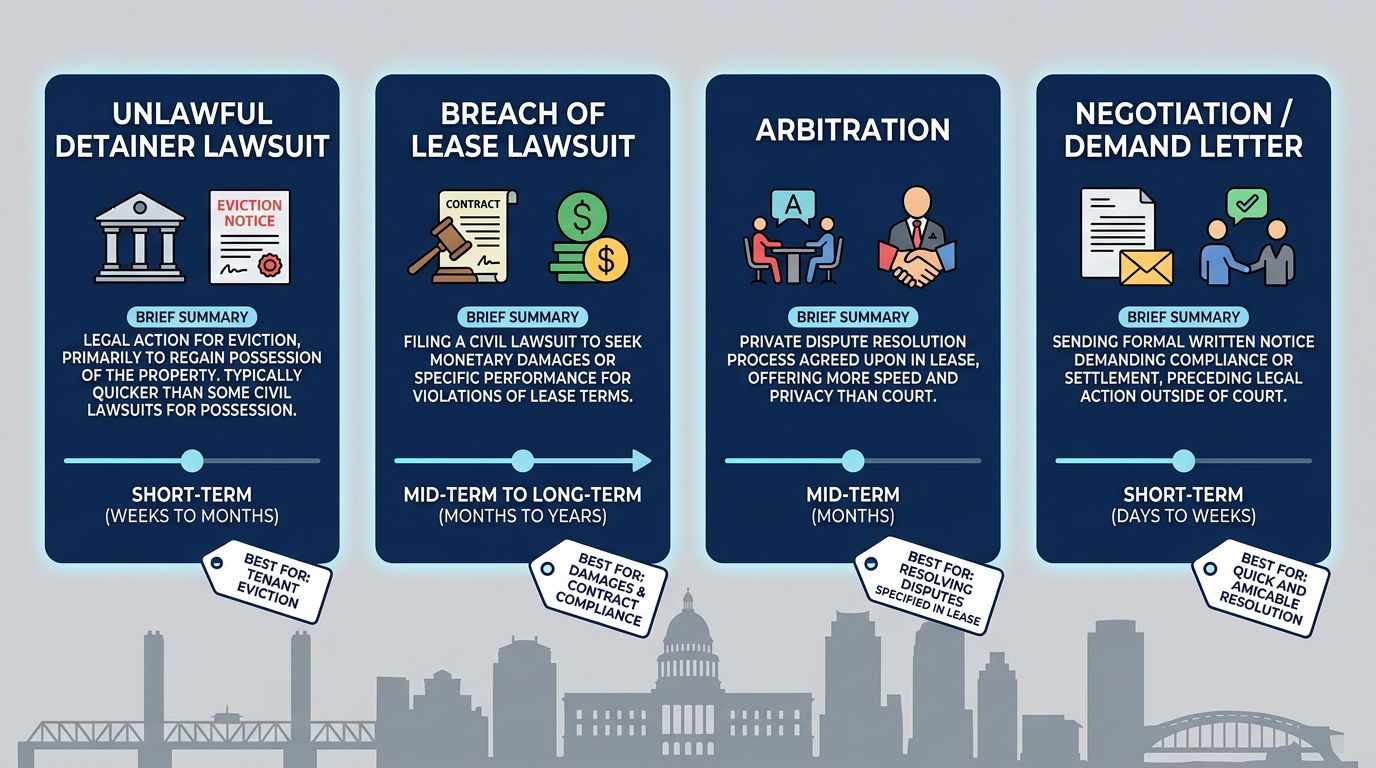
The first stage in commercial lease enforcement is issuing a written default notice that specifies the breach and allows the tenant a statutory cure period—typically three days for nonpayment of rent under California law. If the tenant fails to cure, the landlord may file an unlawful detainer action to regain possession or a breach-of-contract claim for money damages. We prepare each step with meticulous attention to the lease terms and local rules, ensuring that deadlines and procedural requirements are strictly observed. This systematic approach minimizes delays and strengthens your position for any subsequent litigation.
Defending Against Lease Enforcement Actions
Tenants facing enforcement can raise several common defenses. A claim of constructive eviction asserts that the landlord’s failure to maintain the premises made them uninhabitable, effectively forcing the tenant out. Another defense is failure to mitigate damages, arguing that the landlord did not take reasonable steps to re-rent the space after the default. Waiver may apply when the landlord accepts late payments or otherwise acts inconsistently with strict enforcement of the lease terms. We thoroughly evaluate the facts in every case to determine the viability of these defenses and craft a response tailored to the circumstances.
Filing a Quiet Title Action: Requirements and Timeline
A quiet title action is the legal mechanism to resolve disputes over who holds valid title to real property. In California, any person or entity claiming an interest in real estate may file, but the complaint must allege the nature of the claim, describe the property, and name all adverse claimants. After service and an opportunity to respond, the court examines the evidence and issues a judgment that declares the true owner and extinguishes competing claims. The process typically takes six to twelve months, though complex cases or crowded court dockets can extend the timeline. Success requires meticulous preparation and strict compliance with statutory requirements.
Understanding the procedural differences between these remedies helps clarify which path to pursue.
| Stage | Key Actions |
|---|---|
| Lease: Written default notice; Quiet Title: File complaint | Notice |
| Lease: Unlawful detainer or breach of contract; Quiet Title: Quiet title action | Litigation |
| Lease: Possession + damages; Quiet Title: Court order clearing title | Resolution |
The table highlights the distinct purposes each remedy serves. Lease enforcement focuses on restoring the landlord’s possessory rights and recovering unpaid sums, while a quiet title action establishes clear ownership and eliminates competing claims. Because both processes demand strict adherence to procedural rules and deadlines, partnering with experienced counsel significantly improves the likelihood of a favorable outcome.
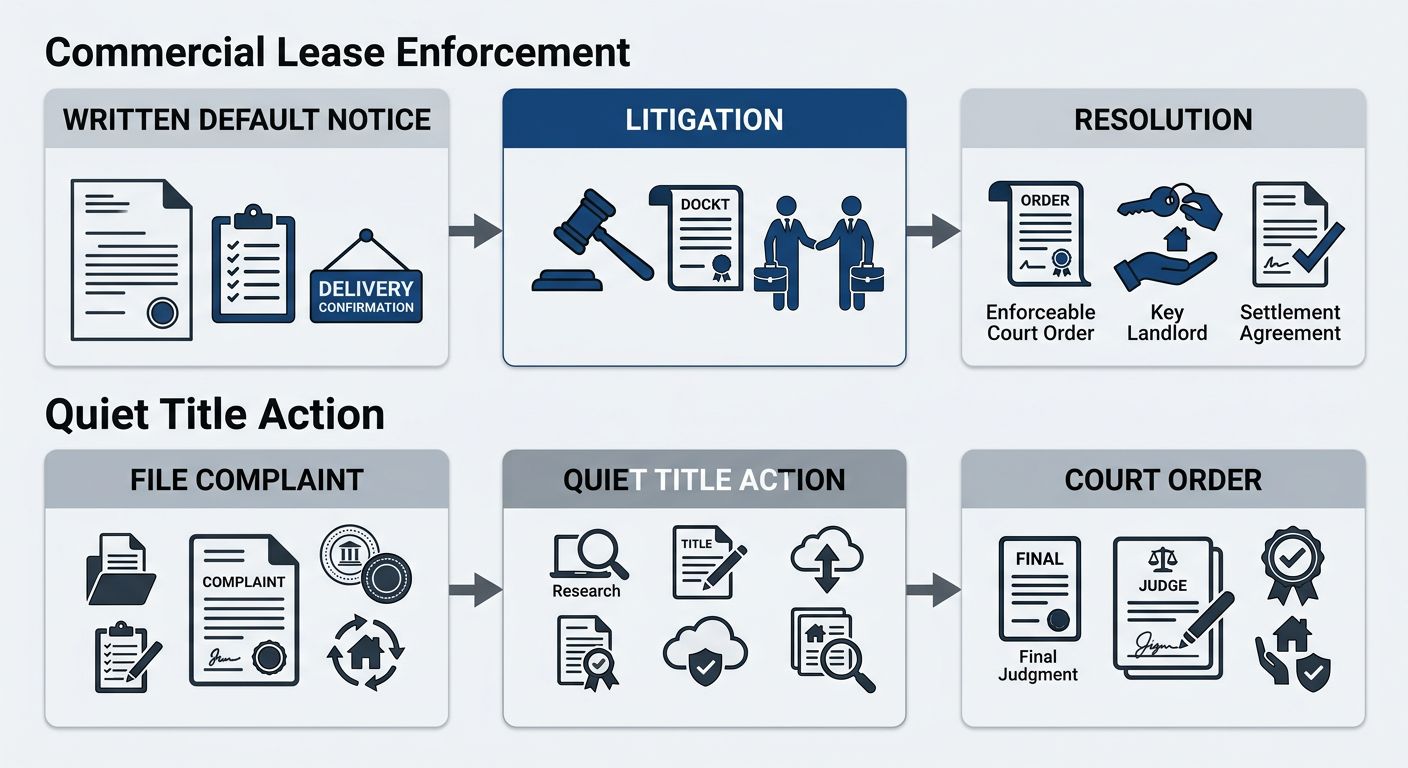
Comparison of lease enforcement and quiet title action procedures
This content is for informational purposes only and does not constitute legal advice. Contacting McCaslin Law, PC does not create an attorney-client relationship.
Advanced Strategies: Partnership Disputes, Broker Commissions, and Trial Preparation
Building on the fundamentals of commercial real estate conflicts, experienced commercial real estate dispute lawyers in Northern California employ advanced strategies to resolve complex partnership and commission disputes. These matters demand meticulous preparation and assertive courtroom advocacy to protect our clients’ interests.
Partnership disputes often stem from profit allocation disagreements, dissolution negotiations, or claims of breach of fiduciary duty. As outlined in McCaslin Law, PC’s partnership dispute FAQ, our commercial real estate litigation attorneys handle conflicts involving hidden profits, unauthorized asset transfers, and oppressive partner conduct. We thoroughly investigate each situation to build a strong case for trial or a favorable settlement.
Broker commission conflicts arise when entitlement is challenged, payments are withheld, or contractual language is ambiguous. Whether the issue involves commercial lease enforcement or a quiet title action to clear ownership rights, our real estate dispute counsel analyzes the contract and applicable law to hold parties accountable. We prepare each case as if it will go to verdict, leveraging our trial experience to drive resolution.
Trial preparation for these disputes demands organized evidence gathering, witness preparation, and strategic motion practice. We identify critical documents, depose key witnesses, and frame legal arguments early, ensuring no detail is overlooked. This disciplined approach maximizes outcomes whether the dispute ultimately goes before a judge, an arbitrator, or a mediator.
The following table contrasts three primary paths for resolving commercial real estate disputes:
| Approach | Key Considerations |
|---|---|
| Aggressive advocacy, precedent-setting, but costly and public | Trial |
| Private, faster, but limited appeal rights | Arbitration |
| Cost-effective, preserves relationships, but non-binding | Mediation |
Each option carries distinct benefits and risks. Our trial-first mentality means we prepare every case for litigation while remaining open to cost-effective alternatives when they serve our clients’ goals. This aggressive stance often strengthens our position during arbitration or mediation.
Our medical malpractice attorney brings the same aggressive advocacy and meticulous preparation to commercial real estate disputes, reflecting our firm-wide commitment to courtroom excellence. With these strategies in mind, the next step is to examine how we prepare for trial to maximize outcomes for our clients in Northern California.
This website is for informational purposes only and does not constitute legal advice. Contacting McCaslin Law, PC does not create an attorney-client relationship.
Frequently Asked Questions About Commercial Real Estate Disputes
After learning about the complexities of these matters, you likely have questions. The following answers address common concerns we hear from clients facing commercial real estate disputes.
What is a commercial real estate dispute?
A commercial real estate dispute is any legal conflict involving property used for business purposes. These disagreements arise between property owners, tenants, developers, or lenders and can involve issues from boundary lines to financing. Our commercial real estate dispute lawyers handle these matters with a trial-first mentality, preparing every case for the courtroom from day one.
What are common commercial lease enforcement issues?
Commercial lease enforcement covers scenarios where landlords or tenants fail to meet their contractual obligations, such as unpaid rent, unauthorized alterations, or early termination disputes. Remedies can include eviction proceedings, monetary damages, or specific performance of the lease terms. We approach commercial lease enforcement aggressively, protecting your business interests through decisive legal action.
What is a quiet title action?
A quiet title action is a lawsuit filed to establish clear ownership of real property and resolve competing claims or clouds on the title. It is especially useful in boundary disputes, lien challenges, or when a property’s chain of title contains errors. The quiet title action process demands meticulous preparation, and our firm litigates these claims with the exhaustive attention they require.
How can a lawyer help with my commercial real estate dispute?
An experienced litigation lawyer identifies your legal rights, evaluates the strength of your position, and develops a strategy for resolution through negotiation or trial. We provide direct attorney involvement, so you work with seasoned counsel at every stage. You can check our standing with the State Bar of California for further confidence.
What should I do if I am involved in a commercial lease dispute?
Document all communications and gather your lease agreement, payment records, and any correspondence with the other party. Then contact a qualified litigation firm promptly to understand your options before critical deadlines pass.
If these answers raise additional questions, we encourage you to reach out directly. Every situation is unique, and we are here to provide clarity and aggressive advocacy for your commercial real estate challenges.
This website is for informational purposes only and does not constitute legal advice. Contacting McCaslin Law, PC does not create an attorney-client relationship. Prior results do not guarantee similar outcomes.
Securing Experienced Representation for Your Commercial Real Estate Dispute
When you face a complex property conflict, you need skilled representation from lawyers who handle these matters every day. Our firm brings a trial-first mentality and aggressive advocacy to every case, drawing on decades of Northern California courtroom experience. We have a record of proven success against well-funded defense teams in purchase and sale agreement disputes, commercial lease enforcement, quiet title action, and related litigation. Strategic, meticulous preparation defines our approach. Boutique Litigation. Formidable Results.
Resources
- Sue Insurers for Bad Faith in California
- Find a Real Estate Litigation Attorney in Sacramento
- Tips for Evaluating Medical Malpractice Attorneys
- Investigate Truck Accident Liability in Oakland
- Understand California Workers Compensation Exclusions
- Real Estate Litigation Services for Boundary Disputes
- Find a Business Contract Dispute Lawyer in Sacramento
- American Bar Association Information and Resources
- California Judicial Branch Court Information and Services
- State Bar of California Lawyer Regulation and Resources