Northern California Civil & Real Estate Litigation | McCaslin Law

Category: Real Estate Law

  • Top 5 Partition Action Lawyers Sacramento for 2026

    Top 5 Partition Action Lawyers Sacramento for 2026

    Table of Contents

    Partition Action Lawyer in Sacramento, California: Protecting Your Property Rights

    When co-owners of real estate cannot agree on the future of their property, a partition action becomes the legal remedy to resolve the impasse. As experienced partition action lawyers in Sacramento, we provide aggressive advocacy to protect your financial interests and bring these disputes to a decisive conclusion. We are a firm of real estate litigation attorney in Sacramento professionals who understand that property represents more than an asset—it is often your most significant investment.

    A partition action is a court-ordered proceeding to divide or force the sale of jointly owned real estate. In California, this occurs through one of two methods: partition in kind, where the property is physically divided among co-owners, or partition by sale, which is far more common. Under a forced sale of jointly owned property California proceeding, the court typically appoints a neutral partition referee California to market and sell the home or land, then distribute the net proceeds according to each owner’s interest. Common disputes leading to partition actions include inherited family homes where siblings disagree, or investment properties where business partners have irreconcilable differences.

    We approach every partition dispute with a trial-first mentality, preparing each case as though it will proceed to verdict. This rigorous preparation, combined with our extensive Northern California courtroom experience, positions our clients for favorable resolutions. Our Sacramento partition action attorney works directly with you at every stage, ensuring you understand your rights and the path forward.

    If you are ready to resolve a co-ownership dispute, contact our office to schedule a consultation. Please note that contacting McCaslin Law, PC does not create an attorney-client relationship. This website is for informational purposes only and does not constitute legal advice. Prior results do not guarantee similar outcomes.

    Understanding Partition Actions in the Sacramento Real Estate Market

    When co-ownership disputes in Sacramento real estate become intractable, a partition action provides the legal pathway forward. As California court resources for partition explain, this remedy allows co-owners to petition the court for resolution when they cannot agree on the use or disposition of jointly held property. For those seeking partition action lawyers in Sacramento, understanding the two primary forms of partition is essential before pursuing a claim.

    Partition by sale is the more common remedy in Sacramento disputes. The property is sold on the open market, and the net proceeds are divided among the co-owners according to their respective ownership interests. This approach is typically ordered when the property cannot be physically divided — think single-family homes or condominiums — or when division would significantly diminish its market value. A forced sale of jointly owned property in California is a statutory right, and courts routinely appoint a partition referee to manage the listing, sale, and distribution of funds under court supervision.

    Partition in kind, by contrast, involves physically dividing the property among the co-owners. This remedy is reserved for situations where the property can be split without substantial loss of value, such as large undeveloped parcels or certain multi-unit structures. The partition referee in California may still play a role here, particularly when appraisals or surveys are required, though the process can be straightforward enough to proceed without one.

    The following table compares these two approaches as they apply to Sacramento real estate disputes:

    Comparing Partition Action Types for Sacramento Properties
    ConsiderationPartition by SalePartition in Kind
    OutcomeProperty sold, proceeds divided among co-ownersPhysical division of property among co-owners
    Best ForWhen co-owners cannot agree on property use or divisionWhen property can be divided without losing value
    ComplexityModerate; involves listing, sale, and distributionHigh; requires appraisal and physical division
    Role of RefereeCourt-appointed referee oversees sale processMay not require referee if division is straightforward

    Choosing between these options depends on several Sacramento-specific factors — property type, market conditions, and the nature of the co-owners’ relationship all influence which approach a court is likely to endorse. We help property owners evaluate these variables and pursue the remedy best suited to their needs.
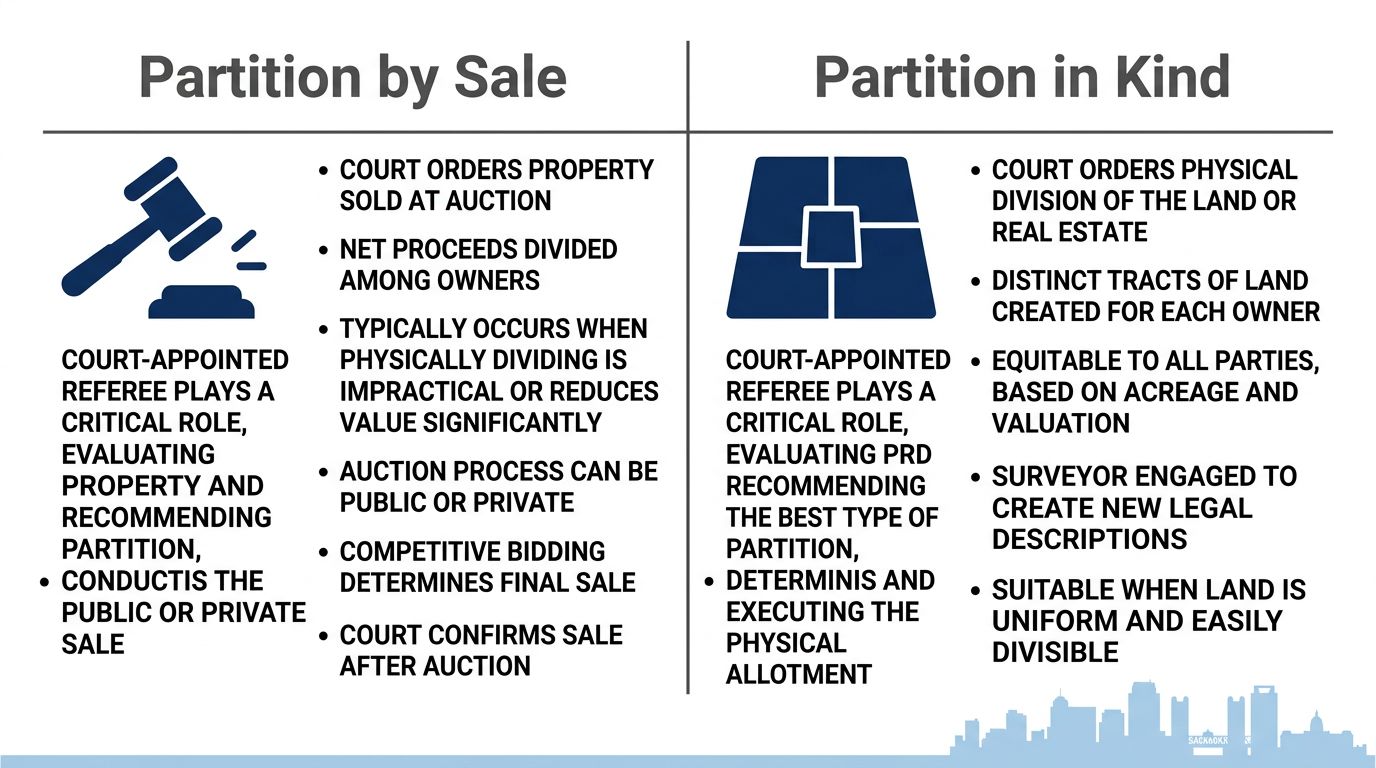
    Infographic comparing partition by sale and partition in kind in the Sacramento real estate market
    Comparison of partition by sale and partition in kind actions

    In our experience, most Sacramento partition lawsuits conclude with a sale, particularly for residential properties where physical division is impractical. The court-appointed referee serves as a neutral third party who handles the practicalities — from engaging a real estate broker to approving the final sale terms — ensuring that the process remains fair and transparent for all co-owners. Once the partition action concludes, the focus shifts to executing the court’s order, a process we guide clients through at every stage.

    For property owners seeking partition action lawyers in Sacramento, McCaslin Law, PC provides aggressive representation in the Sacramento County Superior Court. A partition action is a legal mechanism that allows co-owners of real property to force the division or sale of the asset when they cannot agree on its disposition. We prepare every case with a trial-first mentality, ensuring that our clients are positioned for a favorable outcome from the outset.

    Under California law, a partition may be sought either in kind, where the property is physically divided among the owners, or by sale, which is more common when division is impractical. We handle both residential and commercial disputes, guiding clients through the complexities of a forced sale of jointly owned property in California. Our team manages all phases of litigation, from initial demand letters through trial, so that co-owners can resolve deadlocks efficiently.

    When a court orders a partition by sale, it typically appoints a partition referee to oversee the marketing and sale of the property. We assist clients in selecting a qualified partition referee lawyer in California through services such as the State Bar referral program. Because the referee’s role is critical to achieving a fair sales price, we aggressively advocate for our client’s interests at every hearing and negotiation. This approach reflects our core belief in excellence in litigation, relentless in pursuit, resolute in defense.

    Key Local Factors in Sacramento Partition Lawsuits

    For co-owners facing a deadlock over real estate, partition action lawyers in Sacramento understand that local market conditions heavily influence case strategy. High property values throughout the region often make a forced sale of jointly owned property California’s most practical remedy, as physical division of a single-family home or commercial building is rarely feasible. When a negotiated buyout fails, our firm moves decisively to file in Sacramento Superior Court, where judges typically appoint a partition referee California law empowers to manage the property’s appraisal, marketing, and sale under court supervision. Common disputes leading to these actions include siblings inheriting a family home, estranged spouses dividing rental investments, or business partners dissolving a real estate holding. Property damage can further complicate matters, especially when an insurer acts unreasonably—understanding california bad faith insurance claims becomes critical when claim delays stall a partition sale. Understanding these local factors helps explain why choosing a partition action lawyer familiar with Sacramento’s courts and real estate market is crucial for an efficient resolution.

    Steps to Begin Your Partition Action Case with McCaslin Law

    When a co-ownership dispute becomes intractable, reaching out to experienced partition action lawyers in Sacramento is the essential first step. McCaslin Law brings a Boutique Litigation. Formidable Results. approach to each case, and our attorneys are licensed and regulated by the State Bar of California.

    • Initial consultation: Contact us to schedule a free, confidential discussion. Meanwhile, assemble your title, deed, co-ownership agreements, and correspondence so we can begin evaluating your situation efficiently.
    • Strategy session: We determine whether a forced sale of jointly owned property in California or a partition in kind makes sense, and then outline the legal path ahead.
    • Complaint filing: Once you retain us, we draft and file the partition complaint in the proper California superior court. Our trial-first mentality drives preparation from day one.
    • Referee oversight: When the court appoints a partition referee in California, our aggressive advocacy ensures the sale or division is fair — because we are Excellence in Litigation. Relentless in Pursuit. Resolute in Defense.

    Our firm also handles personal injury claims — see our slip & fall attorney FAQ page for a sample.

    Contact McCaslin Law to start. The information here is general; visiting our website does not create an attorney-client relationship. Reach out to discuss your unique case.

    Secure Your Property Interests with Experienced Counsel

    For partition action lawyers Sacramento, the protection of your ownership stake begins with strategic legal planning. We guide clients through the complexities of a forced sale of jointly owned property in California, ensuring your financial interests remain the primary focus.

    A court-appointed partition referee in California oversees the division or sale, but our team’s Trial-first mentality ensures every preparation is made for a decisive outcome. We deliver Aggressive advocacy to secure favorable terms, though contacting us does not create an attorney-client relationship and prior results do not guarantee similar outcomes.

    Now let’s examine how these strategies are applied in real-world disputes.

    Resources

  • Best Commercial Real Estate Dispute Lawyers in Sacramento

    Best Commercial Real Estate Dispute Lawyers in Sacramento

    Table of Contents

    Commercial real estate law is complex and high-stakes, requiring experienced commercial real estate dispute lawyers who understand the unique legal landscape in Northern California. At McCaslin Law, PC, we represent property owners, commercial tenants, developers, and investors in a wide range of commercial property conflicts. Our practice covers the full spectrum of disputes, including:

    • Commercial lease enforcement matters, such as breach of lease, unlawful detainer, and covenant disputes.
    • Purchase and sale agreement disputes involving financing, inspection, and closing issues.
    • Title, boundary, and easement conflicts, including quiet title action proceedings to resolve ownership claims.
    • Construction defect litigation over faulty work or materials in commercial projects.
    • Landlord-tenant litigation addressing eviction, habitability, and contract interpretation.

    Our Trial-first mentality and Aggressive advocacy set McCaslin Law, PC apart. With more than 25 years of Northern California courtroom experience, our commercial real estate dispute lawyers are intimately familiar with local judges, procedures, and the strategies that get results in venues like Sacramento, San Francisco, and the surrounding counties. Under the ethical guidelines of the American Bar Association, we prepare every commercial real estate dispute as if it will be tried, giving our clients leverage from day one. We provide tailored strategies and direct attorney involvement, ensuring that each matter receives the aggressive, prepared advocacy it deserves.

    In the following sections, we delve deeper into the specific categories of commercial real estate disputes, exploring how our firm navigates lease disputes, purchase agreement conflicts, and other real estate litigation.

    This content is for informational purposes only and does not constitute legal advice. Contacting McCaslin Law, PC does not create an attorney-client relationship.

    Understanding Common Triggers for Commercial Real Estate Litigation

    Commercial real estate transactions and property relationships are inherently complex, and when disputes arise, they often follow predictable patterns. Whether it’s a disagreement over lease terms, a boundary issue that clouds a property’s title, or a construction project that fails to meet expectations, these situations can rapidly escalate into formal litigation. When disputes escalate, commercial real estate dispute lawyers step in to resolve them. Understanding these common triggers helps property owners, tenants, and developers in California recognize when they may need aggressive legal representation.

    Common Triggers for Commercial Real Estate Litigation
    Trigger TypeKey Legal Issues
    Rent defaults, lease enforcement, valuation disagreements Lease Disputes
    Easement conflicts, boundary disputes, quiet title actions Title Disputes
    Defective work, delay damages, professional negligence Construction Defects

    This table provides a high-level view of the situations that frequently give rise to litigation. Each of these categories encompasses a range of specific conflicts, often involving breach of contract claims, property rights disputes, and negligence allegations. We see these patterns regularly in our practice, and recognizing them early can be critical to protecting your legal interests.

    Lease Disputes represent the most common trigger for commercial real estate litigation in our experience. These conflicts typically arise when one party fails to meet their contractual obligations under a commercial lease agreement. Rent defaults occur when a tenant stops making payments, forcing landlords to pursue legal remedies. Valuation disagreements can surface during rent escalations, renewal option exercises, or when calculating common area maintenance charges. Our firm has detailed resources on these topics—as explained in our Commercial Lease Enforcement FAQ, understanding the remedies available is essential. The legal issues in these cases center on breach of contract, and they often require commercial lease enforcement actions through the court system.

    Title Disputes involve conflicts over who holds legal ownership of a property or what rights attach to that ownership. Easement conflicts frequently arise when one party’s use of a driveway, utility line, or access road is challenged by a neighboring property owner. Boundary disputes can surface years after a transaction closes when a survey reveals encroachments or inaccuracies. When the chain of title is clouded or contested, a quiet title action may be necessary. These cases are filed in the California Judicial Branch, where a judge determines property rights and resolves competing claims. The core legal issues involve property law principles, and we approach these matters with the meticulous preparation they demand.

    Construction Defects frequently lead to litigation when completed work fails to meet contractual specifications or industry standards. Defective workmanship can range from structural deficiencies to substandard materials that compromise a building’s integrity. Delay damages become a contentious issue when projects extend beyond agreed timelines, resulting in lost revenue and additional carrying costs for property owners. Professional negligence claims may target architects, engineers, or contractors whose design or oversight failures contributed to the defects. These disputes typically involve breach of contract and tort-based claims, requiring thorough factual investigation and expert analysis.

    Recognizing these triggers is the first step toward protecting your interests. Our trial-first mentality means we evaluate every case as though it will proceed to verdict, positioning our clients for the strongest possible outcome. Understanding these triggers helps commercial real estate dispute lawyers address client needs effectively.

    This website is for informational purposes only and does not constitute legal advice.

    Resolving Complex Disputes: Lease Valuation, Partition Actions, and Quiet Title

    Complex commercial real estate disputes demand knowledgeable representation. At McCaslin Law, PC, we handle lease valuation disagreements, partition actions, and quiet title actions for clients throughout Northern California. We also litigate related matters such as California bad faith insurance claims, reflecting our comprehensive civil litigation practice.

    Commercial Lease Valuation Disagreements

    Commercial lease valuation disputes arise when landlords and tenants cannot agree on rent adjustments, market comparables, or space measurements. These disagreements often escalate into litigation, especially in ground leases or percentage rent arrangements. To resolve these conflicts, we employ negotiation, mediation, and, when the lease contains an appraisal clause, a binding third-party determination. Our approach to commercial lease enforcement is rooted in a trial-first mentality; we prepare every matter as though it will proceed to trial, leveraging aggressive advocacy to achieve favorable outcomes. We represent both landlords and tenants in disputes over rent resets, operating expense pass-throughs, and default remedies, always with an eye toward protecting our clients’ bottom lines.

    California Partition Actions for Commercial Property

    A partition action is a statutory remedy that allows co-owners of commercial property to force the division or sale of the asset when collaboration fails. California courts may order a physical partition if the property can be divided equitably, but for commercial real estate, a sale with proceeds distributed among owners is the more common result. We handle partition actions with aggressive advocacy, recognizing that these disputes often involve substantial financial stakes and deep personal conflicts. Our trial-first mentality means we prepare every partition case for courtroom resolution, whether that involves contested hearings over ownership shares, appraisals, or the terms of sale. We also work to minimize delay and expense by exploring buy-out negotiations and mediation when those avenues align with our clients’ goals.

    Quiet Title Actions: Clearing Clouds on Property Title

    A quiet title action is a court proceeding used to eliminate clouds on property title, such as competing claims, unreleased liens, or recording errors. According to our firm’s FAQ, a successful plaintiff must prove a superior right to the property and show that the defendant’s assertions lack legal merit. We litigate quiet title actions with meticulous attention to documenting chain of title and challenging adverse claims. Our trial-first mentality ensures that we are prepared to present compelling evidence and legal argument to the court. Because title defects can halt sales, financing, or development, we move swiftly to identify the source of the cloud and pursue resolution through negotiation or judgment. With aggressive advocacy, we seek not only to clear title but also to recover damages and attorney fees where permitted.

    The following table summarizes the three primary methods we use to resolve complex commercial real estate disputes in California.

    Comparison of Dispute Resolution Methods
    MethodKey Characteristics
    Negotiation, mediation, appraisal clause Lease Valuation
    Statutory proceeding, sale or division of property Partition Action
    Court action to clear title defects Quiet Title

    With a trial-first mentality and aggressive advocacy, McCaslin Law, PC delivers formidable results in lease valuation, partition, and quiet title matters. Contact us to discuss your commercial real estate dispute.

    Practical Steps for Lease Enforcement and Quiet Title Actions

    Once a dispute arises, taking the right procedural steps is critical. Whether facing a tenant default or a title defect, commercial real estate dispute lawyers provide the strategic guidance necessary to protect your interests. A real estate litigation attorney in Sacramento can help you navigate these complex procedures and pursue the most effective remedies.

    Enforcing Commercial Leases After a Default

    The first stage in commercial lease enforcement is issuing a written default notice that specifies the breach and allows the tenant a statutory cure period—typically three days for nonpayment of rent under California law. If the tenant fails to cure, the landlord may file an unlawful detainer action to regain possession or a breach-of-contract claim for money damages. We prepare each step with meticulous attention to the lease terms and local rules, ensuring that deadlines and procedural requirements are strictly observed. This systematic approach minimizes delays and strengthens your position for any subsequent litigation.

    Defending Against Lease Enforcement Actions

    Tenants facing enforcement can raise several common defenses. A claim of constructive eviction asserts that the landlord’s failure to maintain the premises made them uninhabitable, effectively forcing the tenant out. Another defense is failure to mitigate damages, arguing that the landlord did not take reasonable steps to re-rent the space after the default. Waiver may apply when the landlord accepts late payments or otherwise acts inconsistently with strict enforcement of the lease terms. We thoroughly evaluate the facts in every case to determine the viability of these defenses and craft a response tailored to the circumstances.

    Filing a Quiet Title Action: Requirements and Timeline

    A quiet title action is the legal mechanism to resolve disputes over who holds valid title to real property. In California, any person or entity claiming an interest in real estate may file, but the complaint must allege the nature of the claim, describe the property, and name all adverse claimants. After service and an opportunity to respond, the court examines the evidence and issues a judgment that declares the true owner and extinguishes competing claims. The process typically takes six to twelve months, though complex cases or crowded court dockets can extend the timeline. Success requires meticulous preparation and strict compliance with statutory requirements.

    Understanding the procedural differences between these remedies helps clarify which path to pursue.

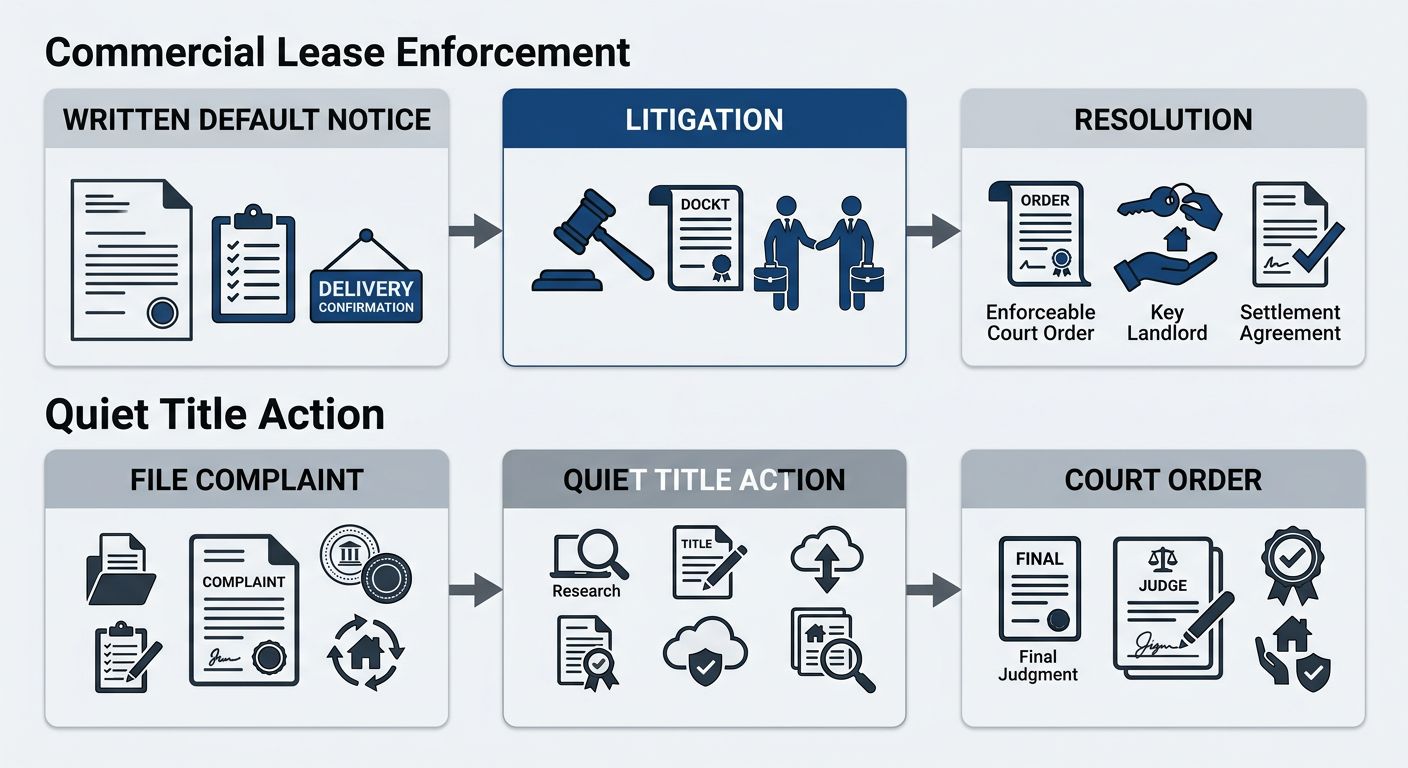
    Lease Enforcement vs Quiet Title Action Process
    StageKey Actions
    Lease: Written default notice; Quiet Title: File complaint Notice
    Lease: Unlawful detainer or breach of contract; Quiet Title: Quiet title action Litigation
    Lease: Possession + damages; Quiet Title: Court order clearing title Resolution

    The table highlights the distinct purposes each remedy serves. Lease enforcement focuses on restoring the landlord’s possessory rights and recovering unpaid sums, while a quiet title action establishes clear ownership and eliminates competing claims. Because both processes demand strict adherence to procedural rules and deadlines, partnering with experienced counsel significantly improves the likelihood of a favorable outcome.

    Horizontal process-flow infographic comparing Commercial Lease Enforcement and Quiet Title Action sequences, each with three stages connected by arrows, using a blue and grey professional color scheme.

    Comparison of lease enforcement and quiet title action procedures

    This content is for informational purposes only and does not constitute legal advice. Contacting McCaslin Law, PC does not create an attorney-client relationship.

    Advanced Strategies: Partnership Disputes, Broker Commissions, and Trial Preparation

    Building on the fundamentals of commercial real estate conflicts, experienced commercial real estate dispute lawyers in Northern California employ advanced strategies to resolve complex partnership and commission disputes. These matters demand meticulous preparation and assertive courtroom advocacy to protect our clients’ interests.

    Partnership disputes often stem from profit allocation disagreements, dissolution negotiations, or claims of breach of fiduciary duty. As outlined in McCaslin Law, PC’s partnership dispute FAQ, our commercial real estate litigation attorneys handle conflicts involving hidden profits, unauthorized asset transfers, and oppressive partner conduct. We thoroughly investigate each situation to build a strong case for trial or a favorable settlement.

    Broker commission conflicts arise when entitlement is challenged, payments are withheld, or contractual language is ambiguous. Whether the issue involves commercial lease enforcement or a quiet title action to clear ownership rights, our real estate dispute counsel analyzes the contract and applicable law to hold parties accountable. We prepare each case as if it will go to verdict, leveraging our trial experience to drive resolution.

    Trial preparation for these disputes demands organized evidence gathering, witness preparation, and strategic motion practice. We identify critical documents, depose key witnesses, and frame legal arguments early, ensuring no detail is overlooked. This disciplined approach maximizes outcomes whether the dispute ultimately goes before a judge, an arbitrator, or a mediator.

    The following table contrasts three primary paths for resolving commercial real estate disputes:

    Litigation vs Alternative Dispute Resolution
    ApproachKey Considerations
    Aggressive advocacy, precedent-setting, but costly and public Trial
    Private, faster, but limited appeal rights Arbitration
    Cost-effective, preserves relationships, but non-binding Mediation

    Each option carries distinct benefits and risks. Our trial-first mentality means we prepare every case for litigation while remaining open to cost-effective alternatives when they serve our clients’ goals. This aggressive stance often strengthens our position during arbitration or mediation.

    Our medical malpractice attorney brings the same aggressive advocacy and meticulous preparation to commercial real estate disputes, reflecting our firm-wide commitment to courtroom excellence. With these strategies in mind, the next step is to examine how we prepare for trial to maximize outcomes for our clients in Northern California.

    This website is for informational purposes only and does not constitute legal advice. Contacting McCaslin Law, PC does not create an attorney-client relationship.

    Frequently Asked Questions About Commercial Real Estate Disputes

    After learning about the complexities of these matters, you likely have questions. The following answers address common concerns we hear from clients facing commercial real estate disputes.

    What is a commercial real estate dispute?

    A commercial real estate dispute is any legal conflict involving property used for business purposes. These disagreements arise between property owners, tenants, developers, or lenders and can involve issues from boundary lines to financing. Our commercial real estate dispute lawyers handle these matters with a trial-first mentality, preparing every case for the courtroom from day one.

    What are common commercial lease enforcement issues?

    Commercial lease enforcement covers scenarios where landlords or tenants fail to meet their contractual obligations, such as unpaid rent, unauthorized alterations, or early termination disputes. Remedies can include eviction proceedings, monetary damages, or specific performance of the lease terms. We approach commercial lease enforcement aggressively, protecting your business interests through decisive legal action.

    What is a quiet title action?

    A quiet title action is a lawsuit filed to establish clear ownership of real property and resolve competing claims or clouds on the title. It is especially useful in boundary disputes, lien challenges, or when a property’s chain of title contains errors. The quiet title action process demands meticulous preparation, and our firm litigates these claims with the exhaustive attention they require.

    How can a lawyer help with my commercial real estate dispute?

    An experienced litigation lawyer identifies your legal rights, evaluates the strength of your position, and develops a strategy for resolution through negotiation or trial. We provide direct attorney involvement, so you work with seasoned counsel at every stage. You can check our standing with the State Bar of California for further confidence.

    What should I do if I am involved in a commercial lease dispute?

    Document all communications and gather your lease agreement, payment records, and any correspondence with the other party. Then contact a qualified litigation firm promptly to understand your options before critical deadlines pass.

    If these answers raise additional questions, we encourage you to reach out directly. Every situation is unique, and we are here to provide clarity and aggressive advocacy for your commercial real estate challenges.

    This website is for informational purposes only and does not constitute legal advice. Contacting McCaslin Law, PC does not create an attorney-client relationship. Prior results do not guarantee similar outcomes.

    Securing Experienced Representation for Your Commercial Real Estate Dispute

    When you face a complex property conflict, you need skilled representation from lawyers who handle these matters every day. Our firm brings a trial-first mentality and aggressive advocacy to every case, drawing on decades of Northern California courtroom experience. We have a record of proven success against well-funded defense teams in purchase and sale agreement disputes, commercial lease enforcement, quiet title action, and related litigation. Strategic, meticulous preparation defines our approach. Boutique Litigation. Formidable Results.

    Resources

  • Top Northern California Contract Dispute Litigation Firms 2026

    Top Northern California Contract Dispute Litigation Firms 2026

    Table of Contents

    Northern California’s economic diversity generates a wide range of northern california contract dispute litigation, from tech innovations to agricultural supply conflicts. When contractual commitments unravel, business owners need seasoned civil litigation in Northern California to navigate state and federal courts.

    Courts impose distinct procedural demands—complex case departments, mandatory settlement conferences, and aggressive discovery timelines. Effective civil litigation in Northern California requires mastering these processes while integrating expert witness strategy. For real estate litigation in Northern California arising from failed purchase agreements, this mastery is critical. Our trial-first mentality, grounded in the American Bar Association’s litigation standards, often shifts settlement dynamics decisively. This approach often leads to earlier, more favorable resolutions. Protecting cash flow and market position requires a litigator who prepares for trial from day one. Whether facing a breach of contract or a complex commercial impasse, structured litigation planning remains the surest path to a decisive resolution.

    The Northern California Litigation Environment

    For businesses and individuals facing northern california contract dispute litigation, the region’s court systems present both strategic opportunities and procedural challenges.

    Key Court Systems and Venues

    Northern California’s litigation framework comprises two federal district courts—the Eastern District, covering Sacramento, Fresno, and Eastern counties, and the Northern District, centered in San Francisco—alongside county-level Superior Courts like Sacramento and San Francisco. Our experience in civil litigation in Northern California informs strategic venue selection.

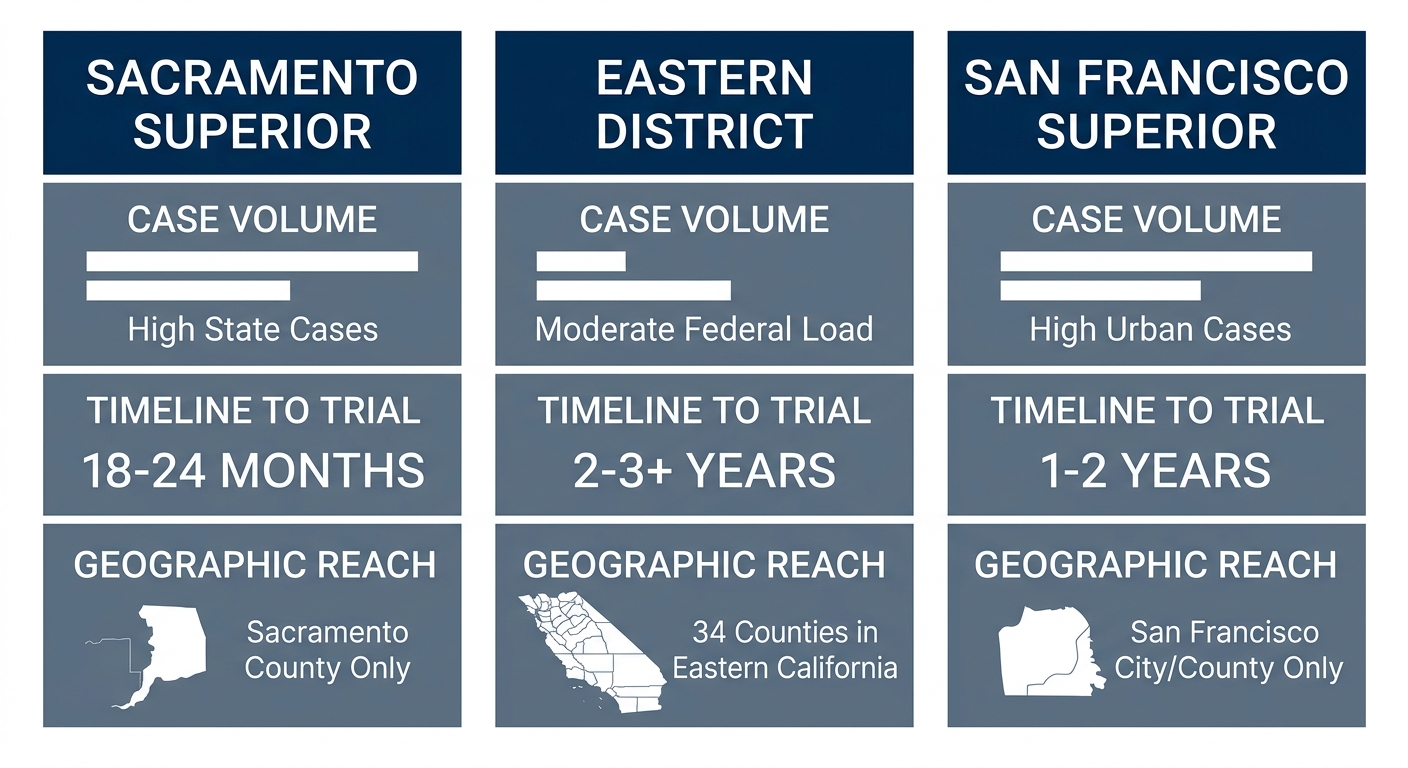
    Venue Comparison for Northern California Contract Disputes
    ConsiderationSacramento County Superior CourtU.S. District Court, Eastern District of CASan Francisco County Superior Court
    Case VolumeHigh volume, local disputesModerate volume, federal questionsVery high volume, diverse docket
    Typical Timeline to Trial12-18 months18-24 months12-24 months
    Key Geographic ReachSacramento CountySacramento, Fresno, and Eastern countiesSan Francisco County
    Firm ExperienceExtensive trial experienceActive federal court practiceFamiliarity with complex procedures

    Timelines are estimates based on public court data and can vary significantly based on case complexity and court resources.

    The Sacramento County Superior Court’s typical 12–18 month timeline to trial compresses every phase of litigation, demanding immediate and intensive preparation. In contrast, the U.S. District Court for the Eastern District’s 18–24 month runway provides more time for discovery but requires sustained attention to complex federal procedure. Our trial-first mentality ensures that from the moment a complaint is filed, we calibrate discovery plans, dispositive motions, and expert retention to the court’s anticipated schedule, rather than scrambling near trial. This proactive calibration, coupled with our active federal court practice, transforms procedural deadlines into strategic advantages.

    Comparative infographic highlighting key characteristics of three Northern California trial courts, including case volume, timeline to trial, and geographic reach for Sacramento County, Eastern District of California, and San Francisco County.

    Comparative overview of key Northern California litigation venues and their average case profiles.

    These venue-specific pressures explain why the triggers for business disputes require a similarly strategic approach.

    Common Triggers for Business and Contract Disputes

    Growth-related partnership dissolutions, breaches of complex commercial purchase-and-sale agreements, and real estate litigation in Northern California frequently drive business litigation in this region. Northern California real estate litigation matters—from construction defects to easement disputes—further populate the dockets of both state and federal courts. Recognizing these patterns allows us to anticipate opposing tactics and build a case narrative from the very first client meeting.

    The Role of a Trial-Ready Firm from Day One

    Our trial-first mentality is not mere bravado—it is a strategic imperative. With timelines that can sprint from filing to verdict in as little as 12 months, litigation demands aggressive advocacy from inception. We embrace the credo “Boutique Litigation. Formidable Results.” by conducting early depositions, engaging experts immediately, and filing dispositive motions at the earliest opportunity. This approach maximizes leverage and positions clients to either force a favorable settlement or prevail at trial.

    Comprehensive Litigation Services Available

    McCaslin Law, PC delivers civil litigation northern california through three core practice areas: contract disputes, real estate litigation, and insurance coverage advocacy.

    Contract and Commercial Dispute Resolution

    Our northern california contract dispute litigation covers partnership and shareholder conflicts, breach of fiduciary duty claims, and purchase and sale agreement disputes. We represent businesses, owners, and shareholders throughout the region, developing meticulous pre-trial strategies with direct partner involvement. We apply aggressive advocacy in discovery and motion practice and prepare every commercial case as if trial is inevitable.

    Real Estate and Property-Based Litigation

    Our northern california real estate litigation practice addresses title, boundary, and easement controversies; construction defect claims; landlord-tenant disputes; and commercial lease disagreements. We represent property owners, developers, landlords, and tenants across Northern California, leveraging deep familiarity with local courts. As a core part of our civil litigation northern california practice, we prepare every real estate matter for trial from day one, drawing on our extensive northern california real estate litigation experience.

    Insurance Coverage and Bad Faith Advocacy

    We represent policyholders in business interruption claims, coverage disputes, and bad faith insurance practices. Our firm pursues full contractual benefits and extra-contractual damages when legally warranted. While our insurance litigation practice focuses on commercial coverage and bad faith claims, matters such as workers compensation in California fall outside our scope. Every insurance matter is prepared with a trial-first mentality to secure the recovery you deserve.

    We also handle personal injury and products liability matters, demonstrating our civil litigation breadth. Our trial-first approach readies us for any dispute.

    Local Strategic Considerations for Northern California Litigants

    In northern california contract dispute litigation, local procedural knowledge is decisive.

    The discovery phase presents unique leverage for litigants in civil litigation northern california. California’s Civil Discovery Act allows us to strategically deploy Form Interrogatories and Requests for Admission, building a formidable evidentiary foundation that pressures opposing parties into settlement. In limited civil cases, we constrain discovery to hone the most compelling narrative, aligning with our trial-first mentality. This command over local rules directly shapes the evidence a jury will hear, often dictating the outcome. By preparing every case as if it will be tried, we turn procedural advantage into courtroom results.

    Understanding Attorney Fee Recovery Provisions

    Litigation costs can be as decisive as the legal merits, especially in northern california real estate litigation. California Code of Civil Procedure § 1032 defines the prevailing party, and Civil Code § 1717 allows fee recovery in contract actions, but local judicial discretion often tempers outcomes. Our aggressive advocacy ensures clients prepare cost memorandums and align fee provisions with the American Bar Association legal resources from the start. By embedding fee recovery strategies into trial preparation, we proactively shift leverage before trial, ensuring every dollar spent is a calculated investment.

    Initiating Your Litigation Strategy

    When a business dispute intensifies, initiating a northern California contract dispute litigation strategy is essential. Selecting the right counsel and taking immediate practical steps can shape the outcome of your case.

    When choosing a litigation firm in Northern California, evaluate these critical criteria. A trial-first mentality—preparing every case as though it will go to trial—often leads to better settlements. McCaslin Law, PC recommends focusing on these criteria:

    • Demonstrated trial experience in the specific county where your dispute will be heard.
    • Direct access to the lead attorney, not just paralegals, throughout the matter.
    • A proven track record of meticulous preparation in similar commercial cases.

    Verify an attorney’s standing through the State Bar of California attorney directory; this ensures a current license and no disciplinary record. This framework applies to all commercial matters, including civil litigation in Northern California and northern California real estate litigation.

    Steps to Take When Facing a Contract Dispute

    When a contract dispute arises, swift and methodical action is crucial. McCaslin Law, PC outlines these key steps:

    1. Immediately preserve all written communications – emails, texts, and letters should be saved.
    2. Organize the contract and any amendments in chronological order.
    3. Create a detailed timeline of events and collect financial records evidencing losses.
    4. Contact McCaslin Law, PC for a confidential evaluation. Submitting a contact request does not create an attorney-client relationship, but it does initiate a confidential assessment of your litigation strategy.

    This methodical preparation extends to all our commercial practice areas, from civil litigation throughout Northern California to northern California real estate litigation.

    We bring a trial-first approach to every northern california contract dispute litigation matter, preparing each case for verdict. Our civil litigation practice in Northern California employs early discovery, motions, and evidence gathering, leveraging decades of courtroom experience to secure decisive advantages for clients. This trial readiness forces adversaries to recognize our resolve, often resulting in higher settlements—even in northern california real estate litigation matters. We deliver decisive outcomes—Boutique Litigation. Formidable Results.

    This article was researched and written with the assistance of AI tools.

    Resources

  • Best Business Litigation Attorney: Compare Top Dispute Lawyers

    Table of Contents

    Understanding the Role of a Business Litigation Attorney in Sacramento, California

    We are a Sacramento-based firm that focuses exclusively on resolving high-stakes commercial conflicts. A business litigation attorney in Sacramento, California is a legal professional who dedicates their practice to representing companies and business owners in complex disputes, distinguishing them from a general practitioner by their deep understanding of commercial law and local court procedures.

    Our firm’s trial-first mentality means we strategize every case as if it will go to verdict, which positions our clients for maximum advantage. As a dedicated business dispute lawyer, we handle a wide array of commercial matters, including contract and business disputes, partnership and shareholder conflicts, and breach of fiduciary duty claims. A skilled commercial litigation attorney from our firm will also litigate purchase and sale agreement disputes with the aggressive advocacy needed to protect your enterprise’s future. This preparation provides a crucial edge, as it demonstrates to opposing counsel that we are fully ready to present a compelling case in a Sacramento courtroom.

    Our attorneys bring extensive Northern California courtroom experience to every representation. While our primary focus is resolving business conflicts, we also understand that commercial interests can intersect with other legal areas, and our team can assist with related issues such as workers compensation in California. We encourage you to schedule a consultation to discuss how our aggressive advocacy can serve your business goals.

    Fundamentals: Business Litigation vs. Corporate Law in Sacramento

    To better understand how we can assist with your legal needs, it helps to distinguish between two key areas of legal practice: business litigation and corporate law. When searching for a business litigation attorney in Sacramento, recognizing this difference is the first step toward finding the right advocate for your specific situation. Our firm focuses exclusively on the litigation side, bringing a trial-first mentality to every dispute we handle.

    The following table highlights the fundamental differences between these two distinct practice areas.

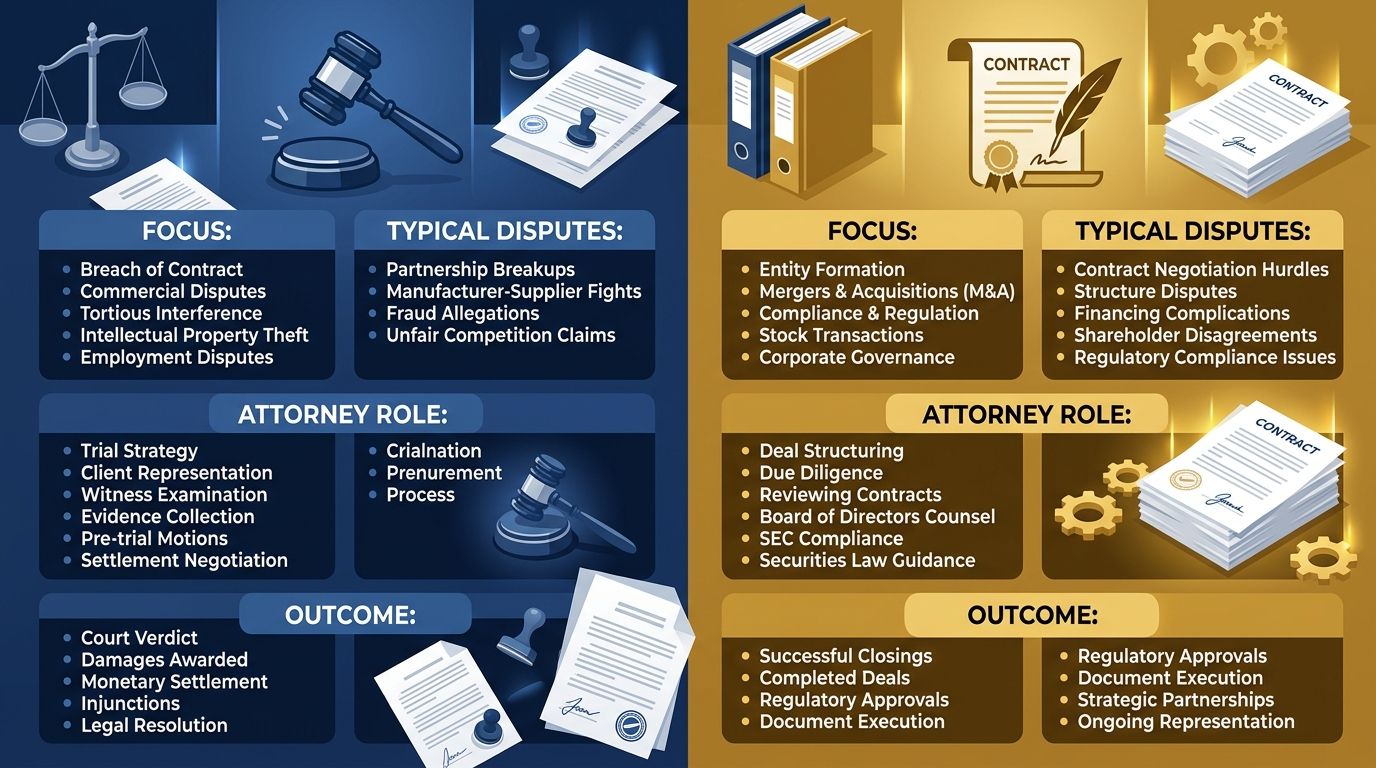
    Comparison: Business Litigation vs. Corporate Law
    AspectBusiness LitigationCorporate Law
    FocusResolving disputes through the court system, trial advocacy, and negotiation under litigation pressure.Structuring transactions, compliance, contracts, mergers, and ongoing business advice.
    Typical DisputesBreach of contract, partnership dissolutions, fraud, tort claims, real estate disputes.Rarely litigated; focus is on avoiding disputes through careful drafting.
    Attorney RoleAdvocate in court, strategist for trial, motion practice, discovery.Advisor, drafter, negotiator for transactions.
    OutcomeCourt judgment, settlement after filing, or jury verdict.Signed contract, successful merger, ongoing compliance.

    Based on McCaslin Law expertise and California Bar Association legal guides, this comparison underscores how different each path truly is. Understanding these distinctions is essential before moving forward with legal action.

    Business litigation is the process of resolving disputes through the court system, involving trial advocacy, motion practice, and discovery. A commercial litigation attorney manages disputes like real estate conflicts and tort claims, drawing on extensive courtroom experience. In contrast, corporate law focuses on structuring transactions and ensuring compliance, with corporate lawyers rarely setting foot in a courtroom. Their primary role is risk avoidance through precise drafting.

    Comparison infographic with two sections: business litigation on the left with gavel icon, corporate law on the right with contract icon, each listing focus areas and outcomes in color-coded boxes

    Side-by-side comparison of business litigation and corporate law differences

    A business litigation attorney focuses on courtroom advocacy, representing clients in civil litigation that includes breach of contract, partnership dissolutions, and shareholder conflicts. Meanwhile, a business dispute lawyer handles partnership dissolutions and breach of contract claims, working to secure court judgments or settlements. Outcomes in litigation include jury verdicts or negotiated resolutions, while corporate law yields signed agreements and ongoing compliance.

    Now that you understand the distinction, we want you to know that McCaslin Law is equipped to handle your disputes in Sacramento with aggressive advocacy and meticulous preparation. While this section focuses on business litigation fundamentals, we also represent clients in related areas such as personal injury and products liability — if you need a defective products lawyer in San Francisco, our firm has the experience to handle those claims as well.

    Deep Dive: Commercial Litigation and Contract Disputes in Sacramento

    Now let’s take a closer look at the specific types of litigation we handle and how we approach complex disputes. As a business litigation attorney in Sacramento, we understand that legal conflicts between companies require a fundamentally different approach than disputes involving individuals.

    Commercial Litigation vs. Civil Litigation: What Sets Them Apart?

    Commercial litigation involves disputes between businesses or business entities, including corporations, LLCs, and partnerships. Civil litigation is a broader category that typically involves individuals or individuals versus businesses. For example, a slip & fall attorney handles premises liability cases that fall under civil litigation rather than commercial. The distinction matters because commercial cases often involve higher stakes, larger financial exposure, and more complex discovery than standard civil litigation.

    The following table illustrates the key distinctions between these two practice areas.

    Comparison: Commercial Litigation vs. Civil Litigation
    AspectCommercial LitigationCivil Litigation
    Parties InvolvedBusinesses, corporations, LLCs, partnerships.Individuals, individuals vs. businesses, government entities.
    Types of ClaimsBreach of contract, business torts, shareholder oppression, UCL claims.Personal injury, employment disputes, property damage, family law.
    ComplexityOften complex, involving multiple parties and voluminous discovery.Ranges from simple to complex; can involve same procedural rules.
    Potential AwardsHigh-value damages, lost profits, specific performance.Compensatory damages, punitive damages in some cases.
    Litigation StrategyFocus on business impact, loss mitigation, and expedited resolutions.Often more focused on individual compensation.

    While both types of cases may proceed through the same court system, the strategic considerations differ significantly. A business dispute lawyer must account for ongoing business relationships, reputational concerns, and the financial realities of the corporate client. Our Trial-first mentality means we prepare every case as though it will go to verdict, regardless of whether it is a commercial or civil matter.

    Common Cases Handled by Commercial Litigation Attorneys

    Our firm handles a range of disputes that a business litigation attorney in Sacramento regularly encounters. The most frequent case types include:

    • Breach of contract: When one party fails to perform under the terms of a written or oral agreement, resulting in financial harm to the other party.
    • Partnership and shareholder disputes: Including shareholder oppression claims where majority owners act against the interests of minority shareholders.
    • Purchase and sale agreement disputes: Conflicts arising from the sale of a business, including allegations of misrepresentation or failure to disclose material information.
    • Real estate litigation: Covering title, boundary, and easement disputes, as well as commercial lease disputes between landlords and tenants.
    • Breach of fiduciary duty claims: When a partner, officer, or director breaches the duty of loyalty or care owed to the business or its owners.

    California Civil Code and the California Business and Professions Code may apply to many of these claims, though the specific statutory framework depends on the facts of each case. Our litigation counsel evaluates every matter individually to determine the most effective strategy.

    How a Commercial Litigation Attorney Approaches a Contract Dispute

    When a business dispute arises, our process follows a structured path designed to maximize leverage and position the case for success. A commercial litigation attorney on our team begins with a detailed demand letter and pre-litigation negotiation, clearly outlining the client’s position and the legal basis for the claim.

    If pre-litigation resolution is not possible, we proceed to filing the complaint and service of process, formally initiating the lawsuit. The discovery phase follows, including document production, interrogatories, and depositions. This stage is often the most intensive, as we uncover the evidence that will drive the case forward.

    Pretrial motions and settlement conferences occur throughout the litigation, and we prepare for each with the same Trial-first mentality that defines our practice. From day one, we build each case as though it will be tried to verdict, which strengthens our position in settlement negotiations and ensures we are never caught unprepared. Trial preparation and the trial itself represent the culmination of this process, where our aggressive advocacy comes to the forefront.

    Understanding the commercial litigation process is the first step; let’s explore how we handle each phase from demand letter to trial.

    This website is for informational purposes only and does not constitute legal advice.

    Practical Guide: Choosing a Business Litigation Attorney in Sacramento, California

    This guide is for informational purposes and does not constitute legal advice.

    Choosing the right business litigation attorney in Sacramento is a critical decision that can significantly influence the trajectory of a commercial dispute. For business owners and managers navigating contract breaches, partnership disagreements, or other commercial conflicts, having a skilled legal advocate is essential. This practical guide outlines the key factors to evaluate, the questions to ask, and the fee structures to understand, helping you make an informed and confident choice when selecting legal representation in Northern California.

    Key Factors to Consider When Evaluating Candidates

    To narrow down your choices, consider these key factors when evaluating a potential litigation counsel:

    • Experience in Similar Business Litigation Cases: Look for a lawyer with a proven history in handling matters identical to yours, such as contract disputes or shareholder disagreements. A seasoned business dispute lawyer will understand the nuances of California commercial law and be better equipped to develop an effective strategy.
    • Trial Track Record: We believe a trial-first mentality is crucial. An attorney’s willingness and ability to take a case to verdict often strengthens negotiation positions and can lead to more favorable resolutions, even without setting foot in a courtroom.
    • Communication Style: Effective representation requires clear, consistent, and timely communication. Evaluate whether the attorney listens attentively, explains complex legal concepts in plain language, and establishes a communication protocol that keeps you informed at every stage.
    • Fee Structure Transparency: A trustworthy attorney will openly discuss their billing practices. You should receive a written fee agreement that clearly outlines how you will be charged, what costs are your responsibility, and what to expect in terms of litigation expenses.
    • Local Court Knowledge in Sacramento Superior Court: Familiarity with local court procedures, judicial preferences, and the Sacramento County legal community can be a distinct advantage. An attorney known and respected in the local courthouse is often better positioned to navigate your case efficiently.

    Questions to Ask During Your Initial Consultation

    Once you have a shortlist of candidates, ask these questions during your initial consultation to gain deeper insight into their practice and approach.

    1. “How many business litigation cases have you handled in Sacramento Superior Court?”
    2. “Will you personally handle my case or delegate significant portions to associates?” Direct attorney involvement is a cornerstone of our practice at McCaslin Law.
    3. “What is your trial experience?” A commercial litigation attorney with substantial trial experience can credibly project our aggressive advocacy, showing opposing counsel they are prepared for all scenarios.
    4. “How do you communicate case updates and strategy developments to your clients?”
    5. “What are your fee arrangements, and can you provide an estimated timeline of costs?”
    6. “Can you provide references from past clients or other professionals who can speak to your capabilities?”

    Asking these targeted questions helps ensure that your chosen Sacramento business litigator aligns with your expectations for involvement, experience, and financial transparency.

    Understanding Fee Structures and Cost Expectations

    Finally, understand the costs involved. Business litigation attorneys typically employ several common fee structures, and the right one depends on the nature of your case. A clear agreement on fees is vital before representation begins.

    Hourly: The attorney bills a set dollar amount for each hour worked on your case. This is standard for ongoing litigation where the scope of work is unpredictable.

    Contingency: The attorney receives an agreed-upon percentage of the financial recovery if you win, and you pay no upfront fee. This is common when pursuing clear monetary damages.

    Retainer: You deposit an upfront sum into a trust account, from which the attorney deducts fees and costs as they are incurred. This provides predictable billing against a defined fund.

    Flat Fee: A single, predetermined fee covers a specific, discrete legal task, such as drafting a demand letter or conducting a contract review.

    The following table summarizes the common fee arrangements for a business litigation attorney in California.

    Common Fee Arrangements for California Business Litigation
    Fee TypeHow It WorksBest ForTypical Cost Range (California)
    HourlyAttorney bills for each hour worked.Ongoing litigation where scope is uncertain.$300–$800 per hour depending on experience and location.
    ContingencyAttorney takes a percentage of the recovery; no upfront fee.Cases with clear monetary recovery (e.g., contract damages).25%–40% of recovery plus costs.
    RetainerUpfront payment deposited into trust; attorney deducts from retainer.Clients who want predictable billing.$5,000–$50,000+ upfront depending on case complexity.
    Flat FeeSingle fee for a defined scope of work.Simple, discrete tasks (e.g. demand letters).$1,500–$10,000 depending on task.

    For a deeper understanding of ethical fee practices, you can review the comprehensive legal guides in California published by the State Bar of California.

    With these considerations in mind, you can confidently schedule consultations and evaluate candidates. Understanding the key factors, asking the right questions, and clarifying fee expectations are the foundational steps to securing a formidable advocate for your business.

    Advanced Considerations: Trial-First Strategy vs. Alternative Dispute Resolution

    For any business litigation attorney, the choice between an immediate trial preparation posture and an early settlement focus defines the entire trajectory of a case. Clients frequently ask us whether they should hire a firm that prepares for trial from day one or one that prioritizes settlement first. At McCaslin Law, PC, our trial-first mentality shapes how we approach every commercial dispute, and our experience shows that this philosophy creates significant strategic advantages for clients facing high-stakes litigation.

    Trial-First Strategy: Building Leverage Through Readiness

    The trial-first approach requires a commercial litigation attorney to invest substantial effort in discovery, motion practice, and trial preparation from the very beginning of representation. We prepare every case as if it will be tried to verdict, regardless of whether settlement discussions are ongoing. This methodology creates a credible trial threat that opposing parties and their counsel recognize and respect. Under California Civil Procedure Code rules governing trial readiness, early preparation ensures that procedural deadlines are met, evidence is preserved, and the factual record is developed strategically (McCaslin Law FAQ – Commercial Litigation).

    When opposing counsel understands that a business dispute lawyer is genuinely ready to try a case, settlement negotiations shift markedly. The credible threat of trial—backed by completed discovery, prepared witnesses, and developed legal theories—fundamentally alters the bargaining dynamics. Our experience shows that this approach often maximizes settlement value because the defense cannot bank on procedural delays or incomplete preparation to gain leverage. While trial-first requires a higher upfront investment in discovery and trial preparation, the potential for higher net recovery frequently justifies that investment, particularly in complex commercial disputes where significant sums are at stake.

    Settlement-First Approach: Efficiency with Potential Tradeoffs

    A settlement-first model prioritizes early resolution through negotiation, mediation, or informal settlement discussions. In many traditional firms, this approach means that junior associates handle the bulk of case work, with partners stepping in only for settlement conferences or mediation. This structure can reduce immediate legal costs and may result in faster resolution for straightforward claims. However, business dispute counsel operating under this model may find themselves in a weaker negotiating position precisely because the opposing party perceives no credible trial threat.

    The primary risk of a settlement-first strategy lies in leaving value on the table. Without the leverage that comes from demonstrated trial readiness, clients may accept settlement offers below what their claims could yield at trial. For smaller claims or parties seeking quick resolution with less cost exposure, this tradeoff may be acceptable. For complex, high-stakes commercial disputes, however, the settlement-first approach carries real strategic cost—the inability to project credible trial readiness can permanently cap settlement negotiations at suboptimal levels.

    Understanding these strategic differences helps clients evaluate which approach best serves their specific circumstances. The trial-first strategy that we employ aligns with the needs of clients facing complex disputes where the stakes justify rigorous preparation and where demonstrating genuine willingness to go to trial can transform settlement dynamics. Next, we explore how these strategic principles apply across specific case types and practice areas.

    Frequently Asked Questions About Business Litigation Attorneys

    Below are answers to common questions about working with a business litigation attorney.

    What does a business litigation attorney do? A business litigation attorney resolves disputes that arise in a commercial context, guiding clients through negotiation, mediation, and, when necessary, courtroom trials. As your commercial litigation counsel, we handle breaches of contract, protect shareholder rights, and pursue tort claims with a Trial-first mentality from the very first filing.

    When should I hire a business dispute lawyer? You should consult a business dispute lawyer the moment a commercial conflict threatens your company’s operations or reputation in Northern California. Early intervention by an experienced business dispute attorney in Northern California allows us to secure evidence, define your legal position, and often resolve matters favorably before the cost of litigation escalates.

    How does McCaslin Law, PC approach these cases? We bring aggressive advocacy to every dispute, preparing each case as if it will be tried to a jury. This strategic, trial-ready posture, backed by more than 25 years of experience, creates leverage that insurance companies and opposing counsel cannot ignore and frequently leads to stronger settlements for our clients.

    This website is for informational purposes only and does not constitute legal advice.

    Making an Informed Decision for Your Business Dispute

    Selecting the right legal advocate is one of the most critical decisions a business owner will make. At McCaslin Law, PC, we are a business litigation attorney with over 25 years of trial experience serving Sacramento businesses. Our trial-first mentality strengthens your negotiating position from the outset—opposing parties know we prepare every case as if it will go to verdict. As your business dispute lawyer, you work directly with John C. McCaslin, not a team of junior associates. Our extensive Northern California courtroom experience gives your case added credibility during settlement discussions. We invite you to schedule a confidential consultation to discuss your situation and strategy. Contacting us does not create an attorney-client relationship.

    Resources

  • California Bad Faith Insurance Claims: Top Lawyers for Your Case

    California Bad Faith Insurance Claims: Top Lawyers for Your Case

    Table of Contents

    Bad Faith Insurance Claims in California

    When insurers fail to uphold the implied covenant of good faith and fair dealing, California bad faith insurance claims arise. These claims stem from unreasonable denial, delay, or lowball settlement offers that breach the insurer’s duty to its policyholder.

    Common bad faith practices include failing to properly investigate a claim, refusing payment without reasonable basis, threats of litigation to force low settlements, and misleading communications about policy terms. When insurer bad faith conduct results in an unreasonable insurance claim denial in California, policyholders can recover contract damages, emotional distress damages, and even punitive damages.

    At McCaslin Law, our trial-first mentality and aggressive advocacy benefit policyholders seeking a San Francisco insurance bad faith lawyer or any Northern California counsel. For experienced representation, speak with an insurance claims attorney in California today. Contacting McCaslin Law, PC does not create an attorney-client relationship.

    Bad Faith Insurance Claims Across Northern California

    Our firm serves as a dedicated civil litigation attorney in California, handling california bad faith insurance claims throughout Northern California. Bad faith occurs when an insurer unreasonably denies, delays, or underpays a valid claim, violating the duty of good faith and fair dealing. Policyholders facing such conduct have legal remedies, and our team aggressively pursues these claims to protect your rights.

    Common examples of bad faith practices include claim denial without reasonable basis, failure to conduct a proper investigation, unreasonable delays in payment, and misrepresenting policy terms. Our aggressive advocacy and trial-first mentality drive us to prepare every case for trial, creating strong leverage for favorable settlements. Insurers know that when policyholders retain a San Francisco insurance bad faith lawyer with courtroom experience, they are far more likely to negotiate fairly. An insurance claim denial California residents experience can be challenged through strategic litigation, and our direct attorney involvement ensures your case receives focused attention from start to finish.

    We handle bad faith claims in San Francisco, Oakland, Sacramento, and surrounding counties. If your insurer has acted unreasonably, contact us to discuss your situation. Please note that contacting us does not create an attorney-client relationship. Whether your claim involves a denied policy or delayed payment, our trial-ready team is prepared to fight for you. Explore our other insurance-related services below.

    Trial-First Representation for California Bad Faith Claims

    To achieve meaningful outcomes in California bad faith insurance claims, we employ a trial-first mentality from day one. This means we prepare every case as if it will go to verdict, with thorough investigation, strategic evidence gathering, and direct attorney involvement at every stage.

    This trial-first approach distinguishes our practice in the resolution of California bad faith insurance claims. Our reputation as a San Francisco insurance bad faith lawyer is built on aggressive advocacy against insurers that exploit policyholders. When an insurance claim denial in California occurs, we respond with a meticulously prepared trial strategy. We have secured substantial verdicts and settlements, though prior results do not guarantee similar outcomes. At McCaslin Law, we combine Boutique Litigation. Formidable Results. with the principle of Excellence in Litigation. Relentless in Pursuit. Resolute in Defense. Our aggressive advocacy forces insurance companies to confront the full weight of evidence and legal precedent. Clients receive hands-on attention from John C. McCaslin, a trial attorney with over 25 years of Northern California courtroom experience—never a junior associate or paralegal.

    We are equally dedicated when serving as a real estate litigation attorney in California, applying the same rigorous trial preparation. Our commitment to Boutique Litigation. Formidable Results. and Excellence in Litigation. Relentless in Pursuit. Resolute in Defense. extends across all practice areas. Our attorneys bring this same relentless preparation to every case.

    Navigating a bad faith claim requires understanding the legal landscape that governs it. Below we outline key considerations unique to california bad faith insurance claims and, importantly, how they vary across Northern California courts.

    Policyholders confronting an insurance claim denial California must recognize that these actions can be brought as both tort and breach of contract claims. The statutes of limitations differ: two years for tort actions under Code of Civil Procedure §335.1 and four years for written contract breaches under §337. To succeed, a policyholder must prove the insurer unreasonably withheld benefits without proper cause, a standard established by the California Supreme Court. Recoverable damages often include policy benefits, interest, attorney’s fees, and emotional distress under the implied covenant of good faith and fair dealing.

    The following table compares important regional variations in bad faith claims across Northern California.

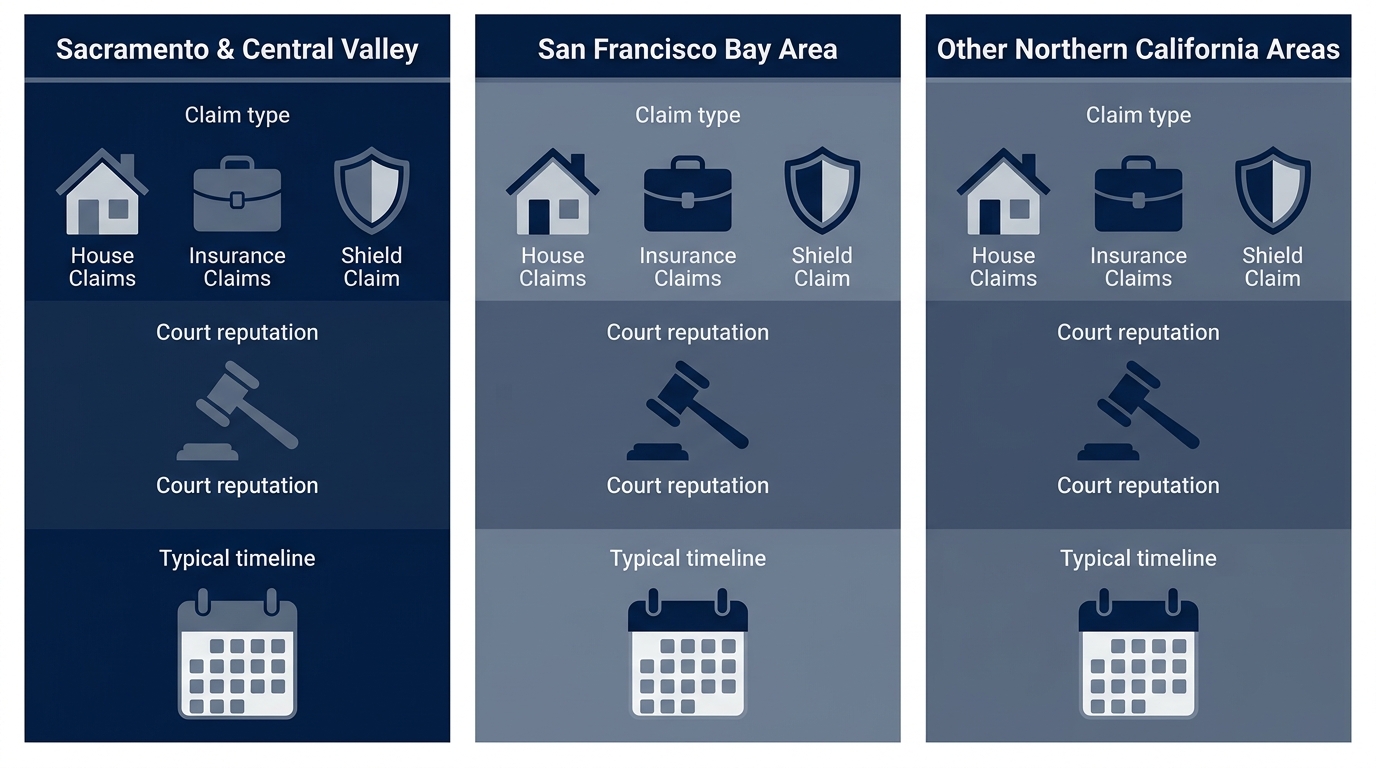
    Comparison of Bad Faith Claim Considerations Across Northern California Regions
    RegionTypical Claim TypesLocal Court ReputationAverage Timeline
    Sacramento and Central ValleyFirst-party property, auto insurance denialKnown for efficient docket management and experienced civil judges12 to 18 months to trial
    San Francisco Bay AreaBusiness interruption, professional liability denialComplex litigation expertise; longer pretrial discovery periods18 to 24 months to trial
    Other Northern California AreasMixed caseload; heavy on coverage disputes and fire claimsVaried by county; some courts specialize in insurance matters12 to 20 months to trial

    As the table shows, claimants in the Bay Area often face longer timelines due to complex discovery, while Sacramento courts move cases more efficiently. This variance underscores why engaging a San Francisco insurance bad faith lawyer with local experience is critical. California courts have a pro-consumer reputation in insurance matters, but local rules and judicial tendencies can significantly influence case strategy.

    Infographic comparing bad faith insurance claim characteristics across three Northern California regions using icons for claim type, court reputation, and timeline.

    Visual comparison of bad faith claim factors in three California regions.

    Given these legal parameters, our firm applies a trial-first mentality to every case. If you are seeking an attorney, consider the State Bar’s California certified lawyer referral service to find a practitioner vetted for bad faith litigation. This content is for informational purposes only and does not constitute legal advice. Individual outcomes depend on specific facts and circumstances.

    Taking the First Steps in a Bad Faith Insurance Claim

    If you believe your insurer has acted in bad faith in your California bad faith insurance claims, we recommend taking these immediate steps to protect your rights. The actions you take now can be critical to preserving evidence and strengthening your position.

    • Document all insurance company communications: note dates, times, names, and content of phone calls, emails, and letters.
    • Preserve evidence: retain copies of all correspondence, claim forms, denial letters, and supporting documents.
    • Review your policy: identify key coverage provisions, exclusions, and deadlines for filing appeals or lawsuits.
    • Flag red flags of bad faith: watch for unreasonable delays, inadequate investigation, lowball settlement offers, or an unfounded insurance claim denial in California.
    • Consult an insurance bad faith lawyer in San Francisco or an experienced bad faith attorney in your area; use the California attorney license lookup to verify standing.
    • Do not sign any release or settlement agreement without independent legal review.

    With this evidence in hand, an experienced attorney can evaluate the next steps—including litigation. We approach every case with aggressive advocacy and a trial-first mentality to hold insurers accountable. This website is for informational purposes only and does not constitute legal advice, and contacting McCaslin Law, PC does not create an attorney-client relationship.

    Secure Aggressive Advocacy for Your Bad Faith Claim

    To counter insurers’ delay and denial tactics, California bad faith insurance claims demand aggressive advocacy from a trial-ready lawyer.

    As a San Francisco insurance bad faith lawyer, we directly confront insurers over claim denials in California, employing a trial-first mentality to secure justice. John McCaslin personally handles every case, backed by decades of Northern California courtroom experience.

    While California court self-help resources offer general guidance, bad faith claims demand experienced advocacy. Contact us to discuss your case.

    This article was researched and written with the assistance of AI tools.

    Resources