Tag: Sacramento Law Firm

  • Best Commercial Real Estate Dispute Lawyers in Sacramento

    Best Commercial Real Estate Dispute Lawyers in Sacramento

    Table of Contents

    Commercial real estate law is complex and high-stakes, requiring experienced commercial real estate dispute lawyers who understand the unique legal landscape in Northern California. At McCaslin Law, PC, we represent property owners, commercial tenants, developers, and investors in a wide range of commercial property conflicts. Our practice covers the full spectrum of disputes, including:

    • Commercial lease enforcement matters, such as breach of lease, unlawful detainer, and covenant disputes.
    • Purchase and sale agreement disputes involving financing, inspection, and closing issues.
    • Title, boundary, and easement conflicts, including quiet title action proceedings to resolve ownership claims.
    • Construction defect litigation over faulty work or materials in commercial projects.
    • Landlord-tenant litigation addressing eviction, habitability, and contract interpretation.

    Our Trial-first mentality and Aggressive advocacy set McCaslin Law, PC apart. With more than 25 years of Northern California courtroom experience, our commercial real estate dispute lawyers are intimately familiar with local judges, procedures, and the strategies that get results in venues like Sacramento, San Francisco, and the surrounding counties. Under the ethical guidelines of the American Bar Association, we prepare every commercial real estate dispute as if it will be tried, giving our clients leverage from day one. We provide tailored strategies and direct attorney involvement, ensuring that each matter receives the aggressive, prepared advocacy it deserves.

    In the following sections, we delve deeper into the specific categories of commercial real estate disputes, exploring how our firm navigates lease disputes, purchase agreement conflicts, and other real estate litigation.

    This content is for informational purposes only and does not constitute legal advice. Contacting McCaslin Law, PC does not create an attorney-client relationship.

    Understanding Common Triggers for Commercial Real Estate Litigation

    Commercial real estate transactions and property relationships are inherently complex, and when disputes arise, they often follow predictable patterns. Whether it’s a disagreement over lease terms, a boundary issue that clouds a property’s title, or a construction project that fails to meet expectations, these situations can rapidly escalate into formal litigation. When disputes escalate, commercial real estate dispute lawyers step in to resolve them. Understanding these common triggers helps property owners, tenants, and developers in California recognize when they may need aggressive legal representation.

    Common Triggers for Commercial Real Estate Litigation
    Trigger TypeKey Legal Issues
    Rent defaults, lease enforcement, valuation disagreements Lease Disputes
    Easement conflicts, boundary disputes, quiet title actions Title Disputes
    Defective work, delay damages, professional negligence Construction Defects

    This table provides a high-level view of the situations that frequently give rise to litigation. Each of these categories encompasses a range of specific conflicts, often involving breach of contract claims, property rights disputes, and negligence allegations. We see these patterns regularly in our practice, and recognizing them early can be critical to protecting your legal interests.

    Lease Disputes represent the most common trigger for commercial real estate litigation in our experience. These conflicts typically arise when one party fails to meet their contractual obligations under a commercial lease agreement. Rent defaults occur when a tenant stops making payments, forcing landlords to pursue legal remedies. Valuation disagreements can surface during rent escalations, renewal option exercises, or when calculating common area maintenance charges. Our firm has detailed resources on these topics—as explained in our Commercial Lease Enforcement FAQ, understanding the remedies available is essential. The legal issues in these cases center on breach of contract, and they often require commercial lease enforcement actions through the court system.

    Title Disputes involve conflicts over who holds legal ownership of a property or what rights attach to that ownership. Easement conflicts frequently arise when one party’s use of a driveway, utility line, or access road is challenged by a neighboring property owner. Boundary disputes can surface years after a transaction closes when a survey reveals encroachments or inaccuracies. When the chain of title is clouded or contested, a quiet title action may be necessary. These cases are filed in the California Judicial Branch, where a judge determines property rights and resolves competing claims. The core legal issues involve property law principles, and we approach these matters with the meticulous preparation they demand.

    Construction Defects frequently lead to litigation when completed work fails to meet contractual specifications or industry standards. Defective workmanship can range from structural deficiencies to substandard materials that compromise a building’s integrity. Delay damages become a contentious issue when projects extend beyond agreed timelines, resulting in lost revenue and additional carrying costs for property owners. Professional negligence claims may target architects, engineers, or contractors whose design or oversight failures contributed to the defects. These disputes typically involve breach of contract and tort-based claims, requiring thorough factual investigation and expert analysis.

    Recognizing these triggers is the first step toward protecting your interests. Our trial-first mentality means we evaluate every case as though it will proceed to verdict, positioning our clients for the strongest possible outcome. Understanding these triggers helps commercial real estate dispute lawyers address client needs effectively.

    This website is for informational purposes only and does not constitute legal advice.

    Resolving Complex Disputes: Lease Valuation, Partition Actions, and Quiet Title

    Complex commercial real estate disputes demand knowledgeable representation. At McCaslin Law, PC, we handle lease valuation disagreements, partition actions, and quiet title actions for clients throughout Northern California. We also litigate related matters such as California bad faith insurance claims, reflecting our comprehensive civil litigation practice.

    Commercial Lease Valuation Disagreements

    Commercial lease valuation disputes arise when landlords and tenants cannot agree on rent adjustments, market comparables, or space measurements. These disagreements often escalate into litigation, especially in ground leases or percentage rent arrangements. To resolve these conflicts, we employ negotiation, mediation, and, when the lease contains an appraisal clause, a binding third-party determination. Our approach to commercial lease enforcement is rooted in a trial-first mentality; we prepare every matter as though it will proceed to trial, leveraging aggressive advocacy to achieve favorable outcomes. We represent both landlords and tenants in disputes over rent resets, operating expense pass-throughs, and default remedies, always with an eye toward protecting our clients’ bottom lines.

    California Partition Actions for Commercial Property

    A partition action is a statutory remedy that allows co-owners of commercial property to force the division or sale of the asset when collaboration fails. California courts may order a physical partition if the property can be divided equitably, but for commercial real estate, a sale with proceeds distributed among owners is the more common result. We handle partition actions with aggressive advocacy, recognizing that these disputes often involve substantial financial stakes and deep personal conflicts. Our trial-first mentality means we prepare every partition case for courtroom resolution, whether that involves contested hearings over ownership shares, appraisals, or the terms of sale. We also work to minimize delay and expense by exploring buy-out negotiations and mediation when those avenues align with our clients’ goals.

    Quiet Title Actions: Clearing Clouds on Property Title

    A quiet title action is a court proceeding used to eliminate clouds on property title, such as competing claims, unreleased liens, or recording errors. According to our firm’s FAQ, a successful plaintiff must prove a superior right to the property and show that the defendant’s assertions lack legal merit. We litigate quiet title actions with meticulous attention to documenting chain of title and challenging adverse claims. Our trial-first mentality ensures that we are prepared to present compelling evidence and legal argument to the court. Because title defects can halt sales, financing, or development, we move swiftly to identify the source of the cloud and pursue resolution through negotiation or judgment. With aggressive advocacy, we seek not only to clear title but also to recover damages and attorney fees where permitted.

    The following table summarizes the three primary methods we use to resolve complex commercial real estate disputes in California.

    Comparison of Dispute Resolution Methods
    MethodKey Characteristics
    Negotiation, mediation, appraisal clause Lease Valuation
    Statutory proceeding, sale or division of property Partition Action
    Court action to clear title defects Quiet Title

    With a trial-first mentality and aggressive advocacy, McCaslin Law, PC delivers formidable results in lease valuation, partition, and quiet title matters. Contact us to discuss your commercial real estate dispute.

    Practical Steps for Lease Enforcement and Quiet Title Actions

    Once a dispute arises, taking the right procedural steps is critical. Whether facing a tenant default or a title defect, commercial real estate dispute lawyers provide the strategic guidance necessary to protect your interests. A real estate litigation attorney in Sacramento can help you navigate these complex procedures and pursue the most effective remedies.

    Enforcing Commercial Leases After a Default

    The first stage in commercial lease enforcement is issuing a written default notice that specifies the breach and allows the tenant a statutory cure period—typically three days for nonpayment of rent under California law. If the tenant fails to cure, the landlord may file an unlawful detainer action to regain possession or a breach-of-contract claim for money damages. We prepare each step with meticulous attention to the lease terms and local rules, ensuring that deadlines and procedural requirements are strictly observed. This systematic approach minimizes delays and strengthens your position for any subsequent litigation.

    Defending Against Lease Enforcement Actions

    Tenants facing enforcement can raise several common defenses. A claim of constructive eviction asserts that the landlord’s failure to maintain the premises made them uninhabitable, effectively forcing the tenant out. Another defense is failure to mitigate damages, arguing that the landlord did not take reasonable steps to re-rent the space after the default. Waiver may apply when the landlord accepts late payments or otherwise acts inconsistently with strict enforcement of the lease terms. We thoroughly evaluate the facts in every case to determine the viability of these defenses and craft a response tailored to the circumstances.

    Filing a Quiet Title Action: Requirements and Timeline

    A quiet title action is the legal mechanism to resolve disputes over who holds valid title to real property. In California, any person or entity claiming an interest in real estate may file, but the complaint must allege the nature of the claim, describe the property, and name all adverse claimants. After service and an opportunity to respond, the court examines the evidence and issues a judgment that declares the true owner and extinguishes competing claims. The process typically takes six to twelve months, though complex cases or crowded court dockets can extend the timeline. Success requires meticulous preparation and strict compliance with statutory requirements.

    Understanding the procedural differences between these remedies helps clarify which path to pursue.

    Lease Enforcement vs Quiet Title Action Process
    StageKey Actions
    Lease: Written default notice; Quiet Title: File complaint Notice
    Lease: Unlawful detainer or breach of contract; Quiet Title: Quiet title action Litigation
    Lease: Possession + damages; Quiet Title: Court order clearing title Resolution

    The table highlights the distinct purposes each remedy serves. Lease enforcement focuses on restoring the landlord’s possessory rights and recovering unpaid sums, while a quiet title action establishes clear ownership and eliminates competing claims. Because both processes demand strict adherence to procedural rules and deadlines, partnering with experienced counsel significantly improves the likelihood of a favorable outcome.
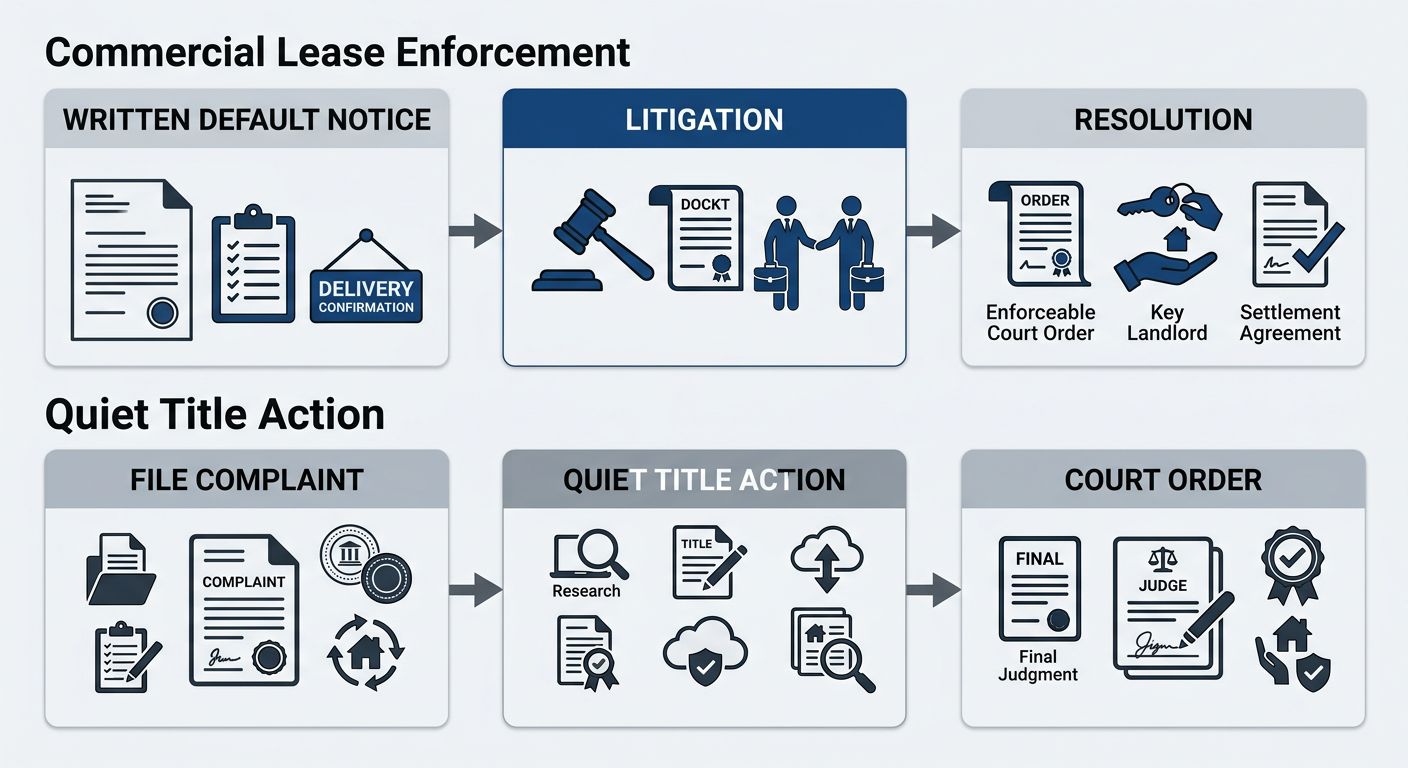
    Horizontal process-flow infographic comparing Commercial Lease Enforcement and Quiet Title Action sequences, each with three stages connected by arrows, using a blue and grey professional color scheme.

    Comparison of lease enforcement and quiet title action procedures

    This content is for informational purposes only and does not constitute legal advice. Contacting McCaslin Law, PC does not create an attorney-client relationship.

    Advanced Strategies: Partnership Disputes, Broker Commissions, and Trial Preparation

    Building on the fundamentals of commercial real estate conflicts, experienced commercial real estate dispute lawyers in Northern California employ advanced strategies to resolve complex partnership and commission disputes. These matters demand meticulous preparation and assertive courtroom advocacy to protect our clients’ interests.

    Partnership disputes often stem from profit allocation disagreements, dissolution negotiations, or claims of breach of fiduciary duty. As outlined in McCaslin Law, PC’s partnership dispute FAQ, our commercial real estate litigation attorneys handle conflicts involving hidden profits, unauthorized asset transfers, and oppressive partner conduct. We thoroughly investigate each situation to build a strong case for trial or a favorable settlement.

    Broker commission conflicts arise when entitlement is challenged, payments are withheld, or contractual language is ambiguous. Whether the issue involves commercial lease enforcement or a quiet title action to clear ownership rights, our real estate dispute counsel analyzes the contract and applicable law to hold parties accountable. We prepare each case as if it will go to verdict, leveraging our trial experience to drive resolution.

    Trial preparation for these disputes demands organized evidence gathering, witness preparation, and strategic motion practice. We identify critical documents, depose key witnesses, and frame legal arguments early, ensuring no detail is overlooked. This disciplined approach maximizes outcomes whether the dispute ultimately goes before a judge, an arbitrator, or a mediator.

    The following table contrasts three primary paths for resolving commercial real estate disputes:

    Litigation vs Alternative Dispute Resolution
    ApproachKey Considerations
    Aggressive advocacy, precedent-setting, but costly and public Trial
    Private, faster, but limited appeal rights Arbitration
    Cost-effective, preserves relationships, but non-binding Mediation

    Each option carries distinct benefits and risks. Our trial-first mentality means we prepare every case for litigation while remaining open to cost-effective alternatives when they serve our clients’ goals. This aggressive stance often strengthens our position during arbitration or mediation.

    Our medical malpractice attorney brings the same aggressive advocacy and meticulous preparation to commercial real estate disputes, reflecting our firm-wide commitment to courtroom excellence. With these strategies in mind, the next step is to examine how we prepare for trial to maximize outcomes for our clients in Northern California.

    This website is for informational purposes only and does not constitute legal advice. Contacting McCaslin Law, PC does not create an attorney-client relationship.

    Frequently Asked Questions About Commercial Real Estate Disputes

    After learning about the complexities of these matters, you likely have questions. The following answers address common concerns we hear from clients facing commercial real estate disputes.

    What is a commercial real estate dispute?

    A commercial real estate dispute is any legal conflict involving property used for business purposes. These disagreements arise between property owners, tenants, developers, or lenders and can involve issues from boundary lines to financing. Our commercial real estate dispute lawyers handle these matters with a trial-first mentality, preparing every case for the courtroom from day one.

    What are common commercial lease enforcement issues?

    Commercial lease enforcement covers scenarios where landlords or tenants fail to meet their contractual obligations, such as unpaid rent, unauthorized alterations, or early termination disputes. Remedies can include eviction proceedings, monetary damages, or specific performance of the lease terms. We approach commercial lease enforcement aggressively, protecting your business interests through decisive legal action.

    What is a quiet title action?

    A quiet title action is a lawsuit filed to establish clear ownership of real property and resolve competing claims or clouds on the title. It is especially useful in boundary disputes, lien challenges, or when a property’s chain of title contains errors. The quiet title action process demands meticulous preparation, and our firm litigates these claims with the exhaustive attention they require.

    How can a lawyer help with my commercial real estate dispute?

    An experienced litigation lawyer identifies your legal rights, evaluates the strength of your position, and develops a strategy for resolution through negotiation or trial. We provide direct attorney involvement, so you work with seasoned counsel at every stage. You can check our standing with the State Bar of California for further confidence.

    What should I do if I am involved in a commercial lease dispute?

    Document all communications and gather your lease agreement, payment records, and any correspondence with the other party. Then contact a qualified litigation firm promptly to understand your options before critical deadlines pass.

    If these answers raise additional questions, we encourage you to reach out directly. Every situation is unique, and we are here to provide clarity and aggressive advocacy for your commercial real estate challenges.

    This website is for informational purposes only and does not constitute legal advice. Contacting McCaslin Law, PC does not create an attorney-client relationship. Prior results do not guarantee similar outcomes.

    Securing Experienced Representation for Your Commercial Real Estate Dispute

    When you face a complex property conflict, you need skilled representation from lawyers who handle these matters every day. Our firm brings a trial-first mentality and aggressive advocacy to every case, drawing on decades of Northern California courtroom experience. We have a record of proven success against well-funded defense teams in purchase and sale agreement disputes, commercial lease enforcement, quiet title action, and related litigation. Strategic, meticulous preparation defines our approach. Boutique Litigation. Formidable Results.

    Resources

  • Hire Non-Disclosure Agreement Disputes Lawyer Sacramento: Fast Response

    Hire Non-Disclosure Agreement Disputes Lawyer Sacramento: Fast Response

    Table of Contents

    Retain an Experienced NDA Disputes Lawyer in Sacramento, California

    When your confidential information is at stake, you need a dedicated non-disclosure agreement disputes lawyer who prepares every case for trial. At McCaslin Law, PC, we bring a trial-first mentality to NDA enforcement and defense across Northern California.

    We handle complex breach of confidentiality matters, from improper disclosure by former employees to competition by departing partners. Whether you are enforcing non-disclosure agreements in California or defending against a claim, we prepare each matter as if it will go to verdict. Our team works directly with clients to pursue breach of confidentiality agreement remedies, including injunctive relief and damages. We leverage courtroom-tested evidence preservation and aggressive motion practice to protect client interests early and throughout litigation effectively. As detailed in our internal NDA dispute resources, our experience spans state and federal courtrooms in Sacramento and beyond.

    Contact us to discuss your NDA dispute with an experienced trial attorney. This website is for informational purposes only and does not constitute legal advice. Contacting McCaslin Law does not create an attorney-client relationship. You can verify our standing through California Bar Association public resources.

    Understanding Your Options with an NDA Disputes Lawyer in Sacramento, California

    When confidential business information is disclosed without authorization, the consequences can be severe. Whether you are a business owner, an inventor, or a professional protecting trade secrets, a breach of a non-disclosure agreement can threaten your competitive advantage. At McCaslin Law, PC, we approach every case with a trial-first mentality, ensuring that when you seek a non-disclosure agreement disputes lawyer in Sacramento, California, you receive resolute and strategic representation from the outset.

    In California, the enforcement of non-disclosure agreements is primarily governed by the Uniform Trade Secrets Act (UTSA), codified in California Civil Code sections 3426 through 3426.11, along with established common law principles for breach of contract. This framework provides the legal basis for protecting proprietary information, defining a trade secret broadly as information that derives independent economic value from not being generally known and is subject to reasonable efforts to maintain its secrecy. For those unfamiliar with procedural nuances, California court system resources offer general self-help guidance, though navigating litigation requires experienced counsel.

    Our role in enforcing non-disclosure agreements in California begins with a meticulous analysis of the contract itself. We examine the agreement’s scope, including how it defines confidential information, the duration of the secrecy obligation, and the specific exclusions. A well-drafted NDA is your first line of defense, but even a broadly written agreement can be vigorously enforced when the underlying information meets the statutory definition of a trade secret. We prepare every matter as if it will be tried to a verdict, leveraging our deep understanding of California law to build a commanding case from the initial filing.

    Identifying a Breach of Confidentiality

    Recognizing a violation early is critical to mitigating damage. Common breach scenarios we handle in Sacramento include a former employee downloading sensitive client lists before joining a competitor, a business partner using proprietary manufacturing processes after a partnership dissolves, or a consultant sharing your strategic roadmap with a third party in violation of explicit contractual terms. These situations often arise quietly, surfacing only when a competitor suddenly gains an inexplicable market advantage or client accounts begin to erode unexpectedly.

    When we investigate a potential breach, we look for concrete evidence of unauthorized use or disclosure. This can include forensic analysis of digital footprints, sudden patterns of client migration, or even the appearance of a startlingly similar product from a former collaborator. Direct evidence is compelling, but circumstantial proof, such as a former fiduciary’s unusual behavior or unexplained wealth, can also form the basis of a strong claim. Our aggressive advocacy ensures we pursue every avenue to uncover the truth and hold the responsible party accountable.

    California law provides a range of powerful remedies for NDA violations. The most immediate form of relief is a temporary restraining order or a preliminary injunction, which commands the breaching party to stop using or disclosing the protected information immediately. This court order is often the most critical tool for containing damage, preventing the swift erosion of your market position while the lawsuit proceeds. Injunctive relief is not automatic, however; a plaintiff must demonstrate a likelihood of success on the merits and the threat of irreparable harm, a standard we routinely meet through meticulous preparation.

    Beyond stopping the breach, our firm pursues monetary damages designed to make you whole. These breach of confidentiality agreement remedies can include actual losses incurred as a direct result of the breach and restitution of any unjust enrichment gained by the wrongdoer. In cases where the misappropriation is willful and malicious, we may also seek exemplary damages and recovery of reasonable attorney’s fees, as authorized under the California UTSA. Every approach we take is infused with our aggressive advocacy, maximizing pressure on the opposing party to achieve a decisive result, whether through a favorable settlement or at trial.

    For more on how we handle NDA litigation and our unwavering commitment to preparing every case for the courtroom, we invite you to see our approach. Contact McCaslin Law, PC to discuss your specific situation and how we can help protect your most valuable assets.

    This website is for informational purposes only and does not constitute legal advice. Contacting McCaslin Law, PC does not create an attorney-client relationship. Prior results do not guarantee similar outcomes.

    Key Benefits of Hiring an NDA Disputes Lawyer in Sacramento, California

    When your confidential business information is at risk, securing a non-disclosure agreement disputes lawyer in Sacramento, California is a critical step toward protecting your interests. At McCaslin Law, PC, we combine deep local court knowledge with a relentless commitment to safeguarding our clients’ proprietary information, ensuring that every aspect of your case is handled with the urgency and precision it demands.

    Direct Attorney Involvement from the Start

    From the initial consultation through resolution, you work directly with an experienced trial attorney who personally manages every facet of your case. We do not delegate critical legal work to junior associates or paralegals. This model ensures that the person developing your strategy, negotiating with opposing counsel, and arguing before the court is the same seasoned litigator you hired. For businesses facing the theft of trade secrets or a confidential information leak, this direct line of communication means faster decisions, a deeper understanding of your commercial realities, and a cohesive strategy that doesn’t get lost in translation. Our clients benefit from over 25 years of trial experience focused entirely on their matter, providing a level of service and accountability that larger, assembly-line firms simply cannot match.

    Trial-Ready Strategy for Complex NDA Cases

    We approach every dispute with a Trial-first mentality. This means we prepare your case from day one as if it will be decided by a judge or jury, not just settled at a conference table. This aggressive posture fundamentally changes the dynamics of a dispute. When opposing parties recognize that your legal team is fully prepared to litigate, they are often compelled to offer more favorable settlement terms. Our methodology involves meticulous evidence gathering, proactive witness preparation, and the development of a compelling narrative that resonates in court. For clients seeking remedies for a breach of confidentiality, such as enforcing non-disclosure agreements California demands, this strategy turns the threat of a trial into a powerful negotiation tool. You gain the confidence of knowing that if a fair settlement is not reached, you are represented by a team that is fully equipped and eager to achieve Boutique Litigation. Formidable Results.

    Comprehensive Protection for Trade Secrets and Confidential Information

    The moment a non-disclosure agreement is violated, swift action is essential to prevent irreparable harm. We provide a full spectrum of protection, starting with immediate emergency measures. This includes obtaining temporary restraining orders (TROs) and preliminary injunctions to immediately halt the dissemination of your sensitive data. From there, we build a long-term litigation strategy aimed at recovering damages and permanently enjoining the wrongful conduct. Our firm handles complex matters far beyond NDA disputes, including cases such as bad faith insurance claims in California, demonstrating our versatile litigation prowess. By pursuing all available breach of confidentiality agreement remedies, we send an unequivocal message that we will exhaust every legal avenue to protect your intellectual property and goodwill, embodying our commitment to Aggressive advocacy for every client.

    This website is for informational purposes only and does not constitute legal advice.

    How an NDA Disputes Lawyer in Sacramento, California Builds Your Case

    Once you understand the fundamentals of a non-disclosure agreement breach, the next step is recognizing how a dedicated non-disclosure agreement disputes lawyer translates your situation into a powerful, actionable legal strategy. At McCaslin Law, PC, we bring a trial-first mentality to every case, meticulously constructing your claim from the ground up to ensure maximum leverage, whether that leads to a courtroom victory or a highly favorable settlement. Our approach is systematic and aggressive, designed to protect your confidential information through strategic litigation in Sacramento and across Northern California.

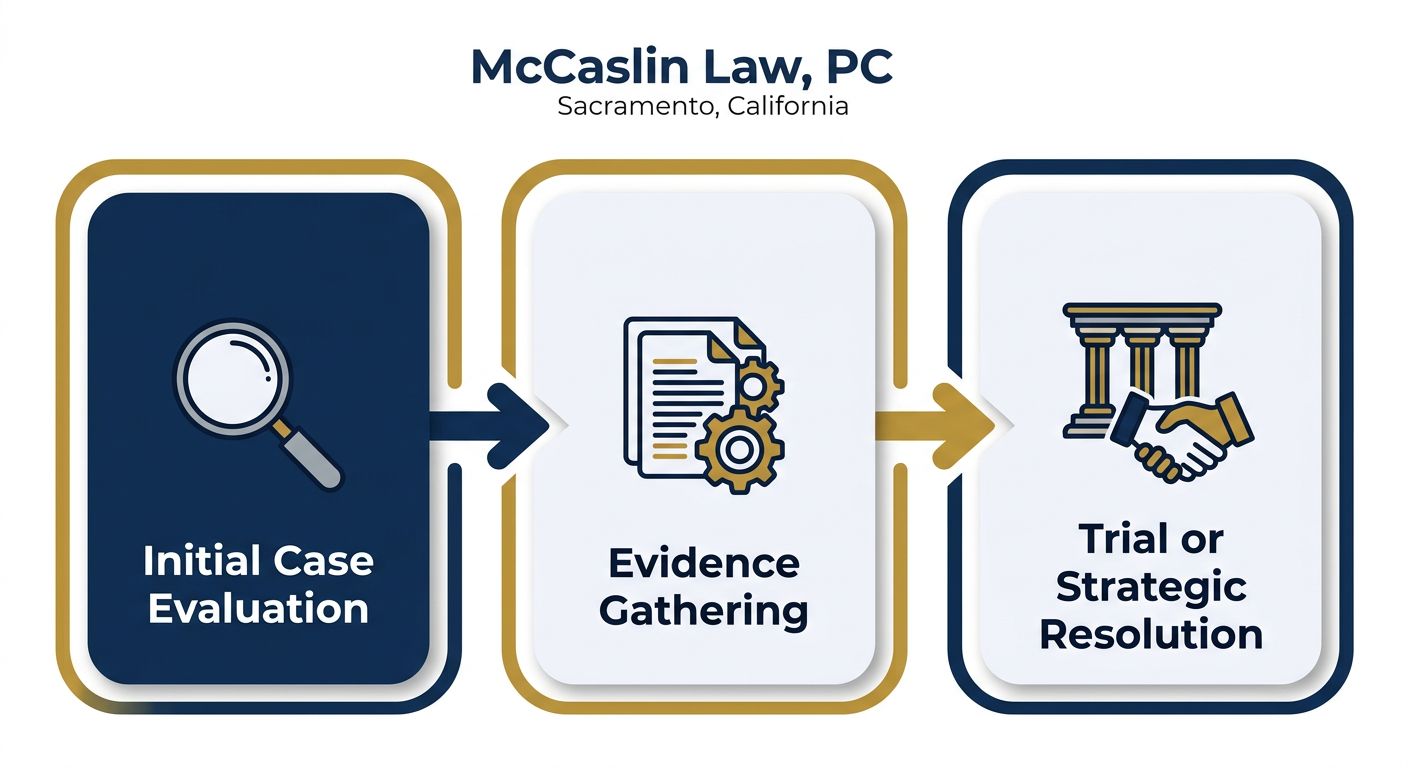
    Horizontal process flow diagram showing three stages of NDA case preparation in Sacramento, California. First stage shows initial case evaluation with magnifying glass, second stage shows evidence gathering with document and gear, third stage shows trial or strategic resolution with courtroom column and handshake. Arrows connect stages left-to-right.
    Systematic NDA case preparation process by McCaslin Law

    This framework is built on decades of Northern California courtroom experience, and it forms the bedrock of how we pursue justice for clients facing an NDA breach.

    Initial Case Evaluation and Strategy Session

    Your case begins with a comprehensive, confidential consultation where we review the signed non-disclosure agreement and meticulously analyze the specifics of the alleged breach. As your non-disclosure agreement disputes lawyer, we will assess the validity and scope of the contract, evaluate the evidence you possess, and outline the potential legal theories available to you under California law. According to McCaslin Law’s NDA Disputes FAQ, a claim hinges on proving a valid NDA, a breach of its terms, and resulting damages. We will discuss a tailored strategy, walking you through the litigation roadmap and what to expect in terms of process. Beyond NDA disputes, our firm also handles workers compensation in California cases with the same relentless, aggressive advocacy, reflecting our broad litigation capability.

    Evidence Gathering and Pre-Trial Preparation

    If litigation becomes necessary, enforcing non-disclosure agreements in California demands a watertight factual record built through rigorous discovery. We immediately act to issue document preservation demands, ensuring no critical electronic or physical evidence is destroyed. Our team conducts exhaustive discovery, including requests for production, interrogatories, and depositions to secure testimony from the opposing party and key witnesses. This phase is about constructing an irrefutable narrative of the breach. We dig deep to trace the misuse of your trade secrets or confidential data, meticulously preparing every exhibit and argument as if a jury will see it tomorrow. This intense preparation directly supports our goal of securing significant breach of confidentiality agreement remedies, which may include injunctive relief, monetary damages, and recovery of legal fees.

    Aggressive Trial Representation or Strategic Resolution

    Every case we build is prepared for a courtroom showdown, embodying our firm’s aggressive advocacy and trial-first mentality. This unwavering preparation creates significant leverage because opposing counsel knows we are fully capable and willing to take a case to verdict. Your case is handled directly by experienced counsel, not delegated to junior associates, ensuring sophisticated oversight at every stage. While we relentlessly prepare for trial, we also remain open to strategic resolution when it aligns with your objectives. A favorable settlement, achieved from a position of undeniable strength, is often the most efficient way to protect your interests. This foundation of meticulous case-building leads directly to why an experienced litigator is not just an option, but a necessity—and how McCaslin Law delivers formidable results in and out of the courtroom.

    This website is for informational purposes only and does not constitute legal advice. Contacting McCaslin Law, PC does not create an attorney-client relationship. Prior results do not guarantee similar outcomes.

    Best Practices for NDA Disputes in Sacramento, California

    Proactive Measures to Safeguard Your Trade Secrets

    Proactive measures are the first line of defense against NDA disputes. We advise businesses in Sacramento, California, to implement clear confidentiality policies that define trade secrets precisely and restrict employee access. Requiring signed non-disclosure agreements for any personnel handling sensitive information is essential. Use access controls such as password-protected systems, locked file cabinets, and restricted areas, and conduct regular training on NDA obligations. Defining what constitutes a trade secret under California law is a critical first step; without clear documentation, enforcing non-disclosure agreements in California becomes significantly harder. We help clients catalog their confidential information and classify access levels, ensuring that every NDA is tailored to the specific risks associated with their business. Regular refresher training keeps employees aware of their duties and reduces inadvertent disclosures. When a dispute arises, a non-disclosure agreement disputes lawyer in Sacramento, California, can evaluate whether these measures were adequate. Our firm’s trial-first mentality ensures that every protection we put in place is designed to withstand courtroom scrutiny, providing aggressive advocacy from the start.

    Responding Swiftly to a Potential Breach

    If you suspect a breach of an NDA, immediate action is critical. Preserve all evidence; save emails, files, and metadata before they can be altered or destroyed. Send a formal cease-and-desist letter demanding the return or destruction of confidential materials and cessation of further use. Contacting an experienced non-disclosure agreement disputes lawyer in Sacramento promptly is vital; do not attempt to negotiate with the other party on your own. We recommend that you avoid any internal investigation that could inadvertently spoil evidence. Understanding breach of confidentiality agreement remedies available under California law allows you to move decisively. Our boutique litigation firm is known for formidable results precisely because we respond with speed and precision, leveraging every tool to protect your trade secrets. We also advise documenting every step taken to preserve a clear record for potential court proceedings. Taking these actions immediately can preserve vital options for legal recourse.

    An experienced litigation attorney should lead your NDA dispute response from the outset. At McCaslin Law, our trial-first mentality means we prepare every matter as if it will go to verdict, which maximizes settlement leverage. Our firm’s FAQ on non-disclosure agreement disputes provides practical guidance on common scenarios and recommended steps, and we encourage clients to review that resource. Strategic timing of legal action, including seeking injunctive relief early, can prevent irreparable harm. We also safeguard privilege and avoid actions that could inadvertently waive protections. Consider leveraging American Bar Association professional development resources to stay current on NDA enforcement trends; our attorneys continually advance their skills through such programs to deliver aggressive advocacy in Sacramento courtrooms. This article is for informational purposes only and does not constitute legal advice. Contacting McCaslin Law, PC through this website does not create an attorney-client relationship.

    Contact an NDA Disputes Lawyer in Sacramento, California Today

    If you are dealing with a violation of a confidentiality agreement, the right legal strategy can make all the difference. As a non-disclosure agreement disputes lawyer in Sacramento, California, our firm is equipped to act quickly to protect your proprietary information and pursue all available remedies for a breach of confidentiality. We understand that time is a critical factor, whether you need to secure a temporary restraining order or are facing an imminent statute of limitations.

    Our firm’s trial-first mentality and commitment to aggressive advocacy set us apart. When you engage an NDA disputes attorney in California, you work directly with experienced counsel who prepares every matter for the courtroom from day one. Whether your case involves enforcing non-disclosure agreements in California or pursuing breach of confidentiality agreement remedies, we deliver the strategic, meticulous preparation that formidable results demand. We also represent clients across a broad spectrum of civil litigation. Whether you need representation for NDA disputes, a truck accident lawyer in Oakland, or other complex civil matters, we are ready to help.

    To take the first step, we invite you to reach out for a free initial consultation to discuss your situation with a confidentiality breach lawyer. Contact McCaslin Law, PC by calling (916) 330-4147 or by using the contact form available on our website. Our team serves individuals and businesses throughout Northern California, bringing extensive courtroom experience to every case.

    Disclaimer: Contacting McCaslin Law, PC does not create an attorney-client relationship. This website is for informational purposes only and does not constitute legal advice. Prior results do not guarantee similar outcomes. Information submitted through this form is not guaranteed to be confidential.

    Resources

  • Expert Commercial Lease Enforcement Sacramento for Landlords

    Expert Commercial Lease Enforcement Sacramento for Landlords

    Table of Contents

    Commercial Lease Enforcement in Sacramento, California

    When a tenant fails to pay rent, holds over past the lease term, or otherwise violates a lease covenant, pursuing commercial lease enforcement in Sacramento becomes necessary to protect your property rights and income stream. The primary legal mechanism for regaining possession is a commercial unlawful detainer action — a summary proceeding filed in Sacramento County Superior Court that is governed by California-specific statutes and accelerated timelines designed to resolve possession disputes more quickly than a standard civil case.

    Beyond eviction, a landlord’s available breach of commercial lease remedies in California include claims for past-due rent, recovery of the leased premises through a judgment for possession, early lease termination, and monetary damages for harm caused by the breach. The American Bar Association emphasizes that exploring early negotiation or alternative dispute resolution can often preserve business relationships when a commercial tenancy falters. Because a commercial unlawful detainer in Sacramento demands strict compliance with notice requirements and court rules, we encourage you to speak with a dedicated commercial litigation attorney in Sacramento who can guide your enforcement strategy. Our firm approaches every dispute with aggressive advocacy and a trial-first mentality, preparing each matter as if it will be tried to verdict. This overview is provided for general information and does not constitute legal advice; contacting McCaslin Law, PC does not create an attorney-client relationship. Learn how we put that philosophy to work in commercial lease conflicts by continuing below.

    The Commercial Lease Enforcement Landscape in Sacramento

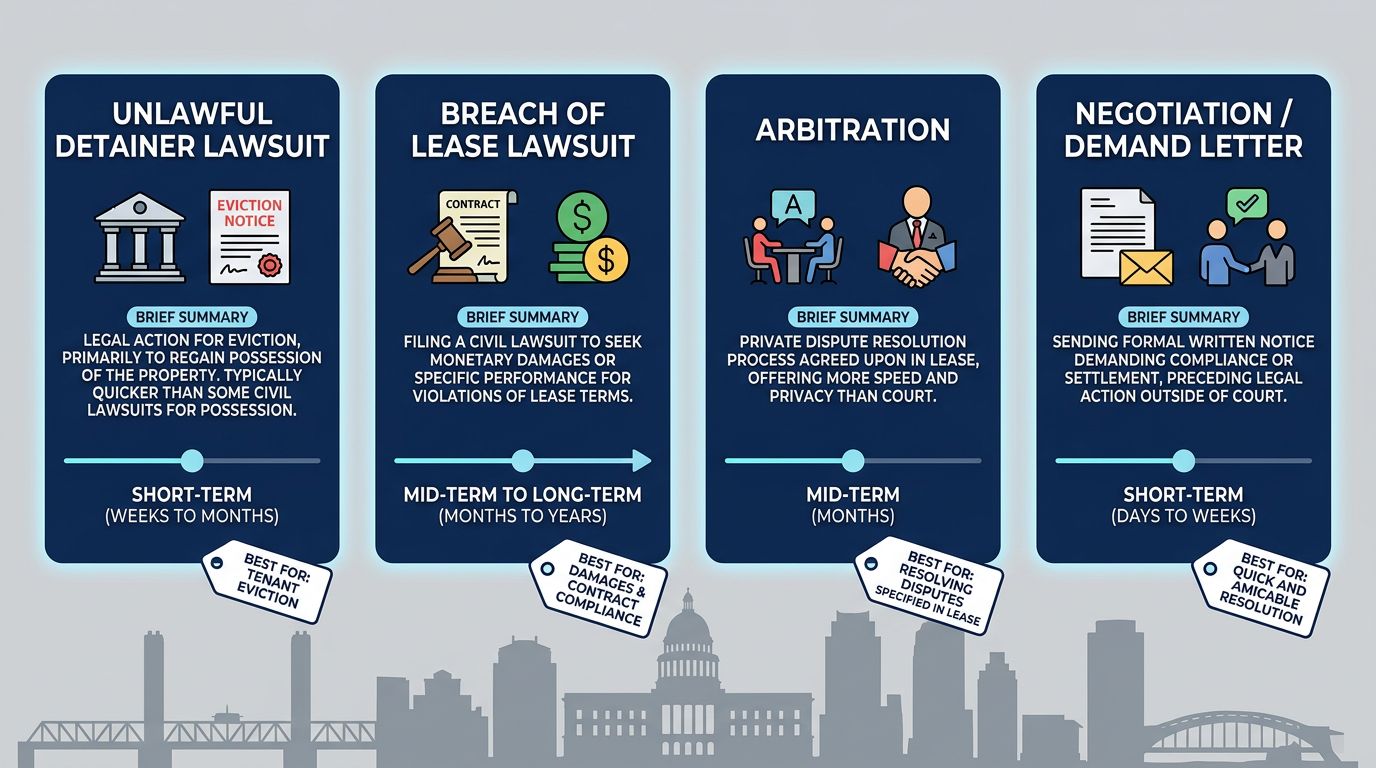
    For Sacramento landlords, a commercial lease breach demands swift action. The commercial lease enforcement sacramento landscape includes powerful legal remedies to recover possession, unpaid rent, and enforce lease terms. At McCaslin Law, we bring a Trial-first mentality and Aggressive advocacy, preparing each case for trial. The table below outlines each method.

    Commercial Lease Enforcement Options in Sacramento
    MethodDescriptionTimelineBest For
    Unlawful Detainer LawsuitCourt action to evict tenant and recover possession.Typically 4-8 weeks if uncontested.Clear-cut non-payment or holdover cases.
    Breach of Lease LawsuitSuit for damages or specific performance.Months to a year depending on complexity.Non-monetary violations or complex disputes.
    ArbitrationPrivate dispute resolution per lease terms.Varies; often faster than litigation.Parties seeking confidentiality and efficiency.
    Negotiation / Demand LetterPre-litigation demand to resolve without court.Days to weeks.Early-stage disputes or cooperative tenants.

    The unlawful detainer lawsuit handles eviction for non-payment or holdover, with the California Courts noting a timeline of 4-8 weeks if uncontested, known as a commercial unlawful detainer sacramento action. For non-monetary breaches, a breach of lease lawsuit may seek breach of commercial lease remedies california like damages or specific performance, though litigation can take months. Arbitration and demand letters provide faster, private alternatives; consult a real estate litigation attorney in Sacramento to determine the best path.

    Infographic comparing four commercial lease enforcement methods: Unlawful Detainer, Breach of Lease, Arbitration, and Negotiation/Demand Letter, with timeline and best-use indicators, featuring Sacramento skyline silhouette.

    Qualitative comparison of lease enforcement methods for Sacramento commercial tenants and landlords.

    Understanding the full commercial lease enforcement sacramento landscape is essential; contact us to discuss your dispute.

    Commercial Lease Enforcement Services for Sacramento Property Owners

    When a commercial tenant breaches a lease in California, time and revenue are at stake. Our firm provides decisive commercial lease enforcement in Sacramento that helps property owners regain control of their premises and recover what is owed. We represent landlords in disputes ranging from non-payment of rent to unauthorized property alterations and holdover tenancies.

    For the most urgent cases, we rely on the commercial unlawful detainer process. This fast-track proceeding under California law allows us to quickly restore possession of the property when a tenant refuses to pay rent or otherwise substantially violates the lease. Unlike a general eviction procedure, a well-prepared unlawful detainer action in Sacramento can move from filing to a court hearing in weeks rather than months.

    Beyond eviction, we pursue a full range of breach of commercial lease remedies in California to protect your investment:

    • Monetary damages covering unpaid rent, repair costs, and lost profits
    • Injunctive relief to stop harmful or unauthorized conduct
    • Recovery of attorney’s fees when the lease permits

    What sets our approach apart is our trial-first mentality. Every matter is prepared as if it will be tried to verdict, which means we enter negotiations from a position of strength. Our experienced litigators handle every stage directly, whether through aggressive pre-litigation negotiation or formal proceedings in state and federal court. You can learn more by visiting our FAQ pages on commercial and real estate litigation. To confirm our credentials, use the California State Bar attorney search for your own due diligence.

    Please remember: this website is for informational purposes only and does not constitute legal advice. Contacting McCaslin Law, PC does not create an attorney-client relationship. Prior results do not guarantee similar outcomes.

    The landscape of commercial lease enforcement Sacramento demands a clear understanding of local legal procedures and remedies. For commercial landlords and tenants operating in and around California’s capital city, the primary statutory mechanism for resolving lease-based conflicts is the unlawful detainer process, a specialized eviction lawsuit governed by the California court unlawful detainer process. Codified in California Code of Civil Procedure Sections 1159 through 1179a, this action is designed to restore possession of the premises to the rightful party. At McCaslin Law, we bring a trial-first mentality to these matters, ensuring every procedural step in Sacramento County Superior Court is handled with precision and strategic foresight.

    A commercial unlawful detainer Sacramento action proceeds rapidly, with the statutory timeline typically bringing a case from initial filing to a judgment within 30 to 45 days, according to California Courts. This expedited process contrasts sharply with standard civil litigation but does not offer commercial tenants the protections commonly associated with residential rent control in California. The legal remedies available for a breach of commercial lease remedies California are generally limited to three core options: termination of the lease, monetary damages to compensate for losses incurred, and specific performance—a court order compelling a party to fulfill the terms of the agreement, as framed by industry standards from the American Bar Association.

    Understanding these Sacramento-specific legal frameworks is critical for navigating a dispute effectively. The procedural rules and swift timeline require a firm that is prepared to act decisively. This information is provided for general educational purposes only and does not constitute legal advice; contacting McCaslin Law, PC does not create an attorney-client relationship.

    This content is for informational purposes only and does not constitute legal advice. Contacting McCaslin Law, PC does not create an attorney-client relationship. Prior results do not guarantee similar outcomes.

    Begin Your Commercial Lease Enforcement Case with McCaslin Law

    A breached commercial lease demands immediate action. For commercial lease enforcement Sacramento clients trust, McCaslin Law brings a trial-first mentality and aggressive advocacy to every dispute. We handle commercial unlawful detainer Sacramento filings and pursue every breach of commercial lease remedies California allows, with direct attorney involvement at every stage.

    In many Sacramento commercial lease disputes, we first explore alternative resolution. American Bar Association lease dispute arbitration offers a structured process that can save time and cost when both sides are willing to negotiate. But when negotiation fails, our firm is prepared to litigate for the fullest possible remedies for lease breach.

    To begin your case, please gather your lease, any breach notices, and correspondence, then contact us:

    • Call (916) 330-4147 to schedule a free initial consultation
    • Provide details about the lease, the alleged breach and any prior communication with the other party
    • We will evaluate your situation and outline a strategy tailored to your objectives

    This website is for informational purposes only and does not constitute legal advice. Contacting McCaslin Law, PC does not create an attorney-client relationship. Prior results do not guarantee similar outcomes.

    Protect Your Property Investment with Aggressive Lease Enforcement

    Effective commercial lease enforcement in Sacramento safeguards your property investment. The breach of commercial lease remedies California law authorizes can stop losses quickly. Common breaches include:

    • Non-payment of rent
    • Lease violations
    • Holdover tenancies

    Our trial-first strategy deters further misconduct. If a premises defect injures a tenant, consult a slip & fall attorney. For a commercial unlawful detainer in Sacramento, we pursue swift resolution. Contact us.

    This website is for informational purposes only and does not constitute legal advice. Contacting McCaslin Law, PC does not create an attorney-client relationship. Prior results do not guarantee similar outcomes.

    Resources

  • Commercial Litigation Lawyer Hourly Rate in Sacramento: Fee Breakdown for 2026

    Commercial Litigation Lawyer Hourly Rate in Sacramento: Fee Breakdown for 2026

    Table of Contents

    Commercial Litigation Lawyer Hourly Rates in Northern California

    A commercial litigation lawyer hourly rate in Northern California typically ranges from $300 to $800 or more, depending on the attorney’s experience, the complexity of the case, and the prestige of the firm. This market consistently falls on the higher end of national averages. Understanding the cost of skilled representation is the next step in making an informed decision about your legal needs.

    Several key factors influence a litigation cost breakdown. Case complexity is a primary driver—a multi-million dollar partnership dispute demands significantly more resources than a straightforward breach of contract. Attorney experience also plays a major role; a lawyer with decades of trial experience will command a higher rate than a recent graduate. The geographic zone matters too, as rates in San Francisco are often steeper than those in Sacramento or more rural areas. Finally, attorney fee structures vary: you may encounter hourly billing, flat fees for specific tasks, or contingency arrangements where the lawyer only gets paid if you win.

    At McCaslin Law, PC, we believe clients deserve direct access to a seasoned trial lawyer, not a team of junior associates. Our trial-first mentality means every case is prepared for the courtroom, which often leads to better settlements. For a complex northern California contract dispute litigation, our hourly rates may be at the higher end of the range due to extensive discovery and trial preparation, but clients pay for formidable experience. We offer free initial consultations to discuss our fee structures, including our standard retainer requirements.

    You’re not just paying for time; you’re investing in aggressive advocacy with a proven track record in Northern California courtrooms. Now that you know our fee philosophy, let’s look at the experience behind it.

    This website is for informational purposes only and does not constitute legal advice. Contacting McCaslin Law, PC does not create an attorney-client relationship.

    Comparing Attorney Fee Structures for Business Disputes

    Beyond understanding the overall costs, it is essential to evaluate how attorneys charge for their services. The commercial litigation lawyer hourly rate varies widely depending on experience, case complexity, and geographic location, but hourly billing is only one of several fee arrangements available for business disputes. Selecting the right attorney fee structures means weighing predictability, risk, and alignment of incentives—a decision that directly affects the cost of litigation and the attorney-client relationship.

    Common Attorney Fee Structures in Commercial Litigation

    The following table compares four widely used fee models in business dispute representation. Each structure carries distinct advantages and risks depending on the nature and scope of your case.

    Common Attorney Fee Structures in Commercial Litigation
    Fee TypeHow It WorksBest ForRisk to Client
    Hourly FeesClient pays a set rate per hour for all legal work performed.Ongoing or unpredictable litigation where scope is unclear.High — costs can escalate quickly without clear budget controls.
    Flat FeesA single fixed price covers the entire legal matter.Well-defined disputes or specific phases like mediation.Low — predictable cost regardless of hours spent.
    Contingency FeesAttorney fees are contingent on a successful outcome.Plaintiff-side cases with strong damages potential.Medium — no upfront cost but typically a higher percentage of recovery.
    Hybrid FeesA blend of reduced hourly rates and a success bonus.Complex disputes where risk and reward are shared.Medium — lower hourly burden but still some financial exposure.

    Hourly rates remain the most common structure in complex commercial litigation, particularly when the scope of work is difficult to define at the outset. Our firm’s fee FAQ explains typical hourly rate ranges for matters handled in Northern California. The primary drawback of an hourly arrangement is cost unpredictability—without careful budgeting, legal fees can escalate quickly as motions, discovery, and trial preparation intensify. For many clients, understanding the litigation cost breakdown before engaging counsel provides clarity and sets realistic expectations for the financial commitment ahead.

    Flat fees offer cost predictability and are best suited for well-defined disputes or specific phases of litigation. Tasks such as drafting demand letters, attending a single mediation session, or preparing a dispositive motion are often handled on a flat-fee basis. For businesses involved in northern California contract dispute litigation, a flat fee may provide cost certainty for discrete, well-defined matters. Our firm’s fee FAQ notes that flat fees are typically reserved for tasks where the scope and timeline can be reliably estimated at the start of the engagement.

    Contingency fee arrangements shift the financial risk away from the client—attorney fees are only collected upon a successful outcome. The American Bar Association’s ethical guidelines govern contingency fee agreements, which in commercial cases typically range from 25% to 40% of the recovery, subject to state bar rules. We offer contingency representation in appropriate plaintiff-side commercial disputes where the damages potential justifies the risk, though these arrangements are not available for every type of business litigation matter.

    Hybrid fee models are increasingly popular in business litigation. By combining a reduced hourly rate with a success bonus, both attorney and client share risk and reward—an approach that naturally aligns incentives. These arrangements are often tailored during our initial consultations and may be appropriate for complex contract or partnership disputes where traditional hourly or contingency models do not fully serve the client’s interests.

    We encourage potential clients to schedule a fee consultation to discuss which structure best fits their particular business dispute. Every case presents unique financial and strategic considerations, and we work closely with clients to craft billing arrangements that reflect those realities. Contacting McCaslin Law, PC does not create an attorney-client relationship.

    Drilling deeper into the numbers, a transparent view of each cost component reveals how total expenses accumulate in a business dispute. Understanding the commercial litigation lawyer hourly rate and broader attorney fee structures is essential for any company preparing for or defending against a lawsuit. A detailed litigation cost breakdown empowers clients to make informed decisions about case strategy, settlement opportunities, and resource allocation from the outset of a matter. The following table summarizes typical ranges and management strategies for each major cost category.

    Commercial Litigation Cost Component Analysis
    Cost ComponentTypical Range% of Total CostManagement Strategy
    Attorney Fees$300 – $1,000+ per hour40% – 60%Request detailed billing entries and set budget caps for each phase.
    Discovery & E-Discovery$10,000 – $500,000+20% – 30%Use targeted discovery requests and technology-assisted review.
    Expert Witnesses$200 – $800 per hour10% – 20%Engage experts early and use joint experts where possible.
    Court Costs & Filing Fees$500 – $10,0001% – 5%Budget separately as these are hard costs passed through to client.
    Administrative Expenses5% – 10% of fees2% – 5%Confirm whether copy charges, travel, and overtime are included.

    The Major Components of Litigation Costs

    The financial anatomy of a commercial case is comprised of several distinct expense categories, each demanding a specific management approach. Attorney fees are the most substantial portion, typically consuming 40% to 60% of the total litigation budget, and are billed across a spectrum of experience-based tiers. In Northern California, senior partners handling complex commercial matters frequently command rates at the higher end of the professional spectrum, while associates offer a more moderate cost structure for specific tasks. The fee structure of a business dispute should be transparent from the first consultation, allowing clients to align tasks with the appropriate experience level to control the overall expense profile without compromising quality. Expert witness fees, discovery demands, court costs, and administrative overhead form the remaining components, each influenced by the case’s facts and jurisdiction.

    Discovery Costs and E-Discovery Expenses

    Discovery and e-discovery represent the largest variable in the cost breakdown of a commercial case and can quickly become the dominant line item. According to the National Center for State Courts, the sheer volume of electronically stored information in modern business operations drives these expenses, which range from manageable sums in straightforward disputes to over $500,000 in data-intensive, multi-party litigation. The burden of collecting, processing, reviewing, and producing millions of documents and communications is a significant factor in the total cost components of litigation. Employing technology-assisted review and crafting tightly focused discovery requests are proven strategies for containing these expenses. By proactively managing the scope of discovery at the outset, at McCaslin Law we help clients mitigate the risk of runaway costs that can pressure a party into an unfavorable settlement.

    Expert Witness Fees and Administrative Expenses

    Specialized testimony is a powerful but costly tool, with expert witness fees generally ranging from $200 to $800 per hour. In high-stakes matters involving intricate financial models or technical engineering questions, nationally recognized experts command premium rates that push these expenses to the upper boundary of their typical percentage of the total budget. Separately, administrative expenses, including copying, travel, delivery services, and overtime, are typically billed as distinct line items unless the fee agreement explicitly includes them. A discerning client will confirm these details during the initial consultation. For precise schedules of federal court expert witness costs, reference the official fee structure from the Administrative Office of the U.S. Courts. At McCaslin Law, our approach involves coordinating these variable costs transparently, ensuring that testimony is both strategically impactful and economically justified. This analysis is for informational purposes only and does not constitute legal advice or an offer to provide legal services.

    How to Estimate Total Commercial Litigation Costs Before Hiring

    Once you understand the types of costs involved, your next step is to estimate the total before you hire. For most businesses, the single largest variable is understanding how a commercial litigation lawyer hourly rate translates into overall case expense. Effective business litigation cost estimation helps you avoid unexpected financial strain. Our firm believes that transparent strategic financial planning from day one leads to better outcomes and a stronger working relationship.

    Requesting a Detailed Fee Agreement from Your Attorney

    A comprehensive retainer agreement is your primary tool for predicting costs. According to our firm’s published retainer agreement terms, a well-drafted document should eliminate ambiguity by specifying several key elements. You should review your agreement for these critical details:

    • Billing Increments: The agreement should state whether time is tracked in 0.1-hour (six-minute) increments, which is common, or larger blocks. This granularity directly affects how the firm’s time is charged.
    • Hourly Rates by Professional Level: The document must clearly list the rates for partners, associates, and paralegals who may work on your matter, as a blended team affects your overall expense profile.
    • Pass-Through Costs: All third-party expenses should be itemized. Our firm’s standard billing practices include disclosure of filing fees, expert witness fees, court reporter charges for depositions, and travel expenses.
    • Retainer Replenishment: The agreement explains how the initial retainer amount is set, when you must replenish it, and the conditions under which unearned fees are refunded.

    Reviewing these line items before signing creates a foundation of trust and gives you a realistic view of your financial commitment.

    Questions to Ask During Your Litigation Consultation

    The initial consultation is your best opportunity to uncover how a firm manages client funds and to align expectations. To help you get started, here are five critical questions to ask during your initial consultation.

    Essential Questions to Ask When Hiring a Commercial Litigator
    QuestionWhy It MattersWhat a Strong Answer Looks Like
    What percentage of your practice is litigation?Determines whether the attorney has deep trial experience.“Over 90% of our practice is devoted to civil litigation.”
    Can you provide a detailed litigation budget?Shows whether they proactively manage costs.“Yes, we typically provide a phase-by-phase budget at the outset.”
    Who will handle my case day-to-day?Affects the effective hourly rate and quality of work.“You will work directly with the lead trial attorney.”
    How do you handle cost overruns?Protects against surprise budget overruns.“We will notify you immediately and seek approval before exceeding the budget.”
    Do you offer alternative fee arrangements?Indicates flexibility in fee structures.“We tailor our fee structure to the specific needs of your case.”

    When you ask about attorney fee structures, listen for a willingness to move beyond a standard hourly billing model. Firms that provide detailed budgets upfront reduce the risk of billing disputes later. You also want to confirm that the person advising you during the consultation will be the same attorney managing your case day-to-day. John C. McCaslin’s professional background and firm philosophy emphasize that direct handling by a lead trial attorney is a key cost-management advantage, ensuring your case benefits from experienced judgment at every phase.

    Creating a Realistic Budget for Your Business Dispute

    A realistic budget is built on a phase-by-phase litigation cost breakdown. Instead of viewing a case as one large expense, break it into stages as we do when we provide upfront estimates. A typical budget includes:

    1. Pleadings and Pre-Trial Motions: This phase covers drafting the complaint, answer, and any early dispositive motions. Costs are driven by legal research and drafting time.
    2. Discovery: This is often the most expensive phase, encompassing written discovery, document review, and depositions. This stage also includes substantial pass-through costs for court reporters and expert review.
    3. Summary Judgment and Trial Preparation: Preparing motions for summary judgment and the final pre-trial filings requires intensive attorney time.
    4. Trial: The trial itself demands full-time focus from your legal team. Expenses for expert witness testimony and courtroom technology peak here.

    After calculating the estimated cost for each of these four phases, it is wise to add a contingency reserve of 15–30% to your total budget. This reserve protects against unforeseen developments without derailing your company’s finances. Armed with this budget, you can confidently evaluate any representation proposal you receive. This content is for informational purposes only and does not constitute legal advice or create an attorney-client relationship.

    Hybrid Billing Models and Value-Based Fee Arrangements

    Beyond the traditional billable hour, many firms now offer hybrid and value-based fee arrangements that provide greater predictability and align incentives more closely with client goals. For businesses comparing a commercial litigation lawyer hourly rate in Northern California, understanding these alternatives can reveal paths to more transparent budgeting without sacrificing aggressive representation. Modern attorney fee structures have evolved to meet the demands of clients who want both cost control and trial-ready advocacy.

    The table below compares common hybrid fee arrangements used in commercial litigation.

    Hybrid Fee Models in Commercial Litigation
    ModelAdvantagesDisadvantagesIdeal Use Case
    Capped FeesPredictable maximum cost; aligns attorney efficiency with client budget.May require periodic re-negotiation if case scope expands significantly.Discovery or motion practice phases with identifiable scope.
    Blended RatesSingle rate simplifies billing regardless of who performs the work.May not capture the actual value of senior partner time.Ongoing matters with a dedicated team.
    Success FeesStrong alignment of incentives; attorney is rewarded for achieving favorable outcomes.Can be complex to administer and may involve disputes over what constitutes success.Plaintiff-side commercial cases or defense cases with counterclaims.
    Task-Based BillingTransparent cost allocation for specific deliverables.Requires detailed scoping of each task upfront.Matters with discrete, well-defined work streams.

    Capped fees establish a ceiling on legal costs during defined phases such as discovery or motion practice, protecting clients from unexpected overruns while encouraging attorney efficiency. Blended rates simplify the budgeting process by applying a single hourly rate regardless of which team member performs the work, though they may not fully reflect the value senior partners bring to complex matters.

    Success fee arrangements create powerful incentive alignment but demand careful structuring to comply with ethical rules governing fee splitting and conflicts of interest. These outcome-based models are particularly well-suited for northern California contract dispute litigation, where strong outcome alignment can benefit both client and counsel.

    Task-based billing provides a clear litigation cost breakdown for each phase by itemizing fees for discrete deliverables such as drafting motions or taking depositions. This transparency requires upfront scoping but gives clients granular control over their legal spend. Value-based fee arrangements shift focus from hours to results, often combining a reduced hourly rate with a performance bonus that rewards efficient resolution.

    At McCaslin Law, PC, we tailor fee structures to each case, reflecting our boutique approach and commitment to direct attorney involvement. Our trial-first mentality means we are prepared to take every case to verdict, and our fee structures reflect that readiness. Understanding these models is the first step; the next section guides you through selecting the arrangement that fits your specific litigation needs.

    Frequently Asked Questions About Commercial Litigation Fees

    We understand that our clients often have specific questions about fees, and we believe in providing clear answers about how billing works in these matters. Understanding the commercial litigation lawyer hourly rate is the starting point for evaluating the financial commitment involved, and our attorney fee structures are designed to be transparent so that you know exactly what to expect.

    How does the retainer fee process work for commercial litigation? We collect an upfront retainer that is deposited into a trust account and applied against future invoices; as those invoices are paid, the retainer is replenished, and any unused portion is returned when the matter closes.

    Are legal fees and out-of-pocket costs the same thing? No, our hourly fees cover only attorney and paralegal time, while a complete litigation cost breakdown includes separate expenses such as filing fees, expert witness charges, and commercial litigation discovery costs for document review and e-discovery.

    Why does the total cost of litigation vary from one case to another? Because every commercial dispute is unique, the final fee depends on case complexity, how long the litigation lasts, and the specific procedural requirements of the Northern California courts where we practice.

    Choosing the Right Commercial Litigation Partner

    When evaluating a commercial litigation lawyer hourly rate, it is equally important to assess their trial experience and local court familiarity. Understanding attorney fee structures goes beyond the hourly rate; a litigation cost breakdown should include preparation, discovery, and trial phases. We bring a trial-first mentality to every case, ensuring our clients receive direct partner attention — not that of junior associates. Our deep familiarity with Northern California courts gives clients a strategic advantage from the outset. Contact us for a consultation to discuss your matter and fee expectations in detail.

    Resources

  • Fiduciary Duty Breach Litigation Explained: Key Legal Concepts

    Fiduciary Duty Breach Litigation Explained: Key Legal Concepts

    Table of Contents

    Understanding Fiduciary Duty Breach Litigation in California

    A fiduciary duty is a legal obligation requiring one party to act solely in another party’s best interests. When this duty is violated, fiduciary duty breach litigation may arise to hold the wrongdoer accountable. In California, the law imposes a high standard of conduct on fiduciaries because these relationships are built on trust and confidence. We understand that proving a breach requires demonstrating three essential elements: the existence of a fiduciary duty, a breach of that duty, and resulting damages. A breach can be either intentional, through acts like self-dealing, or negligent.

    Common fiduciary relationships in California include:

    • Trustees and beneficiaries
    • Agents and principals
    • Business partners
    • Corporate officers and directors
    • Attorneys and clients
    • Executors and heirs

    These individuals share core duties of loyalty, care, and full disclosure. Unlike bad faith insurance claims in California, which involve a contractual duty of good faith, breach of fiduciary duty claims arise from a special relationship of trust recognized by law. Proving causation means showing the breach was a substantial factor in causing a quantifiable financial harm.

    Victims of a breach can pursue powerful remedies, including compensatory damages, disgorgement of the fiduciary’s profits, and the imposition of a constructive trust. In certain cases, California law may also allow for recovery of attorney fees. With a Trial-first mentality, we offer resolute advocacy for those seeking to recover their losses from a fiduciary’s misconduct.

    What Qualifies as a Breach of Fiduciary Duty in Business

    A claim for breach of fiduciary duty arises when a person who owes a legal duty of loyalty and care to another violates that duty. Under California law, these fiduciary relationships are strictly defined and form the cornerstone of fiduciary duty breach litigation.

    A fiduciary relationship exists when one party—the fiduciary—must place the beneficiary’s interests above their own. Under California law, relationships such as attorney-client, corporate director-shareholder, and business partnership automatically create fiduciary duties, and these relationships are at the heart of fiduciary duty breach litigation. The core duties are loyalty, which prohibits self-dealing and undisclosed conflicts, and care, which requires the fiduciary to act with reasonable prudence. Fiduciaries also owe a duty of disclosure, meaning they must volunteer complete and accurate information. Any violation of these duties can form the basis of a breach of fiduciary duty claim in California.

    Common Examples of Conduct That Constitute a Breach

    Common breaches include self-dealing, where a fiduciary gains personally at the beneficiary’s expense. Misappropriation of a corporate opportunity, such as a director diverting business away from the company, also constitutes a breach. Failure to disclose conflicts of interest is another frequent basis for fiduciary duty breach litigation. In California, courts have found breaches in cases where partners secretly competed with the partnership or where trustees engaged in unauthorized transactions. Fiduciary negligence—failing to exercise the required standard of care—can also trigger liability if it causes harm. At McCaslin Law, we have seen these issues arise most often in partnership and shareholder disputes.

    Who Can Be Sued for Fiduciary Negligence in California

    Corporate directors, officers, partners, agents, and trustees are all potential defendants in a breach of fiduciary duty lawsuit. These individuals owe duties to their organizations, shareholders, or beneficiaries. In some cases, third parties who knowingly aid a fiduciary in committing a breach may also be held liable. Fiduciary duty breach litigation frequently involves allegations that insiders exploited their positions. Such claims often require detailed factual and financial investigation plus close review of governance documents to accurately assess potential liability. If a breach of fiduciary duty causes injury or financial harm, you may need a motorcycle accident lawyer in Oakland to pursue compensation. McCaslin Law brings a trial-first mentality to such claims, ensuring that every case is prepared for court from the start.

    This website is for informational purposes only and does not constitute legal advice. Contacting McCaslin Law, PC does not create an attorney-client relationship.

    When a trusted partner, officer, or director violates their duties, the law provides robust remedies through fiduciary duty breach litigation to restore what was lost. California courts fashion relief aimed at making the harmed party whole, calculating economic damages with precision and employing equitable tools to strip wrongdoers of unjust gains. At McCaslin Law, PC, we approach every breach of duty case with a trial-first mentality, preparing each matter as though it will be decided by a jury. This commitment to aggressive advocacy ensures our clients are positioned to recover the full spectrum of damages available under the law.

    Compensatory and Consequential Damages in Fiduciary Breach Cases

    In fiduciary duty breach litigation, compensatory damages represent the primary category of monetary recovery. Courts calculate these losses by measuring the difference between the injured party’s actual position and the position they would have occupied had the breach not occurred. This analysis often includes lost profits, diminished business value, and expenses directly caused by the misconduct. California courts apply the same measure of damages used in tort actions, evaluating economic harm through financial records, expert testimony, and market data to establish a precise valuation of what was taken or destroyed.

    Consequential damages extend beyond direct losses to cover foreseeable secondary harm flowing from the breach. To recover these amounts, the plaintiff must demonstrate that the damages were a reasonably foreseeable result of the fiduciary’s wrongful conduct at the time the duty was breached. In partnership and shareholder disputes, this can include the cost of replacing key personnel, rebuilding client relationships, or addressing regulatory penalties triggered by the fiduciary’s actions. Establishing this causal chain requires meticulous preparation — an approach that reflects our firm’s belief that thorough case development yields maximum recovery. Consulting an experienced medical malpractice attorney who handles complex fiduciary claims can help you navigate the calculation of these damages, particularly in cases where breaches intersect with professional negligence. For purely commercial breaches, the same rigorous damage-modeling principles apply, ensuring no economic harm goes uncompensated.

    Disgorgement of Profits and Equitable Remedies

    Beyond monetary damages, fiduciary duty breach litigation empowers courts to impose equitable remedies that prevent wrongdoers from profiting from their misconduct. Disgorgement of profits requires the breaching fiduciary to surrender any financial gains obtained through the breach, regardless of whether the injured party suffered a corresponding loss. This remedy serves a dual purpose: it eliminates the incentive for disloyal conduct while restoring the plaintiff to a position of wholeness. California statutory authority under Business & Professions Code 17200 further strengthens these remedies in cases involving unfair competition or fraudulent business practices.

    Courts may also order rescission of contracts tainted by a fiduciary’s breach, effectively unwinding transactions and returning the parties to their pre-deal positions. In appropriate circumstances, a constructive trust may be imposed over property wrongfully acquired by the fiduciary, treating the breaching party as a trustee holding assets for the benefit of the injured principal. These equitable tools reflect the principle that a fiduciary holds their position in trust for another and may not exploit that relationship for personal gain. Our firm’s experience in real estate litigation and business disputes demonstrates that these remedies frequently yield the most meaningful relief for clients.

    The Deterrent Effect of Fiduciary Litigation

    Pursuing fiduciary duty breach litigation accomplishes more than financial recovery — it deters future misconduct and reinforces the integrity of business relationships. When fiduciaries face real consequences for disloyalty, the broader marketplace benefits from clearer standards of conduct. This deterrent effect is particularly significant in closely held businesses, partnerships, and professional practices where trust forms the foundation of every transaction. By holding wrongdoers accountable, plaintiffs protect not only their own interests but also strengthen the governance norms that underpin commercial activity throughout Northern California.

    Taking decisive legal action signals that breaches of loyalty will not be tolerated, safeguarding your business from repeated exploitation. Aggressive advocacy in these matters forces fiduciaries and their insurers to reckon with the full scope of their liability, often leading to resolution on terms that reflect the true value of the claim. At McCaslin Law, PC, we believe that the courtroom remains the most powerful forum for vindicating these rights. As our firm philosophy reflects — Excellence in Litigation. Relentless in Pursuit. Resolute in Defense. — we bring that conviction to every fiduciary breach case we handle, preparing each matter for trial to deliver formidable results for our clients.

    The Process of Bringing a Fiduciary Breach Claim in California

    Pursuing a breach of fiduciary duty in California claim requires meticulous preparation and a deep understanding of the legal framework. At McCaslin Law, PC, we handle every fiduciary duty breach litigation matter with a trial‑first mentality and aggressive advocacy. Below, we outline the three critical stages of such a claim.

    Proving the Elements: Duty, Breach, Causation, and Damages

    To prevail in a breach of fiduciary duty claim, a plaintiff must establish four elements by a preponderance of the evidence: (1) a fiduciary duty existed, (2) the defendant breached that duty, (3) the breach caused the plaintiff’s loss, and (4) the plaintiff sustained actual damages. Proving a fiduciary relationship often turns on the legal or factual relationship—trustee, partner, corporate officer—and the breach must involve conduct below the standard of care. Causation requires a direct link, and damages must be quantified through financial records or expert testimony. Our firm’s meticulous preparation ensures that each element is supported by admissible evidence, anticipating challenges before they arise.

    Discovery and Evidence Gathering in Fiduciary Disputes

    Once litigation commences, discovery becomes the cornerstone of building a strong case. Through document requests, interrogatories, and depositions, we gather critical information—bank statements, emails, corporate minutes—that may reveal breaches. Expert witnesses such as forensic accountants are often indispensable; they analyze complex financial transactions, quantify losses, and provide opinion testimony on fiduciary standards. This phase is where our aggressive advocacy makes a tangible difference; we compel production when necessary and take swift action against spoliation. Every piece of evidence is examined with a trial‑first mentality to ensure we are ready for any forum.

    Defenses Against Fiduciary Claims and How Litigators Respond

    Defendants frequently assert defenses such as the business judgment rule, consent, ratification, or a denial that any fiduciary relationship existed. The statute of limitations also poses a significant hurdle. The California statute of limitations for breach of fiduciary duty is generally three years from discovery, or four years from the wrongful act, whichever is earlier. We counter these defenses by demonstrating bad faith, lack of informed consent, or delayed discovery. By scrutinizing the defendant’s conduct early—often through targeted discovery—we neutralize such arguments and preserve our clients’ claims. Our experience in Sacramento courts informs this proactive response.

    This website is for informational purposes only and does not constitute legal advice. Contacting McCaslin Law, PC does not create an attorney-client relationship. Prior results do not guarantee similar outcomes.

    Best Practices to Prevent and Address Fiduciary Duty Breaches

    A strong fiduciary relationship is the backbone of any successful partnership, joint venture, or closely held business. When those duties are compromised, the resulting disputes can destabilize the entire enterprise. While fiduciary duty breach litigation is sometimes unavoidable, we believe that proactive measures are the most cost-effective way to protect your company. By implementing clear documentation and early detection systems, businesses in Northern California can significantly reduce their exposure to these damaging claims.

    Establishing Clear Fiduciary Agreements and Documentation

    The most effective defense against a breach of fiduciary duty claim is a well-drafted set of foundational documents. We consistently advise businesses to explicitly define the scope of fiduciary obligations in their operating agreements, partnership contracts, and corporate bylaws. Vague language creates ambiguity that can be exploited in a dispute. Instead, these documents should precisely outline duties of loyalty and care, procedures for handling conflicts of interest, and the process for approving transactions involving interested parties. Thorough documentation shouldn’t stop there. Maintaining detailed corporate minutes that record the deliberative process behind major business decisions creates a contemporaneous record of good-faith compliance. This paper trail is invaluable in demonstrating that directors, officers, and majority partners have discharged their duties properly, focusing on the best interests of the entity and all stakeholders.

    Early Warning Signs and Internal Reporting Mechanisms

    Even with strong agreements in place, vigilance is essential. We encourage business owners to be alert to common early warning signs of potential fiduciary misconduct. These red flags include undisclosed conflicts of interest, where a partner or officer has a hidden financial stake in a competing entity or a vendor. Secret transactions that bypass normal internal controls, or a persistent refusal to share relevant financial information and company records, are also serious indicators. To catch these issues early, businesses should implement robust internal reporting mechanisms. A formal whistleblower policy or a confidential reporting channel allows employees and minority stakeholders to raise concerns without fear of retaliation. This type of early detection system can bring potential fiduciary duty claims to light before they have caused irreparable harm to the business.

    Steps to Take When a Breach Is Suspected

    Discovering a potential breach requires swift and methodical action. The absolute first priority is to preserve all relevant evidence. This means securing and backing up all emails, text messages, financial records, contracts, and corporate minutes that may be relevant to the suspected misconduct. The next step is to immediately consult with a qualified civil litigation attorney who has experience handling partnership and shareholder disputes. An attorney can provide a clear-eyed assessment of the situation and advise on the best path forward. This may involve sending a formal demand letter to the offending party, clearly outlining the misconduct and the required corrective actions. In many cases, we find that a well-crafted demand letter, combined with a willingness to engage in mediation, can lead to a resolution. Our trial-first mentality means we prepare this correspondence as if litigation is inevitable, which often motivates a more productive response. However, if these efforts fail, we are prepared to pursue aggressive advocacy to protect our client’s interests in court.

    Ultimately, safeguarding a business from a breach of fiduciary duty requires a two-pronged strategy of prevention and preparedness. Meticulous documentation of duties from the outset is your strongest shield, while a commitment to swift, decisive action is your most effective sword. By recognizing the warning signs and having a clear plan for response, businesses can mitigate damages and work toward a resolution that preserves the company’s health and value.

    This website is for informational purposes only and does not constitute legal advice. Contacting McCaslin Law, PC does not create an attorney-client relationship.

    Protect Your Business from Fiduciary Breaches with Experienced Trial Counsel

    Fiduciary duty breach litigation arises when a party entrusted with managing another’s business interests violates that trust through self-dealing, misappropriation of assets, or undisclosed conflicts of interest. These breaches can inflict severe financial harm, erode shareholder confidence, and damage a company’s reputation—often without warning. When a trusted business partner or officer acts against the enterprise’s best interests, the consequences can be devastating.

    We approach every fiduciary duty case with a trial-first mentality, preparing from day one as if the matter will be decided in court. This aggressive advocacy ensures that our clients’ claims are built on a foundation of meticulous preparation and compelling evidence. Our experienced trial attorneys handle breach of fiduciary duty disputes throughout Northern California, from Sacramento to San Francisco and the surrounding counties, bringing over 25 years of courtroom experience to each engagement.

    As a boutique litigation firm, we offer direct partner involvement and strategic counsel tailored to the unique demands of fiduciary litigation. We understand that success depends on exhaustive discovery, persuasive legal arguments, and the readiness to go to verdict. Boutique Litigation. Formidable Results. is not just our tagline—it is the standard we apply to every representation.

    Disclaimer: Contacting McCaslin Law, PC does not create an attorney-client relationship, and information submitted through our website is not guaranteed to be confidential.

    Resources

  • Top Northern California Contract Dispute Litigation Firms 2026

    Top Northern California Contract Dispute Litigation Firms 2026

    Table of Contents

    Northern California’s economic diversity generates a wide range of northern california contract dispute litigation, from tech innovations to agricultural supply conflicts. When contractual commitments unravel, business owners need seasoned civil litigation in Northern California to navigate state and federal courts.

    Courts impose distinct procedural demands—complex case departments, mandatory settlement conferences, and aggressive discovery timelines. Effective civil litigation in Northern California requires mastering these processes while integrating expert witness strategy. For real estate litigation in Northern California arising from failed purchase agreements, this mastery is critical. Our trial-first mentality, grounded in the American Bar Association’s litigation standards, often shifts settlement dynamics decisively. This approach often leads to earlier, more favorable resolutions. Protecting cash flow and market position requires a litigator who prepares for trial from day one. Whether facing a breach of contract or a complex commercial impasse, structured litigation planning remains the surest path to a decisive resolution.

    The Northern California Litigation Environment

    For businesses and individuals facing northern california contract dispute litigation, the region’s court systems present both strategic opportunities and procedural challenges.

    Key Court Systems and Venues

    Northern California’s litigation framework comprises two federal district courts—the Eastern District, covering Sacramento, Fresno, and Eastern counties, and the Northern District, centered in San Francisco—alongside county-level Superior Courts like Sacramento and San Francisco. Our experience in civil litigation in Northern California informs strategic venue selection.

    Venue Comparison for Northern California Contract Disputes
    ConsiderationSacramento County Superior CourtU.S. District Court, Eastern District of CASan Francisco County Superior Court
    Case VolumeHigh volume, local disputesModerate volume, federal questionsVery high volume, diverse docket
    Typical Timeline to Trial12-18 months18-24 months12-24 months
    Key Geographic ReachSacramento CountySacramento, Fresno, and Eastern countiesSan Francisco County
    Firm ExperienceExtensive trial experienceActive federal court practiceFamiliarity with complex procedures

    Timelines are estimates based on public court data and can vary significantly based on case complexity and court resources.

    The Sacramento County Superior Court’s typical 12–18 month timeline to trial compresses every phase of litigation, demanding immediate and intensive preparation. In contrast, the U.S. District Court for the Eastern District’s 18–24 month runway provides more time for discovery but requires sustained attention to complex federal procedure. Our trial-first mentality ensures that from the moment a complaint is filed, we calibrate discovery plans, dispositive motions, and expert retention to the court’s anticipated schedule, rather than scrambling near trial. This proactive calibration, coupled with our active federal court practice, transforms procedural deadlines into strategic advantages.

    Comparative infographic highlighting key characteristics of three Northern California trial courts, including case volume, timeline to trial, and geographic reach for Sacramento County, Eastern District of California, and San Francisco County.

    Comparative overview of key Northern California litigation venues and their average case profiles.

    These venue-specific pressures explain why the triggers for business disputes require a similarly strategic approach.

    Common Triggers for Business and Contract Disputes

    Growth-related partnership dissolutions, breaches of complex commercial purchase-and-sale agreements, and real estate litigation in Northern California frequently drive business litigation in this region. Northern California real estate litigation matters—from construction defects to easement disputes—further populate the dockets of both state and federal courts. Recognizing these patterns allows us to anticipate opposing tactics and build a case narrative from the very first client meeting.

    The Role of a Trial-Ready Firm from Day One

    Our trial-first mentality is not mere bravado—it is a strategic imperative. With timelines that can sprint from filing to verdict in as little as 12 months, litigation demands aggressive advocacy from inception. We embrace the credo “Boutique Litigation. Formidable Results.” by conducting early depositions, engaging experts immediately, and filing dispositive motions at the earliest opportunity. This approach maximizes leverage and positions clients to either force a favorable settlement or prevail at trial.

    Comprehensive Litigation Services Available

    McCaslin Law, PC delivers civil litigation northern california through three core practice areas: contract disputes, real estate litigation, and insurance coverage advocacy.

    Contract and Commercial Dispute Resolution

    Our northern california contract dispute litigation covers partnership and shareholder conflicts, breach of fiduciary duty claims, and purchase and sale agreement disputes. We represent businesses, owners, and shareholders throughout the region, developing meticulous pre-trial strategies with direct partner involvement. We apply aggressive advocacy in discovery and motion practice and prepare every commercial case as if trial is inevitable.

    Real Estate and Property-Based Litigation

    Our northern california real estate litigation practice addresses title, boundary, and easement controversies; construction defect claims; landlord-tenant disputes; and commercial lease disagreements. We represent property owners, developers, landlords, and tenants across Northern California, leveraging deep familiarity with local courts. As a core part of our civil litigation northern california practice, we prepare every real estate matter for trial from day one, drawing on our extensive northern california real estate litigation experience.

    Insurance Coverage and Bad Faith Advocacy

    We represent policyholders in business interruption claims, coverage disputes, and bad faith insurance practices. Our firm pursues full contractual benefits and extra-contractual damages when legally warranted. While our insurance litigation practice focuses on commercial coverage and bad faith claims, matters such as workers compensation in California fall outside our scope. Every insurance matter is prepared with a trial-first mentality to secure the recovery you deserve.

    We also handle personal injury and products liability matters, demonstrating our civil litigation breadth. Our trial-first approach readies us for any dispute.

    Local Strategic Considerations for Northern California Litigants

    In northern california contract dispute litigation, local procedural knowledge is decisive.

    The discovery phase presents unique leverage for litigants in civil litigation northern california. California’s Civil Discovery Act allows us to strategically deploy Form Interrogatories and Requests for Admission, building a formidable evidentiary foundation that pressures opposing parties into settlement. In limited civil cases, we constrain discovery to hone the most compelling narrative, aligning with our trial-first mentality. This command over local rules directly shapes the evidence a jury will hear, often dictating the outcome. By preparing every case as if it will be tried, we turn procedural advantage into courtroom results.

    Understanding Attorney Fee Recovery Provisions

    Litigation costs can be as decisive as the legal merits, especially in northern california real estate litigation. California Code of Civil Procedure § 1032 defines the prevailing party, and Civil Code § 1717 allows fee recovery in contract actions, but local judicial discretion often tempers outcomes. Our aggressive advocacy ensures clients prepare cost memorandums and align fee provisions with the American Bar Association legal resources from the start. By embedding fee recovery strategies into trial preparation, we proactively shift leverage before trial, ensuring every dollar spent is a calculated investment.

    Initiating Your Litigation Strategy

    When a business dispute intensifies, initiating a northern California contract dispute litigation strategy is essential. Selecting the right counsel and taking immediate practical steps can shape the outcome of your case.

    When choosing a litigation firm in Northern California, evaluate these critical criteria. A trial-first mentality—preparing every case as though it will go to trial—often leads to better settlements. McCaslin Law, PC recommends focusing on these criteria:

    • Demonstrated trial experience in the specific county where your dispute will be heard.
    • Direct access to the lead attorney, not just paralegals, throughout the matter.
    • A proven track record of meticulous preparation in similar commercial cases.

    Verify an attorney’s standing through the State Bar of California attorney directory; this ensures a current license and no disciplinary record. This framework applies to all commercial matters, including civil litigation in Northern California and northern California real estate litigation.

    Steps to Take When Facing a Contract Dispute

    When a contract dispute arises, swift and methodical action is crucial. McCaslin Law, PC outlines these key steps:

    1. Immediately preserve all written communications – emails, texts, and letters should be saved.
    2. Organize the contract and any amendments in chronological order.
    3. Create a detailed timeline of events and collect financial records evidencing losses.
    4. Contact McCaslin Law, PC for a confidential evaluation. Submitting a contact request does not create an attorney-client relationship, but it does initiate a confidential assessment of your litigation strategy.

    This methodical preparation extends to all our commercial practice areas, from civil litigation throughout Northern California to northern California real estate litigation.

    We bring a trial-first approach to every northern california contract dispute litigation matter, preparing each case for verdict. Our civil litigation practice in Northern California employs early discovery, motions, and evidence gathering, leveraging decades of courtroom experience to secure decisive advantages for clients. This trial readiness forces adversaries to recognize our resolve, often resulting in higher settlements—even in northern california real estate litigation matters. We deliver decisive outcomes—Boutique Litigation. Formidable Results.

    This article was researched and written with the assistance of AI tools.

    Resources

  • Best Premises Liability Lawyer in Sacramento: 2026 Guide

    Table of Contents

    Why You Need a Premises Liability Lawyer in Sacramento, California

    If you have been injured on another person’s property, securing a skilled premises liability lawyer in Sacramento is the critical first step toward protecting your rights. Property owners and visitors alike face significant legal risks when unsafe conditions lead to harm, and navigating California’s complex premises liability law requires experienced legal counsel.

    Premises liability is the legal principle that holds property owners accountable when hazardous conditions cause injury. According to our firm’s premises liability guidance, common hazards include defective stairways, broken sidewalks, poor lighting, and negligent maintenance. Our slip and fall accident FAQ explains that wet floors, uneven surfaces, and debris also frequently lead to serious injuries. If you or a loved one has been harmed in a slip & fall attorney incident, understanding your legal options is essential.

    We bring a trial-first mentality and aggressive advocacy to every premises case, ensuring that insurance companies and well-funded defense teams cannot undervalue your claim. With our Boutique Litigation. Formidable Results. approach, you work directly with experienced counsel who prepares every matter as if it will be tried to a verdict. Understanding these risks is the first step; our team is prepared to guide you through every aspect of your premises claim.

    Understanding Premises Liability and How It Differs from Personal Injury

    When an injury occurs on someone else’s property, the legal path to compensation isn’t the same as a typical car accident case. Instead, these claims fall under a specific area of law that focuses on a property owner’s responsibility for maintaining safe conditions. Understanding these foundational legal concepts helps you recognize when you might have a valid claim and what type of legal representation you need.

    What Is Premises Liability?

    Premises liability is a legal doctrine that holds property owners and occupiers responsible when a hazardous condition on their premises causes injury to another person. The claim rests on four legal elements: the owner owed a duty of care to the injured person, the owner breached that duty by failing to address a dangerous condition, the breach directly caused the injury, and the injured party suffered actual damages. Our firm’s legal explainer emphasizes that this duty extends to both commercial establishments like retail stores and residential properties such as apartment complexes. A premises liability lawyer evaluates whether the property owner had actual or constructive knowledge of the hazard, meaning they either knew about the dangerous condition or reasonably should have discovered it through routine inspection and maintenance.

    Personal Injury vs. Premises Liability: Key Distinctions

    While premises liability is technically a subset of personal injury law, the legal strategy and evidence differ significantly from other injury claims. Motor vehicle accidents typically rely on ordinary negligence or negligence per se, where a traffic law violation establishes the breach of duty. A property injury claim, by contrast, hinges on proving the landowner’s knowledge of a hazardous condition. The distinction matters when choosing legal representation. While many firms handle both practice areas, a premises liability lawyer brings specific experience with maintenance records, building codes, and the notice requirements that define these cases. If you have suffered a slip and fall, consulting a qualified slip & fall attorney is essential to evaluate your claim. Evidence in a slip and fall lawsuit differs from a car accident case too, focusing on inspection logs rather than accident reconstruction.

    Common Examples of Premises Liability Claims in Sacramento

    Sacramento’s mix of historic neighborhoods, commercial corridors, and ongoing development projects creates diverse premises liability scenarios. Wet floors in grocery stores and shopping centers represent the most frequent hazardous condition lawsuit type. Inadequate lighting in parking garages and apartment complex stairwells can lead to assaults or trip-and-fall injuries where the property owner may be liable. Broken or deteriorating stairs in older Midtown rental homes could be considered negligent if the landlord failed to make repairs. Dog bites are strictly the owner’s responsibility under California law. Construction zone hazards near Sacramento’s Railyards development or Highway 50 corridor improvements present another common landowner negligence case. We understand how these injuries disrupt your life, and our firm approaches every case with aggressive advocacy to pursue the compensation you deserve. Given these distinctions, the next question is how do you prove the property owner was negligent? That analysis begins with understanding how liability is established under California law.

    The information on this website is for informational purposes only and does not constitute legal advice. Contacting McCaslin Law, PC does not create an attorney-client relationship. Prior results do not guarantee similar outcomes.

    How to Prove a Property Owner Was Negligent in California

    Proving that a property owner was negligent in California is the central challenge of any premises liability claim, and it requires a clear understanding of the legal framework. Successfully establishing fault depends on presenting compelling evidence that an experienced premises liability lawyer knows how to gather and present. The process involves dissecting the incident through a four-step legal analysis to build a strong, persuasive case.

    Elements of Negligence in Premises Liability

    To hold a property owner liable for your injuries, you must prove four essential elements. First, the owner owed a duty of care to keep the premises reasonably safe for visitors like you. Second, that duty was breached when the owner knew or should have known about a dangerous hazard and failed to fix it or provide a warning. For example, if a grocery store manager in Sacramento was alerted to a broken jar of pasta sauce in an aisle but did not cordon off the area for an unreasonable amount of time, that constitutes a breach. Third, you must show causation, meaning that the owner’s failure to act was a direct cause of your injury. Finally, you must have suffered actual damages, such as medical expenses for a broken hip, lost wages from missed work, and pain and suffering, to have a valid claim.

    Key Evidence to Build a Strong Case

    The answer to the crucial question, “What evidence is crucial to winning a slip and fall lawsuit?”, lies in the documentation you can secure. A slip and fall accident lawyer will focus on preserving the following categories of proof. Photographs and video taken at the scene immediately after the incident capture the hazard’s exact condition before it can be altered. A copy of any incident or accident report filed with the property’s manager creates a formal record of the event. Witness names and their statements provide independent accounts that can corroborate your version of events. Crucial internal documents like maintenance logs, inspection records, and cleaning schedules can show whether the property owner had prior knowledge of the hazard and failed to act. Finally, any surveillance footage from the property’s security cameras can serve as irrefutable proof of exactly how your accident occurred, and this is why knowing how courts work in evaluating this type of physical evidence is so vital.

    The Role of a Premises Liability Lawyer in Building Your Case

    A dedicated premises liability lawyer from McCaslin Law will meticulously gather and analyze this evidence to construct a powerful claim on your behalf. Our legal team immediately launches a thorough investigation, often visiting the accident scene to observe the conditions firsthand. We interview witnesses to lock in their testimony and issue subpoenas to compel the property owner to produce maintenance records and surveillance footage they may be withholding. To definitively prove liability, we consult with expert witnesses, such as safety engineers who can testify about the hazard’s foreseeability and medical professionals who can connect your specific injuries directly to the fall. Critically, we apply our trial-first mentality to every premises liability case we accept. This means we prepare every piece of evidence, every witness, and every legal argument as if it is going to be presented to a jury. This aggressive advocacy and meticulous preparation ensures your case is as persuasive as possible, often leading to a favorable resolution without ever needing to step into a courtroom.

    Once negligence is firmly established, the focus of your case shifts to the full extent of the harm you have suffered, which we will detail in the next section.

    Benefits of Hiring a Premises Liability Lawyer After an Injury

    Beyond understanding the legal duty of care, the decision to bring in experienced counsel can shape the entire trajectory of your recovery. When you are injured on someone else’s property, navigating the legal system alone can feel overwhelming. A dedicated premises liability lawyer provides the focus and experience needed to protect your rights from the very beginning of your case in Sacramento.

    When Should You Hire a Lawyer After a Slip and Fall?

    The short answer is as soon as possible after the injury occurs. According to McCaslin Law’s litigation FAQs, prompt consultation with a premises liability attorney is crucial because critical evidence can disappear quickly. Surveillance footage may be overwritten, witnesses’ memories can fade, and hazardous conditions are often repaired before they can be documented. We strongly advise you to speak with us before giving a recorded statement or signing any medical release forms for an insurance adjuster. Insurance representatives may seem friendly, but their goal is to minimize your payout. Hiring a premises liability lawyer early allows our team to immediately secure evidence, interview witnesses, and conduct a thorough site inspection. This aggressive, early action protects you from lowball settlement offers and builds a stronger foundation for your claim, preventing the defense from shifting blame onto you. Taking this step quickly is the single most effective way to level the playing field.

    Maximizing Your Recovery: Types of Damages Available

    The compensation available in a slip and fall lawsuit extends far beyond your initial medical bills. We conduct a comprehensive assessment to ensure all current and future losses are accounted for. An experienced slip and fall accident lawyer will fight to recover every category of damage you are entitled to, which includes:

    • Past and Future Medical Expenses: All costs for emergency room visits, surgeries, hospital stays, medication, physical therapy, and any required long-term care.
    • Lost Wages and Loss of Earning Capacity: Compensation for the income you lost while recovering, and for any reduction in your ability to earn a living in the future due to permanent disability.
    • Pain and Suffering: Non-economic damages for the physical discomfort, emotional distress, anxiety, and reduced quality of life you have endured because of the accident.
    • Punitive Damages: In rare cases involving willful misconduct or gross negligence, these damages may be awarded not to compensate you, but to punish the defendant and deter similar conduct.

    We meticulously document every loss to demand the full value of your claim, refusing to let an insurance company define what your recovery is worth.

    Dealing with Insurance Companies and Defense Teams

    Facing a well-funded insurance company and their sophisticated defense lawyers can be a daunting experience. They deploy teams of adjusters and attorneys whose sole mission is to protect their bottom line, often by exploiting technicalities or pressuring you into a quick, inadequate settlement. McCaslin Law’s premises liability FAQs explain that we dismantle these tactics by preparing every case with a trial-first mentality. We anticipate the defense’s moves from day one, gathering overwhelming evidence and collaborating with medical and safety experts to build an unassailable case. Our aggressive advocacy and reputation for meticulous preparation serve as powerful leverage, signaling that we will not hesitate to take your slip and fall lawsuit before a jury if a fair offer is not made. This resolute posture forces insurance companies to negotiate seriously, because they know our firm’s direct attorney involvement means you have a formidable legal team in your corner, ready to present the full extent of your damages in court.

    This content is for informational purposes only and does not constitute legal advice. Contacting McCaslin Law, PC does not create an attorney-client relationship. Prior results do not guarantee similar outcomes.

    How a Premises Liability Case Works: From Initial Consultation to Resolution

    Once we have identified the nature of your injury, the next step is understanding how the legal process unfolds. If you are looking for a premises liability case in California, understanding the process is critical. At McCaslin Law, PC, we guide clients through each stage of a premises liability claim with a trial-first mentality, ensuring that every case is prepared as if it will be tried to verdict. Our aggressive advocacy begins the moment you walk through our doors, and we work to demystify the legal journey, from the initial consultation to the final resolution.

    Statute of Limitations for Slip and Fall Lawsuits in California

    A slip and fall lawsuit in California must be filed within a specific timeframe, making time truly of the essence. The statute of limitations for personal injury claims, including slip and falls, is two years from the date of the injury, as codified in California Code of Civil Procedure § 335.1. This means you have exactly two years to file a lawsuit; if the deadline passes, the court will likely dismiss your case, barring you from recovering any compensation. There is a critical exception if your claim is against a government entity, as you must file an administrative claim within just six months. While we focus on premises liability here, our team also serves as a dedicated truck accident lawyer in Oakland for those injured in commercial vehicle collisions. Do not wait until it’s too late; contact McCaslin Law, PC immediately so we can begin protecting your rights and your right to compensation.

    The Typical Timeline: How Long Does a Lawsuit Take?

    Understanding the timeline for a premises liability case is crucial for setting realistic expectations. According to the American Bar Association’s guidelines on civil court procedure, while every case is unique and a trial is never guaranteed, most premises liability cases follow this general path:

    • Free Consultation: We listen to your story and provide a candid evaluation of your premises liability claim.
    • Investigation & Evidence Gathering: Our team immediately works to secure critical evidence like incident reports, surveillance footage, and witness statements.
    • Demand Letter: We prepare a comprehensive settlement demand for the insurance company detailing liability and your damages.
    • Filing the Complaint: If the insurer refuses to offer a fair settlement, we file a personal injury lawsuit, initiating the court process.
    • Discovery Phase: This involves exchanging information through depositions and interrogatories to build the strongest possible case.
    • Mediation/Settlement Negotiations: Before trial, a neutral mediator often helps both sides attempt to reach a fair resolution.
    • Trial: If a settlement cannot be reached, McCaslin Law, PC is prepared to present your injury case to a jury and fight for the compensation you deserve.
    Six stages of a California premises liability case process flow

    Six stages of a California premises liability case process flow

    Fee Structures: How Premises Liability Lawyers Charge

    We believe in total transparency, which is why we handle all premises liability cases on a contingency fee basis. This means you pay nothing upfront. Our fee is a percentage of the total recovery we obtain for you, typically 33% if the case settles before a lawsuit is filed, and 40% if a lawsuit is filed. Costs for things like court filing fees and expert witnesses are advanced by the firm and are then deducted from the settlement or verdict after our fee is calculated, so you are never out-of-pocket during the litigation. During your free initial consultation, you should ask three key questions: “What percentage do you charge?”, “Are costs deducted before or after the percentage?”, and “Who will handle my case day-to-day?”

    Once you understand the costs, the next step is evaluating what your case is worth.

    This website is for informational purposes only and does not constitute legal advice. Contacting McCaslin Law, PC does not create an attorney-client relationship. Prior results do not guarantee similar outcomes.

    Best Practices for Pursuing a Premises Liability Claim in Sacramento

    Knowing the law is one thing; knowing what to do next is another. After a serious injury on commercial or residential property, the steps you take immediately can dramatically affect the strength of your claim. Our firm has seen how swift action preserves critical evidence that insurance adjusters might otherwise dispute.

    Immediate Steps After an Injury on Someone Else’s Property

    Your health comes first. Seek medical attention right away, even if you believe your injuries are minor—adrenaline often masks pain, and prompt treatment creates a record linking your harm to the incident. Once you are stable, report the accident to the property owner or manager and request a written incident report. Do not rely on a verbal acknowledgment; insist on documentation.

    Next, document everything you can. Photograph the hazard from multiple angles, your shoes, the lighting conditions, and the weather if you are outdoors. Collect names and phone numbers of any witnesses before they leave the scene. Preserve torn clothing, damaged personal items, and the footwear you were wearing—these are tangible exhibits a slip and fall accident lawyer can use to reconstruct what happened. Many people ask whether they can still file a claim if there was no wet floor sign present. The answer is yes. California law focuses on whether the property owner knew or should have known about the dangerous condition, not whether a warning sign was displayed. A conscientious slip and fall accident attorney will investigate notice issues regardless of posted warnings. With evidence secured, the next challenge is finding the right advocate to handle your case.

    Choosing the Right Attorney: What to Look For

    Selecting a premises liability lawyer in Sacramento who can actually deliver results requires looking beyond billboards and catchy slogans. We recommend applying three non-negotiable criteria to any attorney you interview. First, demand trial experience. The vast majority of insurers will not offer fair value unless they believe your lawyer is prepared to try the case to verdict. Second, insist on direct attorney involvement. Many high-volume firms hand your file to a junior associate or case manager; you need to know the lawyer you hire is the same person who will stand beside you in a courtroom. Third, prioritize deep knowledge of local court rules, judges, and opposing counsel. Sacramento County courts have their own rhythms, and familiarity with those nuances translates into strategic advantage.

    At McCaslin Law, our trial-first mentality means we prepare every premises liability matter as if it will be decided by a jury. Our aggressive advocacy is not a slogan—it is the approach we bring to discovery, motion practice, and settlement negotiations. Clients work directly with founding attorney John C. McCaslin, who brings more than 25 years of trial experience to every case we accept. When you understand your attorney selection criteria, you can confidently evaluate whether you have grounds to sue the responsible party.

    Can You Sue a Commercial Landlord? Understanding Your Rights

    Yes, you can sue a commercial landlord under California premises liability laws. Under California Civil Code § 1714, commercial landlords owe a duty to maintain safe common areas and to repair known hazards within a reasonable time. This duty extends to retail stores, office buildings, apartment complexes, and any commercial property where guests or tenants are invited.

    Common scenarios we litigate include slip-and-falls on wet floors in retail stores, trip-and-falls over broken pavement in parking lots, and injuries from inadequate lighting in apartment complex walkways. In each situation, the landlord’s obligation is the same: exercise reasonable care to prevent foreseeable harm. If a landlord knew about a hazard or should have discovered it through routine inspection and failed to act, they can be held liable for resulting injuries. A seasoned premises liability lawyer in Sacramento can investigate maintenance records, depose property managers, and build the evidence necessary to prove notice and breach of duty. With these best practices in hand, the next step is understanding the full legal process from filing to trial.

    This website is for informational purposes only and does not constitute legal advice. Contacting McCaslin Law, PC does not create an attorney-client relationship.

    Take the Next Step: Secure Experienced Representation for Your Premises Liability Case

    Navigating the aftermath of a serious injury on someone else’s property raises difficult questions about liability and your future. A dedicated premises liability lawyer can answer those questions and build a formidable case on your behalf. You do not have to face well-funded insurance companies or determined property owners alone.

    At McCaslin Law, PC, we take a different approach to litigation. Excellence in Litigation. Relentless in Pursuit. Resolute in Defense. Our trial-first mentality and aggressive advocacy define every slip and fall accident lawyer case we accept. We prepare each claim, from a simple trip-and-fall to a complex premises liability action, as if it will be decided by a jury. This strategy, backed by our extensive experience in Northern California courtrooms and meticulous evidence gathering, creates maximum leverage for our clients. By working directly with an experienced attorney, you gain a partner who thoroughly investigates your incident and strategically positions your case for a successful resolution.

    Understanding your legal options is the first step toward recovery. If you are considering a slip and fall lawsuit, we encourage you to schedule a consultation with our office to discuss your situation in complete confidence. Contacting McCaslin Law, PC does not create an attorney-client relationship and this website is for informational purposes only and does not constitute legal advice. Let our experienced team provide the clear, strategic guidance you deserve.

    Resources

  • Best Insurance Bad Faith Attorney in Sacramento: Proven Results

    Table of Contents

    Insurance Bad Faith Claims in Sacramento: What Policyholders Should Know

    California law imposes a legal duty on regulators to treat their policyholders fairly. When an insurance company unreasonably denies a valid claim, fails to conduct a proper investigation, or drags out payment without justification, it may be acting in bad faith—a breach of the implied covenant of good faith and fair dealing. If you suspect unfair treatment, speaking with an experienced insurance bad faith attorney in Sacramento is critical to protecting your rights.

    Common examples of insurer misconduct include issuing unreasonably low settlement offers, ignoring key evidence, or simply delaying a decision without explanation. A skilled bad faith insurance claims attorney can evaluate whether the carrier’s actions cross the line from routine delay into actionable misconduct. These situations are more than frustrating—they can cause serious financial and emotional harm, and California law allows policyholders to pursue remedies for both.

    Policyholders who have been wronged may sue for breach of contract and, in appropriate cases, recover tort damages that include emotional distress. Consulting an insurance claim denial attorney in Sacramento helps determine whether the facts support a bad faith claim and what the next steps should be. Local court procedures matter, and having counsel who understands Sacramento’s legal landscape is a meaningful advantage.

    If you believe your insurer is acting unfairly, gather your policy documents, claim correspondence, and any written denials, then seek legal review promptly. While this section focuses on insurance bad faith, our firm also handles other complex litigation, including work as a medical malpractice attorney in Northern California. Contacting McCaslin Law, PC does not create an attorney-client relationship, and prior results do not guarantee similar outcomes.

    Insurance bad faith occurs when an insurer breaches the implied covenant of good faith and fair dealing by acting unreasonably or without proper cause in handling a policyholder’s claim. For Sacramento residents, proving such conduct requires a clear understanding of the legal standards under California law. Our firm helps policyholders hold insurers accountable, and the need for an insurance bad faith attorney often arises when an insurer delays, denies, or undercuts a legitimate claim without justification.

    The following table highlights some of the most common bad faith practices policyholders encounter:

    Type of Bad FaithExampleLegal Impact
    Unreasonable Denial of ClaimInsurer denies covered claim without investigationMay constitute statutory bad faith under Cal. Ins. Code § 790.03(h)
    Unreasonable Delay in PaymentInsurer postpones payment beyond reasonable timeExposes insurer to extracontractual damages, including emotional distress
    Inadequate Settlement OfferLowball offer ignoring evidence of lossCan lead to punitive damages if acting with malice or fraud

    These examples illustrate how insurers can violate their duty to policyholders. Whether a claim involves unreasonable denial, protracted delay, or a deliberately low settlement offer, the legal impact can be significant. As explained in our firm’s FAQ resource, bad faith is not merely an inconvenience — it is a serious breach of legal obligations that can expose insurers to liability beyond the original policy limits.

    To establish bad faith, the insured must demonstrate that the insurer acted unreasonably or without proper cause and that the conduct was intentional or reckless. California law also requires proof of actual damages caused by the bad faith conduct, which can include economic loss, emotional distress, and, in egregious cases, punitive damages. Under California Civil Code § 3294, punitive damages require clear and convincing evidence of malice, oppression, or fraud. This high burden underscores why policyholders benefit from an insurance claim denial attorney who understands the nuanced proof requirements.

    Professional infographic showing three common bad faith insurance practices: unreasonable denial, unreasonable delay, and inadequate settlement
    Three common insurance bad faith practices illustrated

    Meeting these legal standards demands thorough investigation, expert analysis, and meticulous litigation preparation. Our firm’s trial-first mentality ensures we are prepared to meet the strict proof requirements of a bad faith claim in Sacramento and throughout Northern California. When insurers refuse to honor their commitments, working with a bad faith insurance claims attorney who is ready to take a case to trial sends a powerful signal that the policyholder is serious about pursuing full accountability.

    Our experience handling complex bad faith claims for individuals and businesses across the region gives us the insight needed to identify insurer misconduct and build compelling cases. For instance, we also serve as a medical malpractice attorney for Sacramento clients, and that broader litigation background strengthens our ability to handle the expert-driven proof required in bad faith insurance disputes.

    Understanding these legal standards is the first step. In the next section, we explain the remedies available to policyholders when insurers act in bad faith.

    This information is for informational purposes only and does not constitute legal advice. Every case is unique. Contacting McCaslin Law, PC does not create an attorney-client relationship.

    Building a Strong Bad Faith Insurance Case in Sacramento

    Pursuing a claim against an insurer requires more than frustration over a denied claim—it demands a strategic approach grounded in California law. As an insurance bad faith attorney in Sacramento, McCaslin Law combines decades of trial experience with meticulous preparation to hold insurers accountable. Our trial-first mentality ensures every case is built to win at trial from day one.

    California Bad Faith Law: Defining Unreasonable Conduct

    California law imposes an implied covenant of good faith and fair dealing on every insurance contract. This means an insurer must fairly consider the interests of its policyholders when evaluating claims, and cannot prioritize its own profits over legitimate coverage obligations. The California Supreme Court articulated this duty in Egan v. Mutual of Omaha, holding that insurers must provide their insureds with a defense and coverage that serves the insured’s interests, not merely their own.

    It is important to distinguish between a simple breach of contract and bad faith. A breach occurs when an insurer fails to pay benefits owed under a policy, but bad faith involves unreasonable conduct—denying a claim without a reasonable basis, failing to conduct a prompt and thorough investigation, misleading policyholders about policy terms, or unreasonably delaying payment for months without justification. In Sacramento bad faith cases, demonstrating that the insurer’s actions went beyond a contractual dispute and into the realm of unreasonable behavior is key to recovering policy benefits, legal interest, and additional damages available under California law. Understanding the types of evidence that illustrate this unreasonable conduct is essential.

    The following table summarizes the critical evidence types we rely on when building a bad faith case:

    Common Bad Faith Insurance Practices
    Type of Bad FaithExampleLegal Impact
    Unreasonable Denial of ClaimInsurer denies covered claim without investigationMay constitute statutory bad faith under Cal. Ins. Code § 790.03(h)
    Unreasonable Delay in PaymentInsurer postpones payment beyond reasonable timeExposes insurer to extracontractual damages, including emotional distress
    Inadequate Settlement OfferLowball offer ignoring evidence of lossCan lead to punitive damages if acting with malice or fraud

    Documentary evidence frequently carries the greatest weight because internal claim notes and correspondence can reveal the precise reasoning—or lack thereof—behind a denial. According to internal guidance from McCaslin Law, the bad faith claim process hinges on uncovering this paper trail to demonstrate that benefits were withheld without proper basis. A bad faith insurance claims attorney will methodically collect and analyze every document the insurer generated during the claim lifecycle to identify deviations from standard industry practice. Equally powerful is expert analysis, where a seasoned insurance professional can explain to a Sacramento court exactly how the insurer’s conduct fell below accepted standards of care.

    Gathering Evidence for Your Bad Faith Claim

    Thorough documentation is the backbone of any strong bad faith case, and at McCaslin Law our aggressive advocacy begins with exhaustive evidence gathering. When you suspect your insurer is acting unreasonably, organizing and preserving the following materials can significantly strengthen your position:

    • Insurance policy language: The full policy, including declarations pages, endorsements, and exclusions, establishes the scope of coverage the insurer owed you.
    • Claim forms and denial letters: These documents show what you told the insurer and their stated reasons for denying or limiting benefits.
    • Claim notes and adjuster correspondence: Internal notes, emails, and letters from the adjuster often contain statements that undermine the claimed basis for denial.
    • Communications with the insurer: Save all emails, text messages, and records of phone calls, including dates, times, and the individuals involved.

    An insurance claim denial attorney reviewing this evidence can identify inconsistencies between what the insurer told you and what its own records reveal. In our experience serving clients throughout Northern California, the difference between a dismissed case and one that compels a favorable settlement often lies in the quality of the documentary record. We work alongside clients to ensure that no relevant communication falls through the cracks, because when we present a bad faith case in Sacramento courts, we want the insurer’s entire claim file to speak for itself.

    The Role of Expert Witnesses in Bad Faith Litigation

    Expert testimony is frequently the linchpin that translates volumes of documents into a compelling narrative for a judge or jury. In bad faith litigation, insurance industry experts provide opinion testimony on whether the insurer’s claims handling met the standard of care. These professionals—often retired claims adjusters or insurance executives with decades of experience—review the claim file and explain precisely where the insurer’s investigation was inadequate, why a denial lacked reasonable basis, or how an unreasonable delay caused measurable harm.

    Economists and forensic accountants can serve a complementary role by quantifying the damages that flowed from the insurer’s misconduct, including lost business income, extra-contractual costs, and emotional distress where recoverable under California law. McCaslin Law regularly collaborates with a network of respected experts to ensure that every deviation from industry standards is clearly articulated for Sacramento courts. Our internal resources confirm that pairing factual documentary evidence with credible expert analysis gives your case the force needed to confront even the most well-funded defense teams.

    While this section focuses on bad faith insurance, McCaslin Law also represents clients in other complex civil disputes—including serving as a medical malpractice attorney for healthcare-related claims. Across every practice area, our commitment remains the same: Boutique Litigation. Formidable Results.

    How to File a Bad Faith Insurance Claim in Sacramento

    Once you suspect bad faith, here is how to take action. When an insurance company unreasonably denies, delays, or underpays a valid claim, California law provides policyholders with powerful remedies. If you need an insurance bad faith attorney in Sacramento, understanding the practical steps for filing a claim is your first line of defense. The process involves careful documentation, regulatory complaints, and ultimately, if necessary, formal litigation.

    Documenting the Insurance Company’s Conduct

    Building a strong bad faith case begins with meticulous documentation. We guide clients through preserving every piece of evidence that demonstrates the insurer’s misconduct. This is a critical phase where professional legal guidance ensures you’re not missing vital information that could make or break your claim.

    The following table contrasts the documentation process with and without attorney guidance:

    Evidence Types for Bad Faith Claims
    Evidence TypeExamplesWeight in Court
    Documentary EvidencePolicy language, claim forms, denial letters, internal notesHigh – directly shows insurer’s conduct
    Testimonial EvidenceWitness statements, policyholder testimonyModerate – credibility dependent
    Expert AnalysisInsurance industry expert reportHigh – helps establish industry standards and deviation

    Based on our firm’s experience, attorney guidance significantly improves the quality of evidence collection and the strength of regulatory complaints. A bad faith insurance claims attorney can immediately identify what specific records and communications are needed to prove your case.

    To start building your file, you should save every piece of correspondence with the insurer. This includes:

    • All letters and emails, especially those containing denials or requests for duplicative information
    • A detailed log of every phone call, noting the date, time, representative’s name, and a summary of what was discussed
    • Your complete insurance policy and any amendments or endorsements
    • Records of all medical bills, repair estimates, or other costs related to your claim
    • Notes documenting unreasonable delays and any misleading statements made by adjusters

    Filing a Complaint with the California Department of Insurance

    The California Department of Insurance (DOI) is a powerful ally for policyholders. Filing a regulatory complaint is a no-cost step that can pressure the insurer to act. For more information on typical fee structures, consult the California State Bar attorney fee information. The DOI investigates allegations of unfair claims practices and may compel the insurer to provide a response, creating an official record that can later be used in a private lawsuit.

    We help clients draft comprehensive DOI complaints that clearly articulate the insurer’s violations. A strong complaint identifies the specific policy provisions at issue, details the timeline of communications, and explains how the insurer’s conduct violated California’s bad faith laws. While you can file a complaint on your own, working with an insurance claim denial attorney in Sacramento ensures the submission is strategically framed to maximize its impact and support future litigation.

    If the DOI complaint does not resolve the dispute, we prepare to take the case to court. A bad faith lawsuit in California generally begins with a formal demand letter to the insurance company, outlining your legal claims and the damages you are seeking. We then file a complaint in the appropriate venue, such as the Sacramento County Superior Court, initiating the formal litigation process.

    From there, the case enters the discovery phase, where both sides exchange evidence and conduct depositions. With our trial-first mentality and aggressive advocacy, we prepare every case as though it will go to verdict, which often leads to more favorable settlements. We handle every phase, from taking depositions to engaging expert witnesses, while you focus on your recovery. If the case proceeds to trial, McCaslin Law is ready to hold the insurer accountable.

    Disclaimer: This website is for informational purposes only and does not constitute legal advice. Contacting McCaslin Law, PC does not create an attorney-client relationship. Prior results do not guarantee similar outcomes.

    Damages and Statute of Limitations for Bad Faith Insurance Claims in Sacramento

    When an insurer acts in bad faith, California law allows the policyholder to seek various remedies. Understanding both the types of recoverable damages and the strict time limits is critical to protecting your rights. The following information is for general educational purposes and does not constitute legal advice. When working with an insurance bad faith attorney, it’s important to recognize that the potential recovery in these cases extends well beyond the original policy benefits.

    The table below summarizes the types of damages a policyholder may recover in a bad faith lawsuit in California.

    Filing Steps: With Attorney vs. Without Attorney
    StepWith AttorneyWithout Attorney
    DocumentationAttorney guides comprehensive evidence collectionPolicyholder may miss critical evidence
    DOI ComplaintAttorney drafts strong complaintPolicyholder submits basic form
    Lawsuit FilingStrategic pleading and discoverySelf-representation challenging

    Compensatory damages represent the baseline recovery, equaling the policy benefits the insurer wrongfully withheld plus any loss of use, such as interest. Your bad faith insurance claims attorney will evaluate whether the insurer’s delay caused additional, foreseeable harm. Consequential damages for an insurance claim denial can include business interruption losses or extra living expenses, but they are recoverable only if these losses were a foreseeable result of the breach at the time the policy was signed. A bad faith insurance claims attorney can help quantify these economic ripple effects to build a comprehensive demand.

    Punitive damages require clear and convincing evidence of oppression, fraud, or malice by the insurer, as set forth in California Civil Code section 3294. For a comprehensive understanding of the standards for awarding punitive damages, litigators often rely on American Bar Association litigation section resources. Our firm’s trial-first mentality means we prepare every case as if it will go to verdict, a posture that often compels insurers to account for these exemplary damages. Additionally, under the Brandt v. Superior Court ruling, policyholders can recover attorney fees incurred not just to obtain the policy benefits, but to pursue the bad faith claim itself.

    The California statute of limitations for a bad faith claim is a critical filing deadline. A claim for tortious bad faith is generally subject to a two-year statute of limitations from the discovery of the insurer’s bad faith conduct, while a breach of contract claim typically must be filed within four years of the breach. Because the applicable deadline depends on the specific facts, you should consult an attorney promptly to preserve your rights. In the next section, we outline the evidence needed to demonstrate bad faith and the process for filing a lawsuit. To discuss how these damage types apply to your case, contact our firm for a consultation.

    Common Questions About Insurance Bad Faith Claims in Sacramento

    Now, let’s answer some common questions about insurance bad faith claims in Sacramento.

    What is insurance bad faith in California?

    Insurance bad faith occurs when an insurer unreasonably denies, delays, or underpays a valid claim, breaching the covenant of good faith and fair dealing under California law.

    What is the statute of limitations for a bad faith claim in Sacramento?

    For tort actions, the statute of limitations for bad faith insurance claims in California is generally two years under Code of Civil Procedure section 335.1, as noted by McCaslin Law, PC.

    How do I file a bad faith insurance claim?

    The process involves a thorough investigation and documentation of the insurer’s actions, followed by a formal demand, and often litigation, as outlined in our firm’s filing guide.

    What evidence do I need to prove bad faith?

    Key evidence includes claim denial letters, records of delayed responses, and documentation showing a lack of reasonable investigation by the carrier.

    When should I contact a bad faith insurance claims attorney in Sacramento?

    You should contact an insurance bad faith attorney in Sacramento as soon as you suspect unfair treatment. An insurance claim denial attorney can protect your rights immediately. We approach each claim with a trial-first mentality to maximize your recovery. This information is for informational purposes only and does not constitute legal advice.

    The Path Forward: Retaining an Insurance Bad Faith Attorney in Sacramento

    If you believe your insurance company has acted in bad faith, the path forward begins with a conversation with an experienced insurance bad faith attorney in Sacramento. We offer a confidential, no-obligation consultation to review your claim and explain your options.

    During this meeting, a bad faith insurance claims attorney will examine your policy and denial letters while we outline how our trial-first mentality and aggressive advocacy distinguish our approach. Contacting McCaslin Law, PC does not create an attorney-client relationship. We are committed to pursuing justice for policyholders at every stage of the process.

    Resources

  • Best Business Litigation Attorney: Compare Top Dispute Lawyers

    Table of Contents

    Understanding the Role of a Business Litigation Attorney in Sacramento, California

    We are a Sacramento-based firm that focuses exclusively on resolving high-stakes commercial conflicts. A business litigation attorney in Sacramento, California is a legal professional who dedicates their practice to representing companies and business owners in complex disputes, distinguishing them from a general practitioner by their deep understanding of commercial law and local court procedures.

    Our firm’s trial-first mentality means we strategize every case as if it will go to verdict, which positions our clients for maximum advantage. As a dedicated business dispute lawyer, we handle a wide array of commercial matters, including contract and business disputes, partnership and shareholder conflicts, and breach of fiduciary duty claims. A skilled commercial litigation attorney from our firm will also litigate purchase and sale agreement disputes with the aggressive advocacy needed to protect your enterprise’s future. This preparation provides a crucial edge, as it demonstrates to opposing counsel that we are fully ready to present a compelling case in a Sacramento courtroom.

    Our attorneys bring extensive Northern California courtroom experience to every representation. While our primary focus is resolving business conflicts, we also understand that commercial interests can intersect with other legal areas, and our team can assist with related issues such as workers compensation in California. We encourage you to schedule a consultation to discuss how our aggressive advocacy can serve your business goals.

    Fundamentals: Business Litigation vs. Corporate Law in Sacramento

    To better understand how we can assist with your legal needs, it helps to distinguish between two key areas of legal practice: business litigation and corporate law. When searching for a business litigation attorney in Sacramento, recognizing this difference is the first step toward finding the right advocate for your specific situation. Our firm focuses exclusively on the litigation side, bringing a trial-first mentality to every dispute we handle.

    The following table highlights the fundamental differences between these two distinct practice areas.

    Comparison: Business Litigation vs. Corporate Law
    AspectBusiness LitigationCorporate Law
    FocusResolving disputes through the court system, trial advocacy, and negotiation under litigation pressure.Structuring transactions, compliance, contracts, mergers, and ongoing business advice.
    Typical DisputesBreach of contract, partnership dissolutions, fraud, tort claims, real estate disputes.Rarely litigated; focus is on avoiding disputes through careful drafting.
    Attorney RoleAdvocate in court, strategist for trial, motion practice, discovery.Advisor, drafter, negotiator for transactions.
    OutcomeCourt judgment, settlement after filing, or jury verdict.Signed contract, successful merger, ongoing compliance.

    Based on McCaslin Law expertise and California Bar Association legal guides, this comparison underscores how different each path truly is. Understanding these distinctions is essential before moving forward with legal action.

    Business litigation is the process of resolving disputes through the court system, involving trial advocacy, motion practice, and discovery. A commercial litigation attorney manages disputes like real estate conflicts and tort claims, drawing on extensive courtroom experience. In contrast, corporate law focuses on structuring transactions and ensuring compliance, with corporate lawyers rarely setting foot in a courtroom. Their primary role is risk avoidance through precise drafting.

    Comparison infographic with two sections: business litigation on the left with gavel icon, corporate law on the right with contract icon, each listing focus areas and outcomes in color-coded boxes

    Side-by-side comparison of business litigation and corporate law differences

    A business litigation attorney focuses on courtroom advocacy, representing clients in civil litigation that includes breach of contract, partnership dissolutions, and shareholder conflicts. Meanwhile, a business dispute lawyer handles partnership dissolutions and breach of contract claims, working to secure court judgments or settlements. Outcomes in litigation include jury verdicts or negotiated resolutions, while corporate law yields signed agreements and ongoing compliance.

    Now that you understand the distinction, we want you to know that McCaslin Law is equipped to handle your disputes in Sacramento with aggressive advocacy and meticulous preparation. While this section focuses on business litigation fundamentals, we also represent clients in related areas such as personal injury and products liability — if you need a defective products lawyer in San Francisco, our firm has the experience to handle those claims as well.

    Deep Dive: Commercial Litigation and Contract Disputes in Sacramento

    Now let’s take a closer look at the specific types of litigation we handle and how we approach complex disputes. As a business litigation attorney in Sacramento, we understand that legal conflicts between companies require a fundamentally different approach than disputes involving individuals.

    Commercial Litigation vs. Civil Litigation: What Sets Them Apart?

    Commercial litigation involves disputes between businesses or business entities, including corporations, LLCs, and partnerships. Civil litigation is a broader category that typically involves individuals or individuals versus businesses. For example, a slip & fall attorney handles premises liability cases that fall under civil litigation rather than commercial. The distinction matters because commercial cases often involve higher stakes, larger financial exposure, and more complex discovery than standard civil litigation.

    The following table illustrates the key distinctions between these two practice areas.

    Comparison: Commercial Litigation vs. Civil Litigation
    AspectCommercial LitigationCivil Litigation
    Parties InvolvedBusinesses, corporations, LLCs, partnerships.Individuals, individuals vs. businesses, government entities.
    Types of ClaimsBreach of contract, business torts, shareholder oppression, UCL claims.Personal injury, employment disputes, property damage, family law.
    ComplexityOften complex, involving multiple parties and voluminous discovery.Ranges from simple to complex; can involve same procedural rules.
    Potential AwardsHigh-value damages, lost profits, specific performance.Compensatory damages, punitive damages in some cases.
    Litigation StrategyFocus on business impact, loss mitigation, and expedited resolutions.Often more focused on individual compensation.

    While both types of cases may proceed through the same court system, the strategic considerations differ significantly. A business dispute lawyer must account for ongoing business relationships, reputational concerns, and the financial realities of the corporate client. Our Trial-first mentality means we prepare every case as though it will go to verdict, regardless of whether it is a commercial or civil matter.

    Common Cases Handled by Commercial Litigation Attorneys

    Our firm handles a range of disputes that a business litigation attorney in Sacramento regularly encounters. The most frequent case types include:

    • Breach of contract: When one party fails to perform under the terms of a written or oral agreement, resulting in financial harm to the other party.
    • Partnership and shareholder disputes: Including shareholder oppression claims where majority owners act against the interests of minority shareholders.
    • Purchase and sale agreement disputes: Conflicts arising from the sale of a business, including allegations of misrepresentation or failure to disclose material information.
    • Real estate litigation: Covering title, boundary, and easement disputes, as well as commercial lease disputes between landlords and tenants.
    • Breach of fiduciary duty claims: When a partner, officer, or director breaches the duty of loyalty or care owed to the business or its owners.

    California Civil Code and the California Business and Professions Code may apply to many of these claims, though the specific statutory framework depends on the facts of each case. Our litigation counsel evaluates every matter individually to determine the most effective strategy.

    How a Commercial Litigation Attorney Approaches a Contract Dispute

    When a business dispute arises, our process follows a structured path designed to maximize leverage and position the case for success. A commercial litigation attorney on our team begins with a detailed demand letter and pre-litigation negotiation, clearly outlining the client’s position and the legal basis for the claim.

    If pre-litigation resolution is not possible, we proceed to filing the complaint and service of process, formally initiating the lawsuit. The discovery phase follows, including document production, interrogatories, and depositions. This stage is often the most intensive, as we uncover the evidence that will drive the case forward.

    Pretrial motions and settlement conferences occur throughout the litigation, and we prepare for each with the same Trial-first mentality that defines our practice. From day one, we build each case as though it will be tried to verdict, which strengthens our position in settlement negotiations and ensures we are never caught unprepared. Trial preparation and the trial itself represent the culmination of this process, where our aggressive advocacy comes to the forefront.

    Understanding the commercial litigation process is the first step; let’s explore how we handle each phase from demand letter to trial.

    This website is for informational purposes only and does not constitute legal advice.

    Practical Guide: Choosing a Business Litigation Attorney in Sacramento, California

    This guide is for informational purposes and does not constitute legal advice.

    Choosing the right business litigation attorney in Sacramento is a critical decision that can significantly influence the trajectory of a commercial dispute. For business owners and managers navigating contract breaches, partnership disagreements, or other commercial conflicts, having a skilled legal advocate is essential. This practical guide outlines the key factors to evaluate, the questions to ask, and the fee structures to understand, helping you make an informed and confident choice when selecting legal representation in Northern California.

    Key Factors to Consider When Evaluating Candidates

    To narrow down your choices, consider these key factors when evaluating a potential litigation counsel:

    • Experience in Similar Business Litigation Cases: Look for a lawyer with a proven history in handling matters identical to yours, such as contract disputes or shareholder disagreements. A seasoned business dispute lawyer will understand the nuances of California commercial law and be better equipped to develop an effective strategy.
    • Trial Track Record: We believe a trial-first mentality is crucial. An attorney’s willingness and ability to take a case to verdict often strengthens negotiation positions and can lead to more favorable resolutions, even without setting foot in a courtroom.
    • Communication Style: Effective representation requires clear, consistent, and timely communication. Evaluate whether the attorney listens attentively, explains complex legal concepts in plain language, and establishes a communication protocol that keeps you informed at every stage.
    • Fee Structure Transparency: A trustworthy attorney will openly discuss their billing practices. You should receive a written fee agreement that clearly outlines how you will be charged, what costs are your responsibility, and what to expect in terms of litigation expenses.
    • Local Court Knowledge in Sacramento Superior Court: Familiarity with local court procedures, judicial preferences, and the Sacramento County legal community can be a distinct advantage. An attorney known and respected in the local courthouse is often better positioned to navigate your case efficiently.

    Questions to Ask During Your Initial Consultation

    Once you have a shortlist of candidates, ask these questions during your initial consultation to gain deeper insight into their practice and approach.

    1. “How many business litigation cases have you handled in Sacramento Superior Court?”
    2. “Will you personally handle my case or delegate significant portions to associates?” Direct attorney involvement is a cornerstone of our practice at McCaslin Law.
    3. “What is your trial experience?” A commercial litigation attorney with substantial trial experience can credibly project our aggressive advocacy, showing opposing counsel they are prepared for all scenarios.
    4. “How do you communicate case updates and strategy developments to your clients?”
    5. “What are your fee arrangements, and can you provide an estimated timeline of costs?”
    6. “Can you provide references from past clients or other professionals who can speak to your capabilities?”

    Asking these targeted questions helps ensure that your chosen Sacramento business litigator aligns with your expectations for involvement, experience, and financial transparency.

    Understanding Fee Structures and Cost Expectations

    Finally, understand the costs involved. Business litigation attorneys typically employ several common fee structures, and the right one depends on the nature of your case. A clear agreement on fees is vital before representation begins.

    Hourly: The attorney bills a set dollar amount for each hour worked on your case. This is standard for ongoing litigation where the scope of work is unpredictable.

    Contingency: The attorney receives an agreed-upon percentage of the financial recovery if you win, and you pay no upfront fee. This is common when pursuing clear monetary damages.

    Retainer: You deposit an upfront sum into a trust account, from which the attorney deducts fees and costs as they are incurred. This provides predictable billing against a defined fund.

    Flat Fee: A single, predetermined fee covers a specific, discrete legal task, such as drafting a demand letter or conducting a contract review.

    The following table summarizes the common fee arrangements for a business litigation attorney in California.

    Common Fee Arrangements for California Business Litigation
    Fee TypeHow It WorksBest ForTypical Cost Range (California)
    HourlyAttorney bills for each hour worked.Ongoing litigation where scope is uncertain.$300–$800 per hour depending on experience and location.
    ContingencyAttorney takes a percentage of the recovery; no upfront fee.Cases with clear monetary recovery (e.g., contract damages).25%–40% of recovery plus costs.
    RetainerUpfront payment deposited into trust; attorney deducts from retainer.Clients who want predictable billing.$5,000–$50,000+ upfront depending on case complexity.
    Flat FeeSingle fee for a defined scope of work.Simple, discrete tasks (e.g. demand letters).$1,500–$10,000 depending on task.

    For a deeper understanding of ethical fee practices, you can review the comprehensive legal guides in California published by the State Bar of California.

    With these considerations in mind, you can confidently schedule consultations and evaluate candidates. Understanding the key factors, asking the right questions, and clarifying fee expectations are the foundational steps to securing a formidable advocate for your business.

    Advanced Considerations: Trial-First Strategy vs. Alternative Dispute Resolution

    For any business litigation attorney, the choice between an immediate trial preparation posture and an early settlement focus defines the entire trajectory of a case. Clients frequently ask us whether they should hire a firm that prepares for trial from day one or one that prioritizes settlement first. At McCaslin Law, PC, our trial-first mentality shapes how we approach every commercial dispute, and our experience shows that this philosophy creates significant strategic advantages for clients facing high-stakes litigation.

    Trial-First Strategy: Building Leverage Through Readiness

    The trial-first approach requires a commercial litigation attorney to invest substantial effort in discovery, motion practice, and trial preparation from the very beginning of representation. We prepare every case as if it will be tried to verdict, regardless of whether settlement discussions are ongoing. This methodology creates a credible trial threat that opposing parties and their counsel recognize and respect. Under California Civil Procedure Code rules governing trial readiness, early preparation ensures that procedural deadlines are met, evidence is preserved, and the factual record is developed strategically (McCaslin Law FAQ – Commercial Litigation).

    When opposing counsel understands that a business dispute lawyer is genuinely ready to try a case, settlement negotiations shift markedly. The credible threat of trial—backed by completed discovery, prepared witnesses, and developed legal theories—fundamentally alters the bargaining dynamics. Our experience shows that this approach often maximizes settlement value because the defense cannot bank on procedural delays or incomplete preparation to gain leverage. While trial-first requires a higher upfront investment in discovery and trial preparation, the potential for higher net recovery frequently justifies that investment, particularly in complex commercial disputes where significant sums are at stake.

    Settlement-First Approach: Efficiency with Potential Tradeoffs

    A settlement-first model prioritizes early resolution through negotiation, mediation, or informal settlement discussions. In many traditional firms, this approach means that junior associates handle the bulk of case work, with partners stepping in only for settlement conferences or mediation. This structure can reduce immediate legal costs and may result in faster resolution for straightforward claims. However, business dispute counsel operating under this model may find themselves in a weaker negotiating position precisely because the opposing party perceives no credible trial threat.

    The primary risk of a settlement-first strategy lies in leaving value on the table. Without the leverage that comes from demonstrated trial readiness, clients may accept settlement offers below what their claims could yield at trial. For smaller claims or parties seeking quick resolution with less cost exposure, this tradeoff may be acceptable. For complex, high-stakes commercial disputes, however, the settlement-first approach carries real strategic cost—the inability to project credible trial readiness can permanently cap settlement negotiations at suboptimal levels.

    Understanding these strategic differences helps clients evaluate which approach best serves their specific circumstances. The trial-first strategy that we employ aligns with the needs of clients facing complex disputes where the stakes justify rigorous preparation and where demonstrating genuine willingness to go to trial can transform settlement dynamics. Next, we explore how these strategic principles apply across specific case types and practice areas.

    Frequently Asked Questions About Business Litigation Attorneys

    Below are answers to common questions about working with a business litigation attorney.

    What does a business litigation attorney do? A business litigation attorney resolves disputes that arise in a commercial context, guiding clients through negotiation, mediation, and, when necessary, courtroom trials. As your commercial litigation counsel, we handle breaches of contract, protect shareholder rights, and pursue tort claims with a Trial-first mentality from the very first filing.

    When should I hire a business dispute lawyer? You should consult a business dispute lawyer the moment a commercial conflict threatens your company’s operations or reputation in Northern California. Early intervention by an experienced business dispute attorney in Northern California allows us to secure evidence, define your legal position, and often resolve matters favorably before the cost of litigation escalates.

    How does McCaslin Law, PC approach these cases? We bring aggressive advocacy to every dispute, preparing each case as if it will be tried to a jury. This strategic, trial-ready posture, backed by more than 25 years of experience, creates leverage that insurance companies and opposing counsel cannot ignore and frequently leads to stronger settlements for our clients.

    This website is for informational purposes only and does not constitute legal advice.

    Making an Informed Decision for Your Business Dispute

    Selecting the right legal advocate is one of the most critical decisions a business owner will make. At McCaslin Law, PC, we are a business litigation attorney with over 25 years of trial experience serving Sacramento businesses. Our trial-first mentality strengthens your negotiating position from the outset—opposing parties know we prepare every case as if it will go to verdict. As your business dispute lawyer, you work directly with John C. McCaslin, not a team of junior associates. Our extensive Northern California courtroom experience gives your case added credibility during settlement discussions. We invite you to schedule a confidential consultation to discuss your situation and strategy. Contacting us does not create an attorney-client relationship.

    Resources

  • San Francisco Defective Products Lawyer: Complete Rights Guide

    San Francisco Defective Products Lawyer: Complete Rights Guide

    Table of Contents

    Understanding Defective Products Claims in San Francisco

    Defective products claims occur when manufacturing defects, design flaws, or inadequate warnings cause injury, such as malfunctioning machinery or contaminated goods affecting San Francisco consumers. A San Francisco defective products lawyer helps navigate these complex cases under California’s strict liability principles.

    The process involves filing in local San Francisco courts, gathering evidence like expert testimony, and pursuing compensation for medical bills, lost wages, and pain. Related to personal injury in Sacramento, our San Francisco product liability attorney practice emphasizes thorough investigations against manufacturers.

    At McCaslin Law, PC, our trial-first mentality and aggressive advocacy ensure strategic preparation with direct attorney involvement. As McCaslin Law’s established expertise in personal injury and products liability matters shows, we deliver Boutique Litigation. Formidable Results. This is informational only and not legal advice.

    Product Liability Landscape in the San Francisco Area

    In the San Francisco area specifically, the product liability landscape emphasizes consumer protections for defective product claims, with courts applying strict liability standards rigorously. A san francisco defective products lawyer familiar with local nuances can guide clients through filing timelines and venue advantages. Consulting a san francisco product liability attorney ensures alignment with Bay Area practices, where discovery rules accelerate case preparation.

    The following Northern California Product Liability Comparison highlights key aspects of defective product claims across regions.

    Northern California Product Liability Comparison

    This table compares key aspects of defective product claims across San Francisco, Sacramento, and statewide California standards to highlight regional consistencies and nuances.

    Northern California Product Liability Comparison
    AspectSan FranciscoSacramentoStatewide (CA)
    Statute of Limitations2 years from injury discoveryGenerally aligned2-4 years per Civil Code §335.1
    Strict Liability AppliedYes, consumer-friendlyYesStandard under CA law
    Contingency Fees Common33-40% typical33-40%Regulated by State Bar

    Across Northern California, strict liability remains uniform, enabling plaintiffs to hold manufacturers accountable without proving negligence, as standard under California law. San Francisco offers consumer-friendly applications, often yielding favorable outcomes in tech-related defective product cases. Contingency fees of 33-40% typical, as outlined by California State Bar guidelines, allow access without upfront costs—McCaslin Law, PC structures fees accordingly in our civil litigation practice.

    These alignments underscore why selecting a san francisco defective product lawyer with regional courtroom experience proves vital. Firms like ours, per our core practice areas at McCaslin Law, PC, leverage these standards effectively.

    Infographic comparing product liability aspects like statute of limitations, strict liability, and contingency fees across San Francisco (blue), Sacramento (green), and California statewide (gray) with icons and Bay Area map overlay

    Northern California product liability comparison matrix infographic

    We employ a trial-first mentality in San Francisco defective product claims, preparing aggressively for verdicts while securing settlements. Explore our practice areas litigation for tailored advocacy. These standards set the stage for successful claims, as seen in our handled cases.

    Accessing Defective Products Lawyers in San Francisco

    When pursuing justice for defective product injuries in San Francisco, accessing the right san francisco defective products lawyer is crucial. At McCaslin Law, P.C., our trial-first mentality drives us to prepare every case for courtroom battle, ensuring aggressive representation against manufacturers and their insurers. With over 25 years of trial experience, we deliver Excellence in Litigation. Relentless in Pursuit. Resolute in Defense. for clients throughout Northern California.

    Effective San Francisco product liability attorneys possess key qualities like aggressive advocacy, direct attorney involvement, and proven success against well-funded defenses. Our firm’s core Personal Injury & Products Liability practice, as outlined on our site, equips us with extensive Northern California courtroom experience in products liability cases, including thorough investigations and expert consultations to secure full compensation for medical expenses and lost income (McCaslin Law, P.C.). We level the playing field for victims of faulty goods, embodying Boutique Litigation. Formidable Results. A reliable san francisco defective product lawyer in San Francisco prioritizes these traits to maximize client outcomes.

    Fee structures follow State Bar of California guidelines, emphasizing transparency with written agreements for cases over $1,000; common arrangements include contingency fees for personal injury matters, where payment depends on successful recovery. Our expertise in insurance claims litigation supports recoveries involving insurer disputes tied to defective product claims (McCaslin Law, P.C.). Schedule a consultation via phone or our form for meticulous case preparation. This website is for informational purposes only and does not constitute legal advice. Contacting McCaslin Law, P.C. does not create an attorney-client relationship. Prior results do not guarantee similar outcomes. Information submitted through this form is not guaranteed to be confidential.

    Contact us today to discuss your case.

    Key Factors in San Francisco Defective Product Cases

    In San Francisco defective product cases, success hinges on several key factors, as a leading san francisco defective products lawyer we emphasize California products liability principles. These include strict liability for design defects, manufacturing flaws, or failure-to-warn, such as faulty medical devices or automotive parts common in urban settings.

    Key considerations include:

    1. Preserving evidence: Retain the defective product intact and file within California’s two-year statute of limitations for personal injury claims.
    2. Expert testimony: Prove causation and damages through specialists, leveraging our extensive Northern California courtroom experience per McCaslin Law, PC’s practice areas overview.
    3. Comparative negligence: California’s rules reduce recovery based on shared fault in multi-party suits, requiring precise fault allocation.
    4. Strategic preparation: Our trial-first mentality and aggressive advocacy ensure direct attorney involvement against well-funded manufacturers, as detailed in McCaslin Law, PC’s civil litigation services.

    As San Francisco product liability attorneys, we build meticulous strategies. Understanding fees via the California legal fees guide aids in selecting representation. Our trial-first mentality ensures these factors are aggressively addressed—contact us for a case evaluation. Prior results do not guarantee similar outcomes.

    Initial Steps After Defective Product Injury in San Francisco

    Following an injury from a faulty product in San Francisco, prioritize your health and evidence preservation. We recommend seeking immediate medical attention from a qualified provider and contacting a San Francisco defective products lawyer to protect your rights early.

    Here are the essential initial steps:

    1. Seek medical care: Document all injuries, treatments, photos, medical records, and expenses thoroughly.
    2. Preserve evidence: Do not alter or discard the defective product; photograph it, the scene, serial numbers, and retain receipts.
    3. Avoid signing documents: Refrain from agreeing to anything from manufacturers or insurers until consulting a San Francisco product liability attorney.
    4. Contact experienced counsel: Reach out to a San Francisco defective product lawyer verified via the State Bar of California search or learn how to find lawyer per American Bar Association guidelines. At McCaslin Law, P.C., our trial-first mentality ensures aggressive advocacy for clients injured by defective products in San Francisco.

    Contact us for a consultation. This website is for informational purposes only and does not constitute legal advice. Once initial steps are secured, understanding your legal options is crucial—see our guide on filing a products liability claim.

    Securing Your Rights Against Defective Products in San Francisco

    If injured by a defective product in San Francisco, promptly consult a san francisco defective products lawyer to preserve evidence and meet California statutes of limitations. At McCaslin Law, PC, our trial-first mentality and aggressive advocacy draw from over 25 years of Northern California courtroom experience against well-funded defendants, as demonstrated by our firm’s proven capabilities in personal injury and products liability.

    Consumers hold key rights under strict liability for defective design, manufacturing defects, or failure to warn. We deliver boutique litigation with resolute defense through direct attorney involvement and meticulous preparation. Verify credentials using California State Bar resources, the authoritative state bar tool. Contact us for a consultation. This website is for informational purposes only and does not constitute legal advice. Contacting McCaslin Law, PC does not create an attorney-client relationship.

    This article was researched and written with the assistance of AI tools.

    Resources