Northern California Civil & Real Estate Litigation | McCaslin Law

Category: Business Law

  • Elements of Breach of Contract California: Essential Legal Guide

    Elements of Breach of Contract California: Essential Legal Guide

    Table of Contents

    The Four Essential Elements of a Breach of Contract in California

    Contracts form the backbone of business and personal dealings in California, and when a party fails to uphold their obligations, a breach of contract claim may arise. As explained by McCaslin Law, PC, to succeed in such a claim, you must prove the four elements of breach of contract california required under California law.

    First, there must be a valid contract between the parties. This means one party made an offer, the other accepted, and there was consideration — something of value exchanged, like money or services.

    Second, the defendant must have breached the contract, meaning they failed to perform a material term without a valid legal excuse.

    Third, the breach must have caused the plaintiff’s injury. The plaintiff must show that the harm they suffered directly resulted from the defendant’s failure to perform.

    Fourth, the plaintiff must have suffered actual damages as a consequence of the breach. Without measurable harm, a breach of contract claim generally cannot succeed.

    All four elements must be proven by a preponderance of the evidence in the California court system, and our firm’s trial-first mentality means we understand how to build strong evidence for each element.

    While these elements form the foundation of breach of contract litigation California, it’s also crucial to consider the statute of limitations breach of contract california, which limits how long you have to file a lawsuit.

    Disclaimer: This website is for informational purposes only and does not constitute legal advice. Contacting McCaslin Law, PC does not create an attorney-client relationship.

    Building Blocks of a Breach of Contract Claim Under California Law

    The elements of breach of contract california law requires rest on four essential prerequisites that a plaintiff must prove to prevail in a claim. First, the plaintiff must demonstrate the existence of a valid and enforceable contract. Second, the plaintiff must show that they performed their obligations under the contract or had a legally recognized excuse for not performing. Third, the plaintiff must establish that the defendant failed to perform, or breached, one or more material terms of the agreement. Fourth, the plaintiff must prove they suffered measurable damages as a direct result of that breach. Each of these components of a claim serves a distinct purpose, and understanding them is the foundation for any successful breach of contract litigation california businesses and individuals pursue.

    Contracts in California can be written, oral, or implied by the conduct of the parties, but the form of the agreement significantly impacts how a dispute unfolds. Written contracts provide the most straightforward path to enforcement because the terms, obligations, and any conditions are clearly documented. When a written agreement exists, the court’s role is primarily to interpret the language and determine whether a breach occurred. Oral contracts, while equally valid under California law, present unique challenges because the parties’ exact commitments must be reconstructed from memory, communications, and surrounding circumstances. The following table summarizes the key distinctions between these two contract types.

    Written vs. Oral Contracts Under California Law
    Contract TypeEnforceabilityStatute of LimitationsBest Evidence
    Written ContractFully enforceable; written terms establish clear contractual obligations.4 years from the date of breach (California Code of Civil Procedure Section 337).The written agreement itself; extrinsic evidence admissible to interpret ambiguous terms.
    Oral ContractEnforceable under California law but more difficult to prove without written documentation.2 years from the date of breach (California Code of Civil Procedure Section 339).Witness testimony, course of dealing, invoices, emails, or other corroborating evidence.

    The differences highlighted above have practical consequences that we address early in every case evaluation. The statute of limitations breach of contract california law imposes means that a party who waits too long to sue may lose the right to recover, and the deadline arrives much sooner for oral contracts. We routinely guide clients through this analysis because miscalculating the limitations period can be fatal to an otherwise strong claim.

    Proving the existence of an oral contract requires more than one party’s word against another’s. California courts look for corroborating evidence that confirms a meeting of the minds occurred, such as contemporaneous emails, text messages, invoices showing partial performance, or testimony from neutral witnesses who observed the parties’ course of dealing. For written contracts, the document itself is typically the best evidence of the parties’ obligations, though we also examine the factual context when a term is ambiguous or when a party asserts that fraud or mistake altered the agreement’s meaning. Under California law, every contract also requires consideration — something of value exchanged between the parties — and without it, no enforceable obligation exists.

    These building blocks form the analytical framework we use when a client presents a potential breach claim. While this section covers contract breach, our firm also handles fiduciary duty breach litigation involving partnership or shareholder disputes. Understanding what must be proven is the necessary first step toward assessing liability, calculating damages, and deciding whether litigation or settlement best serves our client’s interests.

    Valid Contract Formation, Performance, and Material Breach in California

    Understanding the foundational elements of a breach of contract claim is essential for anyone considering legal action in California. When a business deal falls apart or an agreement is not honored, it is critical to know what must be proven to prevail. At McCaslin Law, PC, we help clients navigate these complex disputes, whether you are also seeking an abogados de accidentes de trabajo en San Jose or need aggressive representation in a commercial contract dispute. This section breaks down the three essential components: establishing a valid contract, proving your own performance, and demonstrating the other party’s material breach.

    Establishing a Valid Contract: Offer, Acceptance, and Consideration

    The first step in any breach of contract litigation California case is proving that a legally enforceable contract existed. A valid agreement is more than a handshake; it is a meeting of the minds supported by specific elements of breach of contract California law requires. We must demonstrate a clear offer, an unequivocal acceptance, and mutual consideration. The offer must be communicated in a way that a reasonable person would understand it to be a serious proposal. Acceptance cannot introduce new terms; it must mirror the offer exactly under the “mirror image rule.” Finally, consideration—the bargained-for exchange of value—must flow between the parties. This can be money paid, services performed, or even a promise to refrain from doing something. Without these California breach of contract elements, a court will find no contract was formed in the first place.

    Demonstrating the Plaintiff’s Performance or Valid Excuse

    After establishing the contract, the burden shifts to the plaintiff to prove they did everything the contract required, or that they had a legally valid reason for not doing so. To succeed in a breach of contract litigation California claim, you must first show your own side of the bargain was honored. Performance means fulfilling all contractual duties exactly as specified. If a party has substantially performed, completing all major aspects of the contract but for minor, technical details, this generally satisfies the requirement. Alternatively, a plaintiff can be legally excused from performance. Valid excuses under California law include circumstances where the other party’s actions prevented performance, where performance was waived, or where a supervening event made the contract’s purpose impossible to achieve. At McCaslin Law, PC, we meticulously document our client’s compliance to build an unassailable foundation for the claim.
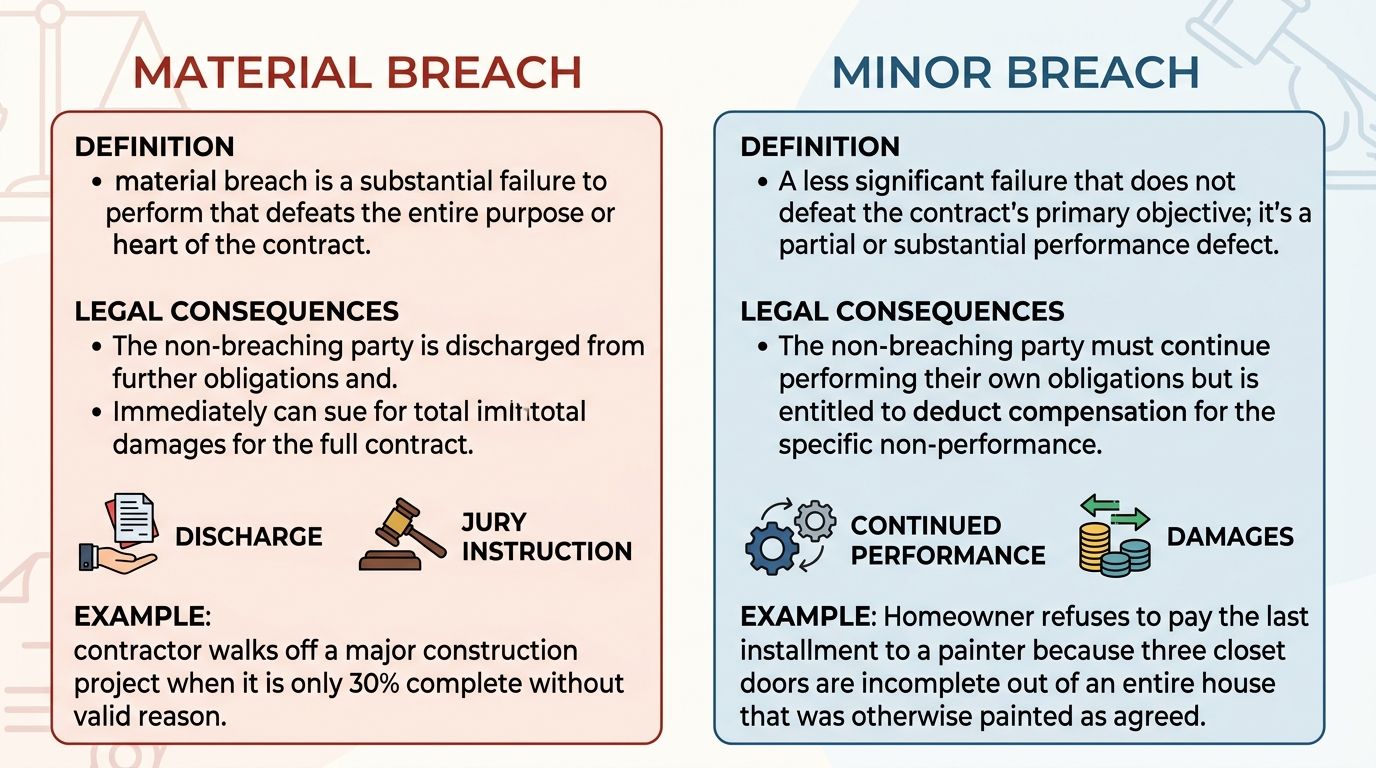
    Side-by-side comparison graphic contrasting material breach and minor breach under California contract law with legal definitions and examples

    Side-by-side comparison of material breach versus minor breach under California contract law

    Understanding Material Breach Under California Law and CACI 303

    The final and most heavily litigated element is proving that the defendant’s failure to perform was more than a minor slip-up; it was a material breach. A material breach is a substantial failure that goes to the heart of the contract, effectively depriving the non-breaching party of the benefit of their bargain. This determination is fact-specific. California courts consider factors such as the extent of the benefit deprived, the adequacy of compensation for that loss, and the likelihood of the breaching party curing the failure. The pivotal CACI 303 jury instruction guides the fact-finder on this very question. According to CACI 303, sourced from the California Courts, the jury must decide whether a failure was so important that it constitutes a material breach, excusing the other party’s performance. It is not a question of a simple failure, but a failure of such consequence that it destroys the essential purpose of the contract.

    To further clarify these distinct legal concepts and their consequences in litigation, the table below provides a side-by-side comparison.

    Aspect Material Breach Minor Breach
    Definition A breach that goes to the essence of the contract and deprives the non-breaching party of the benefit of the bargain. A breach that does not go to the root of the contract; the non-breaching party still receives substantial performance.
    Legal Consequence Non-breaching party may suspend performance and is discharged from further obligations under the contract. Non-breaching party must still perform but may sue for damages caused by the breach.
    CACI 303 Application Jury must find materiality has been proven to justify discharge of duties. CACI 303’s materiality requirement is not triggered; focus is on damages only.
    Example Failure to deliver goods required under a sales contract where time is of the essence. Delivering goods one day late but no time-is-of-the-essence clause.

    The distinction is outcome-determinative. A finding of material breach by a jury under CACI 303 discharges the injured party from their own obligations, a powerful remedy in a breach of contract litigation California dispute. Conversely, a minor breach still requires the non-breaching party to perform, though they retain the right to sue for any monetary losses suffered. As McCaslin Law, PC explains in our analysis of material breach, this legal standard is the fulcrum of most contract disputes. Successfully demonstrating or defending against a material breach claim is often the deciding factor in trial, which is why our aggressive advocacy and trial-first mentality are focused on dominating this critical legal battleground. The information provided here is for educational purposes only and does not constitute legal advice. Contacting our firm does not create an attorney-client relationship, and prior results do not guarantee a similar outcome.

    Proving Causation and Recovering Damages for Breach of Contract in California

    When evaluating the elements of breach of contract in California, proving causation is the step that transforms a broken promise into a compensable claim. As we explain in our overview of breach of contract claims, a plaintiff must establish four elements: existence of a valid contract, the plaintiff’s performance (or valid excuse), the defendant’s material breach, and damages directly caused by that breach. This section narrows the focus to causation and the types of monetary relief available once that link is proven.

    Proving Causation: Connecting the Breach to Resulting Damages

    To recover damages in a California contract dispute, the plaintiff must demonstrate both actual cause and proximate cause. Actual cause—often framed as the “but-for” test—asks whether the plaintiff’s losses would have occurred absent the defendant’s breach. Proximate cause, in turn, limits recovery to harms that were a reasonably foreseeable result of the breach at the time the contract was formed. California courts apply these principles strictly. Even a clear breach yields no recovery if the plaintiff cannot trace the claimed injury directly to the defendant’s failure to perform.

    Establishing causation requires a tight factual narrative supported by documentary and testimonial evidence. We work with clients to map the precise chain of events, distinguishing between losses that flow directly from the breach and those attributable to independent market forces or third-party actions. This approach aligns with the guidance provided by McCaslin Law, PC on the foundational elements of a breach claim—performance, breach, causation, and damage—each of which must be independently proven.

    Categories of Recoverable Damages in California Contract Cases

    Once causation is established, the next question is what damages can be recovered. California law recognizes several distinct categories, each with its own pleading and proof standards. Compensatory damages—also called general damages—serve as the primary measure under California Civil Code Section 3300. They are designed to place the non-breaching party in the position they would have occupied had the contract been performed as agreed. Consequential damages go further, compensating for indirect losses that were within the contemplation of the parties at contract formation. Because these damages are not presumed, they must be specifically pleaded and proven to have been foreseeable at the outset of the agreement. Reliance damages offer an alternative route: instead of seeking lost profits, the plaintiff recovers out-of-pocket expenditures made in reasonable reliance on the contract. Finally, liquidated damages—a fixed sum specified in the contract—are enforceable in California only when the amount constitutes a reasonable estimate of actual harm and does not operate as a penalty, as required by California Civil Code Section 1671.

    Understanding these categories is essential because the choice of damage theory dictates the evidence needed at trial and influences the overall litigation strategy. The table below summarizes how each type functions in California contract litigation.

    Damage Type Definition Recoverable in CA Contracts? Example
    Compensatory (General) Damages Damages that place the non-breaching party in the position they would have been in had the contract been performed. Yes – the primary measure of contract damages under California Civil Code Section 3300. Lost profits from a breached business deal.
    Consequential (Special) Damages Damages that flow indirectly from the breach but were foreseeable by the parties at the time of contracting. Yes, if specifically pleaded and proven to have been within the contemplation of the parties. Lost business opportunities caused by delayed delivery of essential equipment.
    Reliance Damages Damages that reimburse the non-breaching party for expenses incurred in reliance on the contract. Yes, as an alternative to expectancy damages in certain circumstances. Costs incurred preparing to perform under the contract.
    Liquidated Damages A specific sum agreed upon by the parties in the contract as compensation for breach. Yes, if the amount is reasonable and not a penalty under California Civil Code Section 1671. $100 per day late fee specified in a construction contract.

    All damage types are available but each has specific pleading and proof requirements. Selecting the appropriate theory early shapes how we build the evidentiary record and frame the prayer for relief.

    Breach of contract litigation in California rests on the same four-element foundation discussed above but requires a strategic decision about when and how to file. A plaintiff must be prepared to plead and prove a valid contract, the plaintiff’s full performance (or a legally recognized excuse), the defendant’s material breach, and resulting damages connected by adequate causation. Without a cohesive narrative linking these elements, even a strong case can face early dismissal or an adverse summary judgment ruling.

    Our trial-first mentality and aggressive advocacy mean we evaluate every potential claim through the lens of a courtroom presentation. We examine whether the contract’s terms give rise to an unambiguous obligation, whether the defendant’s conduct departed from those terms in a material way, and whether documentary evidence and witness testimony will support each required element. In many instances, fiduciary duty claims arise alongside contract claims, but as noted in McCaslin Law, PC’s analysis of fiduciary breach litigation, these theories carry distinct standards—causation must be separately proven for each cause of action. With contract claims, the focus remains squarely on the express and implied terms of the agreement and the foreseeable consequences of breaching them.

    These legal grounds form the backbone of any breach of contract lawsuit and directly inform the litigation choices discussed in the next section—from forum selection to the framing of the complaint. For information in Spanish on workplace accident attorneys in San Jose, visit our dedicated page on abogados de accidentes de trabajo en San Jose. This website is for informational purposes only and does not constitute legal advice. Contacting McCaslin Law, PC does not create an attorney-client relationship. Prior results do not guarantee similar outcomes.

    Statute of Limitations and Strategic Timing for Breach of Contract Claims

    After establishing what constitutes a breach, the next critical question is when to file a claim. In California, the statute of limitations for a written contract is generally four years under Code of Civil Procedure section 337. This deadline for contract claims—often called the statute of limitations breach of contract California—sets a firm limit on bringing suit. Understanding this timeline is essential for anyone considering breach of contract litigation in California.

    The period starts from the date of the breach, not from discovery, unless fraud or concealment is involved. The clock starts immediately upon the failure to perform, making delay costly. A clear grasp of the California breach of contract statute of limitations helps clients decide when to file, especially for damages or specific performance.

    Strategic timing is crucial because evidence and witnesses can fade. Filing before documents disappear or witnesses become unavailable preserves a strong case. The statute of limitations guides early action; we encourage clients to seek prompt assessment. Proactive timing can prevent dismissal of an otherwise valid claim.

    The elements of breach of contract California law requires—such as a valid contract, performance or excuse, breach, and resulting damages—are closely tied to the statute of limitations. Under CACI jury instructions, a plaintiff must also prove that the claim was timely filed. This adds a procedural layer to the substantive elements of breach of contract claims. McCaslin Law’s trial-first mentality emphasizes early preparation for tactical advantage. By investigating and preserving evidence immediately, we position our clients to meet critical deadlines and strengthen their litigation posture. This strategic approach aligns with our philosophy of aggressive advocacy, ensuring that clients are never caught off guard by a looming statute of limitations breach of contract California deadline. Understanding these timing nuances informs our strategic choices, including the pursuit of damages and specific performance—topics we will explore next.

    Frequently Asked Questions About Breach of Contract in California

    After reviewing the remedies available for a breach, many people have procedural questions about their case. Below we answer the most common questions we hear from clients.

    What constitutes a breach of contract in California?

    A breach occurs when one party fails to perform a duty under a legally enforceable agreement without a valid excuse. The elements of breach of contract in California require proving a valid contract, your performance or excuse for non-performance, the other party’s failure to perform, and resulting damages. The specific facts of your situation will determine whether you have a viable claim.

    What is the statute of limitations for breach of contract in California?

    The statute of limitations breach of contract California is four years for written contracts and two years for oral contracts, according to McCaslin Law’s litigation FAQ. This means you must file a lawsuit within that window or your claim may be permanently barred. The clock typically starts running on the date the breach occurred, not when you signed the agreement.

    Can the statute of limitations be tolled in a California breach of contract case?

    Yes, certain tolling exceptions may pause the limitations period under California law. Common examples include situations involving fraud, where the defendant concealed the breach, or cases where the plaintiff is under a legal disability. These exceptions are highly fact-specific, which is why breach of contract litigation California requires careful analysis of your unique timeline.

    What should I do if someone breaches a contract with me in California?

    First, document the breach thoroughly and preserve all related communications. Then, speak with an experienced litigation attorney who can evaluate the viability of your claim and explain your legal options. At McCaslin Law, PC, we offer consultations to discuss your matter and provide an honest assessment. Contacting us does not create an attorney-client relationship, and this FAQ is for informational purposes only and does not constitute legal advice.

    Proving a California contract claim demands four elements of a breach of contract in California: valid contract, performance, breach, and damages. Under our firm’s internal guidance, in breach of contract litigation in California we gather written agreements, emails, and performance records to prove each element. We assess material versus minor breach and remember the statute of limitations for breach of contract in California is four years for written contracts. With trial-first preparation and aggressive advocacy, we build a robust case against well-funded defense teams. Contact us to evaluate your claim.

    Boutique Litigation. Formidable Results.

    This website is for informational purposes only and does not constitute legal advice. Contacting McCaslin Law, PC does not create an attorney-client relationship.

    Resources

  • Hire Non-Disclosure Agreement Disputes Lawyer Sacramento: Fast Response

    Hire Non-Disclosure Agreement Disputes Lawyer Sacramento: Fast Response

    Table of Contents

    Retain an Experienced NDA Disputes Lawyer in Sacramento, California

    When your confidential information is at stake, you need a dedicated non-disclosure agreement disputes lawyer who prepares every case for trial. At McCaslin Law, PC, we bring a trial-first mentality to NDA enforcement and defense across Northern California.

    We handle complex breach of confidentiality matters, from improper disclosure by former employees to competition by departing partners. Whether you are enforcing non-disclosure agreements in California or defending against a claim, we prepare each matter as if it will go to verdict. Our team works directly with clients to pursue breach of confidentiality agreement remedies, including injunctive relief and damages. We leverage courtroom-tested evidence preservation and aggressive motion practice to protect client interests early and throughout litigation effectively. As detailed in our internal NDA dispute resources, our experience spans state and federal courtrooms in Sacramento and beyond.

    Contact us to discuss your NDA dispute with an experienced trial attorney. This website is for informational purposes only and does not constitute legal advice. Contacting McCaslin Law does not create an attorney-client relationship. You can verify our standing through California Bar Association public resources.

    Understanding Your Options with an NDA Disputes Lawyer in Sacramento, California

    When confidential business information is disclosed without authorization, the consequences can be severe. Whether you are a business owner, an inventor, or a professional protecting trade secrets, a breach of a non-disclosure agreement can threaten your competitive advantage. At McCaslin Law, PC, we approach every case with a trial-first mentality, ensuring that when you seek a non-disclosure agreement disputes lawyer in Sacramento, California, you receive resolute and strategic representation from the outset.

    In California, the enforcement of non-disclosure agreements is primarily governed by the Uniform Trade Secrets Act (UTSA), codified in California Civil Code sections 3426 through 3426.11, along with established common law principles for breach of contract. This framework provides the legal basis for protecting proprietary information, defining a trade secret broadly as information that derives independent economic value from not being generally known and is subject to reasonable efforts to maintain its secrecy. For those unfamiliar with procedural nuances, California court system resources offer general self-help guidance, though navigating litigation requires experienced counsel.

    Our role in enforcing non-disclosure agreements in California begins with a meticulous analysis of the contract itself. We examine the agreement’s scope, including how it defines confidential information, the duration of the secrecy obligation, and the specific exclusions. A well-drafted NDA is your first line of defense, but even a broadly written agreement can be vigorously enforced when the underlying information meets the statutory definition of a trade secret. We prepare every matter as if it will be tried to a verdict, leveraging our deep understanding of California law to build a commanding case from the initial filing.

    Identifying a Breach of Confidentiality

    Recognizing a violation early is critical to mitigating damage. Common breach scenarios we handle in Sacramento include a former employee downloading sensitive client lists before joining a competitor, a business partner using proprietary manufacturing processes after a partnership dissolves, or a consultant sharing your strategic roadmap with a third party in violation of explicit contractual terms. These situations often arise quietly, surfacing only when a competitor suddenly gains an inexplicable market advantage or client accounts begin to erode unexpectedly.

    When we investigate a potential breach, we look for concrete evidence of unauthorized use or disclosure. This can include forensic analysis of digital footprints, sudden patterns of client migration, or even the appearance of a startlingly similar product from a former collaborator. Direct evidence is compelling, but circumstantial proof, such as a former fiduciary’s unusual behavior or unexplained wealth, can also form the basis of a strong claim. Our aggressive advocacy ensures we pursue every avenue to uncover the truth and hold the responsible party accountable.

    California law provides a range of powerful remedies for NDA violations. The most immediate form of relief is a temporary restraining order or a preliminary injunction, which commands the breaching party to stop using or disclosing the protected information immediately. This court order is often the most critical tool for containing damage, preventing the swift erosion of your market position while the lawsuit proceeds. Injunctive relief is not automatic, however; a plaintiff must demonstrate a likelihood of success on the merits and the threat of irreparable harm, a standard we routinely meet through meticulous preparation.

    Beyond stopping the breach, our firm pursues monetary damages designed to make you whole. These breach of confidentiality agreement remedies can include actual losses incurred as a direct result of the breach and restitution of any unjust enrichment gained by the wrongdoer. In cases where the misappropriation is willful and malicious, we may also seek exemplary damages and recovery of reasonable attorney’s fees, as authorized under the California UTSA. Every approach we take is infused with our aggressive advocacy, maximizing pressure on the opposing party to achieve a decisive result, whether through a favorable settlement or at trial.

    For more on how we handle NDA litigation and our unwavering commitment to preparing every case for the courtroom, we invite you to see our approach. Contact McCaslin Law, PC to discuss your specific situation and how we can help protect your most valuable assets.

    This website is for informational purposes only and does not constitute legal advice. Contacting McCaslin Law, PC does not create an attorney-client relationship. Prior results do not guarantee similar outcomes.

    Key Benefits of Hiring an NDA Disputes Lawyer in Sacramento, California

    When your confidential business information is at risk, securing a non-disclosure agreement disputes lawyer in Sacramento, California is a critical step toward protecting your interests. At McCaslin Law, PC, we combine deep local court knowledge with a relentless commitment to safeguarding our clients’ proprietary information, ensuring that every aspect of your case is handled with the urgency and precision it demands.

    Direct Attorney Involvement from the Start

    From the initial consultation through resolution, you work directly with an experienced trial attorney who personally manages every facet of your case. We do not delegate critical legal work to junior associates or paralegals. This model ensures that the person developing your strategy, negotiating with opposing counsel, and arguing before the court is the same seasoned litigator you hired. For businesses facing the theft of trade secrets or a confidential information leak, this direct line of communication means faster decisions, a deeper understanding of your commercial realities, and a cohesive strategy that doesn’t get lost in translation. Our clients benefit from over 25 years of trial experience focused entirely on their matter, providing a level of service and accountability that larger, assembly-line firms simply cannot match.

    Trial-Ready Strategy for Complex NDA Cases

    We approach every dispute with a Trial-first mentality. This means we prepare your case from day one as if it will be decided by a judge or jury, not just settled at a conference table. This aggressive posture fundamentally changes the dynamics of a dispute. When opposing parties recognize that your legal team is fully prepared to litigate, they are often compelled to offer more favorable settlement terms. Our methodology involves meticulous evidence gathering, proactive witness preparation, and the development of a compelling narrative that resonates in court. For clients seeking remedies for a breach of confidentiality, such as enforcing non-disclosure agreements California demands, this strategy turns the threat of a trial into a powerful negotiation tool. You gain the confidence of knowing that if a fair settlement is not reached, you are represented by a team that is fully equipped and eager to achieve Boutique Litigation. Formidable Results.

    Comprehensive Protection for Trade Secrets and Confidential Information

    The moment a non-disclosure agreement is violated, swift action is essential to prevent irreparable harm. We provide a full spectrum of protection, starting with immediate emergency measures. This includes obtaining temporary restraining orders (TROs) and preliminary injunctions to immediately halt the dissemination of your sensitive data. From there, we build a long-term litigation strategy aimed at recovering damages and permanently enjoining the wrongful conduct. Our firm handles complex matters far beyond NDA disputes, including cases such as bad faith insurance claims in California, demonstrating our versatile litigation prowess. By pursuing all available breach of confidentiality agreement remedies, we send an unequivocal message that we will exhaust every legal avenue to protect your intellectual property and goodwill, embodying our commitment to Aggressive advocacy for every client.

    This website is for informational purposes only and does not constitute legal advice.

    How an NDA Disputes Lawyer in Sacramento, California Builds Your Case

    Once you understand the fundamentals of a non-disclosure agreement breach, the next step is recognizing how a dedicated non-disclosure agreement disputes lawyer translates your situation into a powerful, actionable legal strategy. At McCaslin Law, PC, we bring a trial-first mentality to every case, meticulously constructing your claim from the ground up to ensure maximum leverage, whether that leads to a courtroom victory or a highly favorable settlement. Our approach is systematic and aggressive, designed to protect your confidential information through strategic litigation in Sacramento and across Northern California.

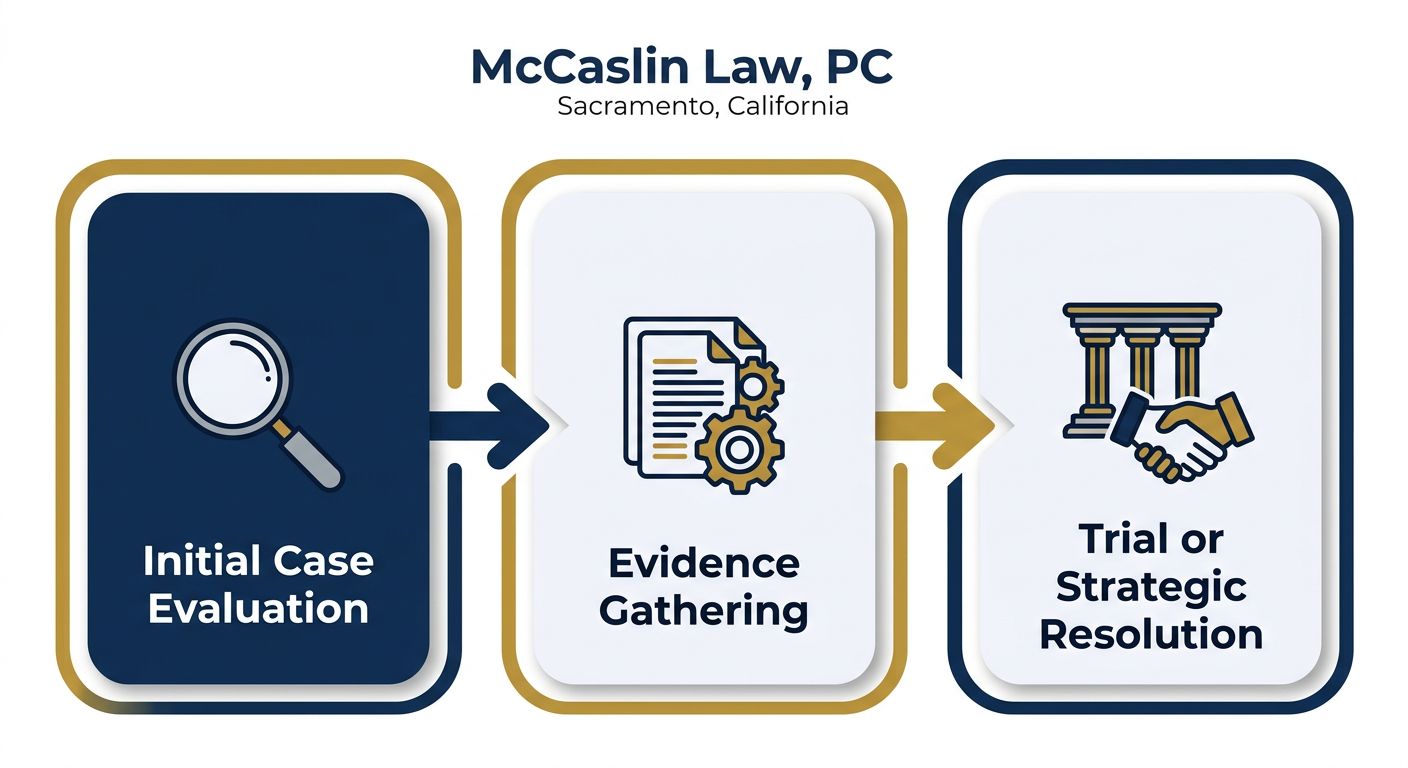
    Horizontal process flow diagram showing three stages of NDA case preparation in Sacramento, California. First stage shows initial case evaluation with magnifying glass, second stage shows evidence gathering with document and gear, third stage shows trial or strategic resolution with courtroom column and handshake. Arrows connect stages left-to-right.
    Systematic NDA case preparation process by McCaslin Law

    This framework is built on decades of Northern California courtroom experience, and it forms the bedrock of how we pursue justice for clients facing an NDA breach.

    Initial Case Evaluation and Strategy Session

    Your case begins with a comprehensive, confidential consultation where we review the signed non-disclosure agreement and meticulously analyze the specifics of the alleged breach. As your non-disclosure agreement disputes lawyer, we will assess the validity and scope of the contract, evaluate the evidence you possess, and outline the potential legal theories available to you under California law. According to McCaslin Law’s NDA Disputes FAQ, a claim hinges on proving a valid NDA, a breach of its terms, and resulting damages. We will discuss a tailored strategy, walking you through the litigation roadmap and what to expect in terms of process. Beyond NDA disputes, our firm also handles workers compensation in California cases with the same relentless, aggressive advocacy, reflecting our broad litigation capability.

    Evidence Gathering and Pre-Trial Preparation

    If litigation becomes necessary, enforcing non-disclosure agreements in California demands a watertight factual record built through rigorous discovery. We immediately act to issue document preservation demands, ensuring no critical electronic or physical evidence is destroyed. Our team conducts exhaustive discovery, including requests for production, interrogatories, and depositions to secure testimony from the opposing party and key witnesses. This phase is about constructing an irrefutable narrative of the breach. We dig deep to trace the misuse of your trade secrets or confidential data, meticulously preparing every exhibit and argument as if a jury will see it tomorrow. This intense preparation directly supports our goal of securing significant breach of confidentiality agreement remedies, which may include injunctive relief, monetary damages, and recovery of legal fees.

    Aggressive Trial Representation or Strategic Resolution

    Every case we build is prepared for a courtroom showdown, embodying our firm’s aggressive advocacy and trial-first mentality. This unwavering preparation creates significant leverage because opposing counsel knows we are fully capable and willing to take a case to verdict. Your case is handled directly by experienced counsel, not delegated to junior associates, ensuring sophisticated oversight at every stage. While we relentlessly prepare for trial, we also remain open to strategic resolution when it aligns with your objectives. A favorable settlement, achieved from a position of undeniable strength, is often the most efficient way to protect your interests. This foundation of meticulous case-building leads directly to why an experienced litigator is not just an option, but a necessity—and how McCaslin Law delivers formidable results in and out of the courtroom.

    This website is for informational purposes only and does not constitute legal advice. Contacting McCaslin Law, PC does not create an attorney-client relationship. Prior results do not guarantee similar outcomes.

    Best Practices for NDA Disputes in Sacramento, California

    Proactive Measures to Safeguard Your Trade Secrets

    Proactive measures are the first line of defense against NDA disputes. We advise businesses in Sacramento, California, to implement clear confidentiality policies that define trade secrets precisely and restrict employee access. Requiring signed non-disclosure agreements for any personnel handling sensitive information is essential. Use access controls such as password-protected systems, locked file cabinets, and restricted areas, and conduct regular training on NDA obligations. Defining what constitutes a trade secret under California law is a critical first step; without clear documentation, enforcing non-disclosure agreements in California becomes significantly harder. We help clients catalog their confidential information and classify access levels, ensuring that every NDA is tailored to the specific risks associated with their business. Regular refresher training keeps employees aware of their duties and reduces inadvertent disclosures. When a dispute arises, a non-disclosure agreement disputes lawyer in Sacramento, California, can evaluate whether these measures were adequate. Our firm’s trial-first mentality ensures that every protection we put in place is designed to withstand courtroom scrutiny, providing aggressive advocacy from the start.

    Responding Swiftly to a Potential Breach

    If you suspect a breach of an NDA, immediate action is critical. Preserve all evidence; save emails, files, and metadata before they can be altered or destroyed. Send a formal cease-and-desist letter demanding the return or destruction of confidential materials and cessation of further use. Contacting an experienced non-disclosure agreement disputes lawyer in Sacramento promptly is vital; do not attempt to negotiate with the other party on your own. We recommend that you avoid any internal investigation that could inadvertently spoil evidence. Understanding breach of confidentiality agreement remedies available under California law allows you to move decisively. Our boutique litigation firm is known for formidable results precisely because we respond with speed and precision, leveraging every tool to protect your trade secrets. We also advise documenting every step taken to preserve a clear record for potential court proceedings. Taking these actions immediately can preserve vital options for legal recourse.

    An experienced litigation attorney should lead your NDA dispute response from the outset. At McCaslin Law, our trial-first mentality means we prepare every matter as if it will go to verdict, which maximizes settlement leverage. Our firm’s FAQ on non-disclosure agreement disputes provides practical guidance on common scenarios and recommended steps, and we encourage clients to review that resource. Strategic timing of legal action, including seeking injunctive relief early, can prevent irreparable harm. We also safeguard privilege and avoid actions that could inadvertently waive protections. Consider leveraging American Bar Association professional development resources to stay current on NDA enforcement trends; our attorneys continually advance their skills through such programs to deliver aggressive advocacy in Sacramento courtrooms. This article is for informational purposes only and does not constitute legal advice. Contacting McCaslin Law, PC through this website does not create an attorney-client relationship.

    Contact an NDA Disputes Lawyer in Sacramento, California Today

    If you are dealing with a violation of a confidentiality agreement, the right legal strategy can make all the difference. As a non-disclosure agreement disputes lawyer in Sacramento, California, our firm is equipped to act quickly to protect your proprietary information and pursue all available remedies for a breach of confidentiality. We understand that time is a critical factor, whether you need to secure a temporary restraining order or are facing an imminent statute of limitations.

    Our firm’s trial-first mentality and commitment to aggressive advocacy set us apart. When you engage an NDA disputes attorney in California, you work directly with experienced counsel who prepares every matter for the courtroom from day one. Whether your case involves enforcing non-disclosure agreements in California or pursuing breach of confidentiality agreement remedies, we deliver the strategic, meticulous preparation that formidable results demand. We also represent clients across a broad spectrum of civil litigation. Whether you need representation for NDA disputes, a truck accident lawyer in Oakland, or other complex civil matters, we are ready to help.

    To take the first step, we invite you to reach out for a free initial consultation to discuss your situation with a confidentiality breach lawyer. Contact McCaslin Law, PC by calling (916) 330-4147 or by using the contact form available on our website. Our team serves individuals and businesses throughout Northern California, bringing extensive courtroom experience to every case.

    Disclaimer: Contacting McCaslin Law, PC does not create an attorney-client relationship. This website is for informational purposes only and does not constitute legal advice. Prior results do not guarantee similar outcomes. Information submitted through this form is not guaranteed to be confidential.

    Resources

  • California Construction Law Updates 2026: Key Changes

    California Construction Law Updates 2026: Key Changes

    Table of Contents

    California Construction Law Updates for 2026: Key Changes Impacting Your Projects

    We are closely monitoring the 2026 construction law changes in California that will reshape project dynamics across the state. For owners, developers, and contractors, understanding the California construction law updates 2026 is critical to maintaining compliance and avoiding costly disputes. One of the most significant legislative developments is Senate Bill 440, which introduces a new framework for retention on private works projects effective January 1, 2026.

    Under the new rules, the private works retention cap California is reduced from the traditional 5% to a more balanced 3%, easing cash flow pressures on contractors and subcontractors while still protecting project owners. Equally important is the SB 440 claims resolution process, which now mandates a structured 30-day notice period and a subsequent 60-day cure period before any legal action can be initiated. This procedural change demands meticulous documentation and swift, strategic responses from all parties involved to preserve their rights and remedies.

    For those navigating these new California construction laws for 2026, the stakes are high. A misstep in the claims process can jeopardize a valid claim or expose a party to unexpected liability. As a dedicated litigation firm in Sacramento, McCaslin Law, PC brings a trial-first mentality and deep experience in construction defect litigation to help clients aggressively advocate for their interests. We prepare every case as if it will go to verdict, positioning you for the most formidable result from the outset.

    This website is for informational purposes only and does not constitute legal advice. Contacting McCaslin Law, PC does not create an attorney-client relationship. Prior results do not guarantee similar outcomes.

    Foundational Changes: SB 440 and the Private Works Retention Cap

    As part of the 2026 California construction law updates, one of the most significant changes is SB 440, which fundamentally restructures how retention is handled on private works projects in California. The legislation introduces a new private works retention cap that limits the amount a property owner can withhold from a contractor’s payment. Under SB 440, the cap is set at 5% of the contract sum for the first $1,000,000, with a reduced rate applying to any amount above that threshold. This represents a substantial departure from prior practice, where retention amounts on private projects were often determined solely by contract terms and could reach much higher percentages.

    SB 440 took effect on January 1, 2026, and applies to private works contracts entered into on or after that date. The full text and enactment details are available through the California legislative information portal, which serves as the authoritative source for the law’s language and requirements. By establishing a statutory ceiling, the law aims to provide clarity and predictability for both contractors and property owners.

    In contrast to public works retention rules, which have long been governed by specific statutory caps, private projects previously lacked uniform standards. While public works projects in California have been subject to retention limits designed to protect subcontractors and suppliers, private works were often governed by contractual agreements that could impose significantly higher withholding amounts. SB 440 brings private works closer to the public works framework, though important differences remain—most notably in the percentages allowed and the triggering events for release.

    Beyond capping the amount withheld, SB 440 also shortens the timeline for releasing retention after project completion or acceptance. This change is intended to improve contractor cash flow and reduce the administrative burden of long-delayed payments. The legislation is part of a broader effort to streamline the SB 440 claims resolution process and reduce disputes that commonly arise when retention funds are tied up for extended periods.

    While these provisions represent a significant shift, they do not provide automatic relief—property owners and contractors must still assert their rights properly. We encourage anyone involved in a private works project to consult a qualified attorney to understand how SB 440 applies to their specific situation. At McCaslin Law, our civil litigation practice has experience resolving retention disputes under the new framework. With our extensive Northern California courtroom experience and aggressive advocacy, we are prepared to help clients navigate the complexities of SB 440 and protect their interests. Whether through negotiation or trial, we build maximum leverage to achieve decisive results.

    Understanding SB 440 Claims and the 5% Retention Cap in Detail

    Following our overview of SB 440’s transformative impact on California’s construction industry, we now examine the specific provisions that directly affect contractors, subcontractors, and project owners operating under private works contracts. The California construction law updates 2026 bring fundamental changes to payment practices, with the legislature establishing clear statutory requirements designed to address long-standing cash flow challenges in the construction sector.

    The Private Works Retention Cap (Civil Code Section 8811)

    California Civil Code Section 8811, as amended by SB 440, establishes that retention proceeds on private works contracts cannot exceed 5% of the contract price. This represents a meaningful reduction from the previous industry standard and applies broadly across private construction projects throughout the state. The private works retention cap California rules are designed to accelerate cash flow to contractors while maintaining sufficient security for project owners concerned about performance deficiencies or lien exposure.

    SB 440 Claims Resolution Process

    The SB 440 claims resolution process introduces a mandatory 15-day timeline for owners to respond to payment claims on private works. This compressed response period, reduced from the previous 30-day standard common in private contracts, requires owners to evaluate claims promptly and provide substantive responses detailing any disputed amounts or specific objections. Failure to respond within the 15-day window can result in significant consequences, including the statutory imposition of interest penalties and potential waiver of defenses to payment.

    Intersection of Retention Rules and the Fair Payment Act

    Under the new statutory framework, contractors in Sacramento and throughout Northern California must evaluate claims under multiple authorities. Our firm handles real estate litigation in Sacramento and assists contractors in understanding how these statutory changes affect their payment rights and enforcement options.

    Aspect Pre-2026 Post-2026 (SB 440)
    Owner response time 30 days (standard contract) 15 days for private works claims
    Maximum retention 10% of contract price 5% of contract price (Civil Code 8811)
    Interest on late payments 1.5% per month (standard) 2% per month mandatory penalty

    Practical Compliance Steps for Contractors and Owners

    Updating Your Contracts for 2026 Compliance

    The cornerstone of compliance with the California construction law updates 2026 is a thorough revision of your standard contract templates. The most critical update concerns the retention cap. For all private works, the amount a project owner can withhold from a contractor is now capped at 5% of the contract price. Your contracts must reflect this private works retention cap California requirement.

    Documenting Change Orders and Prompt Pay Procedures

    Adopting a rigorous SB 440 claims resolution process is essential. This process hinges on the principle that a written change order is required for any deviation from the original scope of work. SB 440 also imposes a strict timeline for owners to respond to payment claims. Failure to respond within the statutory timeframe can have significant consequences. The law’s most powerful enforcement mechanism is its prompt pay penalty: a 2% monthly interest charge on overdue amounts.

    Best Practices for Avoiding Payment Disputes

    When friction escalates beyond a simple fix, leverage early dispute resolution. The new laws’ emphasis on mandatory mediation is a strategic opportunity. However, if these efforts fail, unresolved construction payment conflicts can ultimately lead to complex civil litigation in Sacramento, which requires experienced legal counsel.

    Dispute resolution for contractors has been reshaped by the California construction law updates 2026. Central to the new framework is the SB 440 claims resolution process, a statutory mechanism designed to streamline payment-related disputes. Our firm’s trial-first mentality means that even when we are engaged in alternative dispute resolution, we are meticulously preparing for trial.

    Frequently Asked Questions About the 2026 Construction Law Changes

    When do the 2026 construction law updates in California take effect?
    The statutory changes come into effect on January 1, 2026.

    What is the new retention cap on private works in California?
    Recent legislation establishes a specific private works retention cap in California, reducing the percentage an owner can withhold.

    Preparing Your Business for Success in 2026

    2026 brings important California construction law updates, such as SB 440‘s 5% retention cap. Our trial-first mentality ensures aggressive advocacy when disputes arise. Contact us to navigate the 2026 updates and safeguard your projects.

    Resources

  • Expert Commercial Lease Enforcement Sacramento for Landlords

    Expert Commercial Lease Enforcement Sacramento for Landlords

    Table of Contents

    Commercial Lease Enforcement in Sacramento, California

    When a tenant fails to pay rent, holds over past the lease term, or otherwise violates a lease covenant, pursuing commercial lease enforcement in Sacramento becomes necessary to protect your property rights and income stream. The primary legal mechanism for regaining possession is a commercial unlawful detainer action — a summary proceeding filed in Sacramento County Superior Court that is governed by California-specific statutes and accelerated timelines designed to resolve possession disputes more quickly than a standard civil case.

    Beyond eviction, a landlord’s available breach of commercial lease remedies in California include claims for past-due rent, recovery of the leased premises through a judgment for possession, early lease termination, and monetary damages for harm caused by the breach. The American Bar Association emphasizes that exploring early negotiation or alternative dispute resolution can often preserve business relationships when a commercial tenancy falters. Because a commercial unlawful detainer in Sacramento demands strict compliance with notice requirements and court rules, we encourage you to speak with a dedicated commercial litigation attorney in Sacramento who can guide your enforcement strategy. Our firm approaches every dispute with aggressive advocacy and a trial-first mentality, preparing each matter as if it will be tried to verdict. This overview is provided for general information and does not constitute legal advice; contacting McCaslin Law, PC does not create an attorney-client relationship. Learn how we put that philosophy to work in commercial lease conflicts by continuing below.

    The Commercial Lease Enforcement Landscape in Sacramento

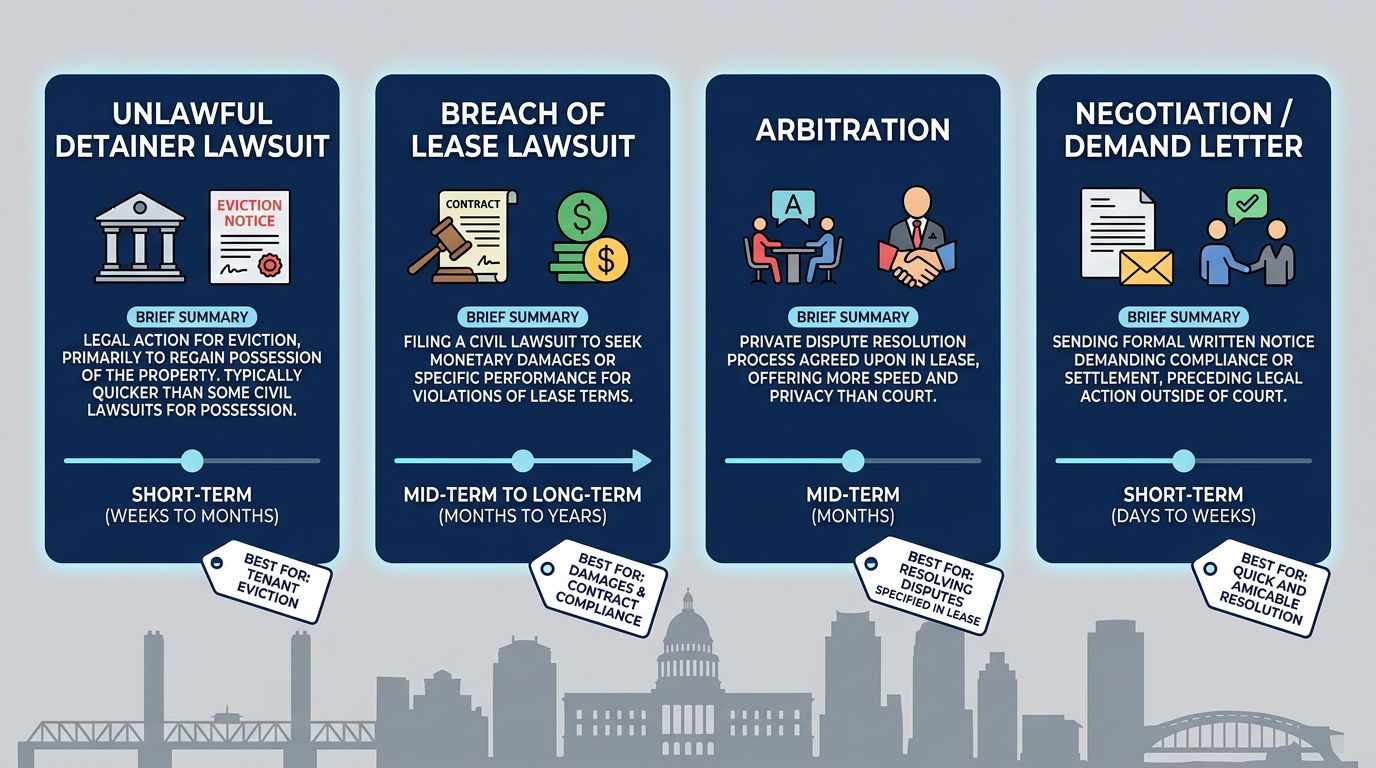
    For Sacramento landlords, a commercial lease breach demands swift action. The commercial lease enforcement sacramento landscape includes powerful legal remedies to recover possession, unpaid rent, and enforce lease terms. At McCaslin Law, we bring a Trial-first mentality and Aggressive advocacy, preparing each case for trial. The table below outlines each method.

    Commercial Lease Enforcement Options in Sacramento
    MethodDescriptionTimelineBest For
    Unlawful Detainer LawsuitCourt action to evict tenant and recover possession.Typically 4-8 weeks if uncontested.Clear-cut non-payment or holdover cases.
    Breach of Lease LawsuitSuit for damages or specific performance.Months to a year depending on complexity.Non-monetary violations or complex disputes.
    ArbitrationPrivate dispute resolution per lease terms.Varies; often faster than litigation.Parties seeking confidentiality and efficiency.
    Negotiation / Demand LetterPre-litigation demand to resolve without court.Days to weeks.Early-stage disputes or cooperative tenants.

    The unlawful detainer lawsuit handles eviction for non-payment or holdover, with the California Courts noting a timeline of 4-8 weeks if uncontested, known as a commercial unlawful detainer sacramento action. For non-monetary breaches, a breach of lease lawsuit may seek breach of commercial lease remedies california like damages or specific performance, though litigation can take months. Arbitration and demand letters provide faster, private alternatives; consult a real estate litigation attorney in Sacramento to determine the best path.

    Infographic comparing four commercial lease enforcement methods: Unlawful Detainer, Breach of Lease, Arbitration, and Negotiation/Demand Letter, with timeline and best-use indicators, featuring Sacramento skyline silhouette.

    Qualitative comparison of lease enforcement methods for Sacramento commercial tenants and landlords.

    Understanding the full commercial lease enforcement sacramento landscape is essential; contact us to discuss your dispute.

    Commercial Lease Enforcement Services for Sacramento Property Owners

    When a commercial tenant breaches a lease in California, time and revenue are at stake. Our firm provides decisive commercial lease enforcement in Sacramento that helps property owners regain control of their premises and recover what is owed. We represent landlords in disputes ranging from non-payment of rent to unauthorized property alterations and holdover tenancies.

    For the most urgent cases, we rely on the commercial unlawful detainer process. This fast-track proceeding under California law allows us to quickly restore possession of the property when a tenant refuses to pay rent or otherwise substantially violates the lease. Unlike a general eviction procedure, a well-prepared unlawful detainer action in Sacramento can move from filing to a court hearing in weeks rather than months.

    Beyond eviction, we pursue a full range of breach of commercial lease remedies in California to protect your investment:

    • Monetary damages covering unpaid rent, repair costs, and lost profits
    • Injunctive relief to stop harmful or unauthorized conduct
    • Recovery of attorney’s fees when the lease permits

    What sets our approach apart is our trial-first mentality. Every matter is prepared as if it will be tried to verdict, which means we enter negotiations from a position of strength. Our experienced litigators handle every stage directly, whether through aggressive pre-litigation negotiation or formal proceedings in state and federal court. You can learn more by visiting our FAQ pages on commercial and real estate litigation. To confirm our credentials, use the California State Bar attorney search for your own due diligence.

    Please remember: this website is for informational purposes only and does not constitute legal advice. Contacting McCaslin Law, PC does not create an attorney-client relationship. Prior results do not guarantee similar outcomes.

    The landscape of commercial lease enforcement Sacramento demands a clear understanding of local legal procedures and remedies. For commercial landlords and tenants operating in and around California’s capital city, the primary statutory mechanism for resolving lease-based conflicts is the unlawful detainer process, a specialized eviction lawsuit governed by the California court unlawful detainer process. Codified in California Code of Civil Procedure Sections 1159 through 1179a, this action is designed to restore possession of the premises to the rightful party. At McCaslin Law, we bring a trial-first mentality to these matters, ensuring every procedural step in Sacramento County Superior Court is handled with precision and strategic foresight.

    A commercial unlawful detainer Sacramento action proceeds rapidly, with the statutory timeline typically bringing a case from initial filing to a judgment within 30 to 45 days, according to California Courts. This expedited process contrasts sharply with standard civil litigation but does not offer commercial tenants the protections commonly associated with residential rent control in California. The legal remedies available for a breach of commercial lease remedies California are generally limited to three core options: termination of the lease, monetary damages to compensate for losses incurred, and specific performance—a court order compelling a party to fulfill the terms of the agreement, as framed by industry standards from the American Bar Association.

    Understanding these Sacramento-specific legal frameworks is critical for navigating a dispute effectively. The procedural rules and swift timeline require a firm that is prepared to act decisively. This information is provided for general educational purposes only and does not constitute legal advice; contacting McCaslin Law, PC does not create an attorney-client relationship.

    This content is for informational purposes only and does not constitute legal advice. Contacting McCaslin Law, PC does not create an attorney-client relationship. Prior results do not guarantee similar outcomes.

    Begin Your Commercial Lease Enforcement Case with McCaslin Law

    A breached commercial lease demands immediate action. For commercial lease enforcement Sacramento clients trust, McCaslin Law brings a trial-first mentality and aggressive advocacy to every dispute. We handle commercial unlawful detainer Sacramento filings and pursue every breach of commercial lease remedies California allows, with direct attorney involvement at every stage.

    In many Sacramento commercial lease disputes, we first explore alternative resolution. American Bar Association lease dispute arbitration offers a structured process that can save time and cost when both sides are willing to negotiate. But when negotiation fails, our firm is prepared to litigate for the fullest possible remedies for lease breach.

    To begin your case, please gather your lease, any breach notices, and correspondence, then contact us:

    • Call (916) 330-4147 to schedule a free initial consultation
    • Provide details about the lease, the alleged breach and any prior communication with the other party
    • We will evaluate your situation and outline a strategy tailored to your objectives

    This website is for informational purposes only and does not constitute legal advice. Contacting McCaslin Law, PC does not create an attorney-client relationship. Prior results do not guarantee similar outcomes.

    Protect Your Property Investment with Aggressive Lease Enforcement

    Effective commercial lease enforcement in Sacramento safeguards your property investment. The breach of commercial lease remedies California law authorizes can stop losses quickly. Common breaches include:

    • Non-payment of rent
    • Lease violations
    • Holdover tenancies

    Our trial-first strategy deters further misconduct. If a premises defect injures a tenant, consult a slip & fall attorney. For a commercial unlawful detainer in Sacramento, we pursue swift resolution. Contact us.

    This website is for informational purposes only and does not constitute legal advice. Contacting McCaslin Law, PC does not create an attorney-client relationship. Prior results do not guarantee similar outcomes.

    Resources

  • Commercial Litigation Lawyer Hourly Rate in Sacramento: Fee Breakdown for 2026

    Commercial Litigation Lawyer Hourly Rate in Sacramento: Fee Breakdown for 2026

    Table of Contents

    Commercial Litigation Lawyer Hourly Rates in Northern California

    A commercial litigation lawyer hourly rate in Northern California typically ranges from $300 to $800 or more, depending on the attorney’s experience, the complexity of the case, and the prestige of the firm. This market consistently falls on the higher end of national averages. Understanding the cost of skilled representation is the next step in making an informed decision about your legal needs.

    Several key factors influence a litigation cost breakdown. Case complexity is a primary driver—a multi-million dollar partnership dispute demands significantly more resources than a straightforward breach of contract. Attorney experience also plays a major role; a lawyer with decades of trial experience will command a higher rate than a recent graduate. The geographic zone matters too, as rates in San Francisco are often steeper than those in Sacramento or more rural areas. Finally, attorney fee structures vary: you may encounter hourly billing, flat fees for specific tasks, or contingency arrangements where the lawyer only gets paid if you win.

    At McCaslin Law, PC, we believe clients deserve direct access to a seasoned trial lawyer, not a team of junior associates. Our trial-first mentality means every case is prepared for the courtroom, which often leads to better settlements. For a complex northern California contract dispute litigation, our hourly rates may be at the higher end of the range due to extensive discovery and trial preparation, but clients pay for formidable experience. We offer free initial consultations to discuss our fee structures, including our standard retainer requirements.

    You’re not just paying for time; you’re investing in aggressive advocacy with a proven track record in Northern California courtrooms. Now that you know our fee philosophy, let’s look at the experience behind it.

    This website is for informational purposes only and does not constitute legal advice. Contacting McCaslin Law, PC does not create an attorney-client relationship.

    Comparing Attorney Fee Structures for Business Disputes

    Beyond understanding the overall costs, it is essential to evaluate how attorneys charge for their services. The commercial litigation lawyer hourly rate varies widely depending on experience, case complexity, and geographic location, but hourly billing is only one of several fee arrangements available for business disputes. Selecting the right attorney fee structures means weighing predictability, risk, and alignment of incentives—a decision that directly affects the cost of litigation and the attorney-client relationship.

    Common Attorney Fee Structures in Commercial Litigation

    The following table compares four widely used fee models in business dispute representation. Each structure carries distinct advantages and risks depending on the nature and scope of your case.

    Common Attorney Fee Structures in Commercial Litigation
    Fee TypeHow It WorksBest ForRisk to Client
    Hourly FeesClient pays a set rate per hour for all legal work performed.Ongoing or unpredictable litigation where scope is unclear.High — costs can escalate quickly without clear budget controls.
    Flat FeesA single fixed price covers the entire legal matter.Well-defined disputes or specific phases like mediation.Low — predictable cost regardless of hours spent.
    Contingency FeesAttorney fees are contingent on a successful outcome.Plaintiff-side cases with strong damages potential.Medium — no upfront cost but typically a higher percentage of recovery.
    Hybrid FeesA blend of reduced hourly rates and a success bonus.Complex disputes where risk and reward are shared.Medium — lower hourly burden but still some financial exposure.

    Hourly rates remain the most common structure in complex commercial litigation, particularly when the scope of work is difficult to define at the outset. Our firm’s fee FAQ explains typical hourly rate ranges for matters handled in Northern California. The primary drawback of an hourly arrangement is cost unpredictability—without careful budgeting, legal fees can escalate quickly as motions, discovery, and trial preparation intensify. For many clients, understanding the litigation cost breakdown before engaging counsel provides clarity and sets realistic expectations for the financial commitment ahead.

    Flat fees offer cost predictability and are best suited for well-defined disputes or specific phases of litigation. Tasks such as drafting demand letters, attending a single mediation session, or preparing a dispositive motion are often handled on a flat-fee basis. For businesses involved in northern California contract dispute litigation, a flat fee may provide cost certainty for discrete, well-defined matters. Our firm’s fee FAQ notes that flat fees are typically reserved for tasks where the scope and timeline can be reliably estimated at the start of the engagement.

    Contingency fee arrangements shift the financial risk away from the client—attorney fees are only collected upon a successful outcome. The American Bar Association’s ethical guidelines govern contingency fee agreements, which in commercial cases typically range from 25% to 40% of the recovery, subject to state bar rules. We offer contingency representation in appropriate plaintiff-side commercial disputes where the damages potential justifies the risk, though these arrangements are not available for every type of business litigation matter.

    Hybrid fee models are increasingly popular in business litigation. By combining a reduced hourly rate with a success bonus, both attorney and client share risk and reward—an approach that naturally aligns incentives. These arrangements are often tailored during our initial consultations and may be appropriate for complex contract or partnership disputes where traditional hourly or contingency models do not fully serve the client’s interests.

    We encourage potential clients to schedule a fee consultation to discuss which structure best fits their particular business dispute. Every case presents unique financial and strategic considerations, and we work closely with clients to craft billing arrangements that reflect those realities. Contacting McCaslin Law, PC does not create an attorney-client relationship.

    Drilling deeper into the numbers, a transparent view of each cost component reveals how total expenses accumulate in a business dispute. Understanding the commercial litigation lawyer hourly rate and broader attorney fee structures is essential for any company preparing for or defending against a lawsuit. A detailed litigation cost breakdown empowers clients to make informed decisions about case strategy, settlement opportunities, and resource allocation from the outset of a matter. The following table summarizes typical ranges and management strategies for each major cost category.

    Commercial Litigation Cost Component Analysis
    Cost ComponentTypical Range% of Total CostManagement Strategy
    Attorney Fees$300 – $1,000+ per hour40% – 60%Request detailed billing entries and set budget caps for each phase.
    Discovery & E-Discovery$10,000 – $500,000+20% – 30%Use targeted discovery requests and technology-assisted review.
    Expert Witnesses$200 – $800 per hour10% – 20%Engage experts early and use joint experts where possible.
    Court Costs & Filing Fees$500 – $10,0001% – 5%Budget separately as these are hard costs passed through to client.
    Administrative Expenses5% – 10% of fees2% – 5%Confirm whether copy charges, travel, and overtime are included.

    The Major Components of Litigation Costs

    The financial anatomy of a commercial case is comprised of several distinct expense categories, each demanding a specific management approach. Attorney fees are the most substantial portion, typically consuming 40% to 60% of the total litigation budget, and are billed across a spectrum of experience-based tiers. In Northern California, senior partners handling complex commercial matters frequently command rates at the higher end of the professional spectrum, while associates offer a more moderate cost structure for specific tasks. The fee structure of a business dispute should be transparent from the first consultation, allowing clients to align tasks with the appropriate experience level to control the overall expense profile without compromising quality. Expert witness fees, discovery demands, court costs, and administrative overhead form the remaining components, each influenced by the case’s facts and jurisdiction.

    Discovery Costs and E-Discovery Expenses

    Discovery and e-discovery represent the largest variable in the cost breakdown of a commercial case and can quickly become the dominant line item. According to the National Center for State Courts, the sheer volume of electronically stored information in modern business operations drives these expenses, which range from manageable sums in straightforward disputes to over $500,000 in data-intensive, multi-party litigation. The burden of collecting, processing, reviewing, and producing millions of documents and communications is a significant factor in the total cost components of litigation. Employing technology-assisted review and crafting tightly focused discovery requests are proven strategies for containing these expenses. By proactively managing the scope of discovery at the outset, at McCaslin Law we help clients mitigate the risk of runaway costs that can pressure a party into an unfavorable settlement.

    Expert Witness Fees and Administrative Expenses

    Specialized testimony is a powerful but costly tool, with expert witness fees generally ranging from $200 to $800 per hour. In high-stakes matters involving intricate financial models or technical engineering questions, nationally recognized experts command premium rates that push these expenses to the upper boundary of their typical percentage of the total budget. Separately, administrative expenses, including copying, travel, delivery services, and overtime, are typically billed as distinct line items unless the fee agreement explicitly includes them. A discerning client will confirm these details during the initial consultation. For precise schedules of federal court expert witness costs, reference the official fee structure from the Administrative Office of the U.S. Courts. At McCaslin Law, our approach involves coordinating these variable costs transparently, ensuring that testimony is both strategically impactful and economically justified. This analysis is for informational purposes only and does not constitute legal advice or an offer to provide legal services.

    How to Estimate Total Commercial Litigation Costs Before Hiring

    Once you understand the types of costs involved, your next step is to estimate the total before you hire. For most businesses, the single largest variable is understanding how a commercial litigation lawyer hourly rate translates into overall case expense. Effective business litigation cost estimation helps you avoid unexpected financial strain. Our firm believes that transparent strategic financial planning from day one leads to better outcomes and a stronger working relationship.

    Requesting a Detailed Fee Agreement from Your Attorney

    A comprehensive retainer agreement is your primary tool for predicting costs. According to our firm’s published retainer agreement terms, a well-drafted document should eliminate ambiguity by specifying several key elements. You should review your agreement for these critical details:

    • Billing Increments: The agreement should state whether time is tracked in 0.1-hour (six-minute) increments, which is common, or larger blocks. This granularity directly affects how the firm’s time is charged.
    • Hourly Rates by Professional Level: The document must clearly list the rates for partners, associates, and paralegals who may work on your matter, as a blended team affects your overall expense profile.
    • Pass-Through Costs: All third-party expenses should be itemized. Our firm’s standard billing practices include disclosure of filing fees, expert witness fees, court reporter charges for depositions, and travel expenses.
    • Retainer Replenishment: The agreement explains how the initial retainer amount is set, when you must replenish it, and the conditions under which unearned fees are refunded.

    Reviewing these line items before signing creates a foundation of trust and gives you a realistic view of your financial commitment.

    Questions to Ask During Your Litigation Consultation

    The initial consultation is your best opportunity to uncover how a firm manages client funds and to align expectations. To help you get started, here are five critical questions to ask during your initial consultation.

    Essential Questions to Ask When Hiring a Commercial Litigator
    QuestionWhy It MattersWhat a Strong Answer Looks Like
    What percentage of your practice is litigation?Determines whether the attorney has deep trial experience.“Over 90% of our practice is devoted to civil litigation.”
    Can you provide a detailed litigation budget?Shows whether they proactively manage costs.“Yes, we typically provide a phase-by-phase budget at the outset.”
    Who will handle my case day-to-day?Affects the effective hourly rate and quality of work.“You will work directly with the lead trial attorney.”
    How do you handle cost overruns?Protects against surprise budget overruns.“We will notify you immediately and seek approval before exceeding the budget.”
    Do you offer alternative fee arrangements?Indicates flexibility in fee structures.“We tailor our fee structure to the specific needs of your case.”

    When you ask about attorney fee structures, listen for a willingness to move beyond a standard hourly billing model. Firms that provide detailed budgets upfront reduce the risk of billing disputes later. You also want to confirm that the person advising you during the consultation will be the same attorney managing your case day-to-day. John C. McCaslin’s professional background and firm philosophy emphasize that direct handling by a lead trial attorney is a key cost-management advantage, ensuring your case benefits from experienced judgment at every phase.

    Creating a Realistic Budget for Your Business Dispute

    A realistic budget is built on a phase-by-phase litigation cost breakdown. Instead of viewing a case as one large expense, break it into stages as we do when we provide upfront estimates. A typical budget includes:

    1. Pleadings and Pre-Trial Motions: This phase covers drafting the complaint, answer, and any early dispositive motions. Costs are driven by legal research and drafting time.
    2. Discovery: This is often the most expensive phase, encompassing written discovery, document review, and depositions. This stage also includes substantial pass-through costs for court reporters and expert review.
    3. Summary Judgment and Trial Preparation: Preparing motions for summary judgment and the final pre-trial filings requires intensive attorney time.
    4. Trial: The trial itself demands full-time focus from your legal team. Expenses for expert witness testimony and courtroom technology peak here.

    After calculating the estimated cost for each of these four phases, it is wise to add a contingency reserve of 15–30% to your total budget. This reserve protects against unforeseen developments without derailing your company’s finances. Armed with this budget, you can confidently evaluate any representation proposal you receive. This content is for informational purposes only and does not constitute legal advice or create an attorney-client relationship.

    Hybrid Billing Models and Value-Based Fee Arrangements

    Beyond the traditional billable hour, many firms now offer hybrid and value-based fee arrangements that provide greater predictability and align incentives more closely with client goals. For businesses comparing a commercial litigation lawyer hourly rate in Northern California, understanding these alternatives can reveal paths to more transparent budgeting without sacrificing aggressive representation. Modern attorney fee structures have evolved to meet the demands of clients who want both cost control and trial-ready advocacy.

    The table below compares common hybrid fee arrangements used in commercial litigation.

    Hybrid Fee Models in Commercial Litigation
    ModelAdvantagesDisadvantagesIdeal Use Case
    Capped FeesPredictable maximum cost; aligns attorney efficiency with client budget.May require periodic re-negotiation if case scope expands significantly.Discovery or motion practice phases with identifiable scope.
    Blended RatesSingle rate simplifies billing regardless of who performs the work.May not capture the actual value of senior partner time.Ongoing matters with a dedicated team.
    Success FeesStrong alignment of incentives; attorney is rewarded for achieving favorable outcomes.Can be complex to administer and may involve disputes over what constitutes success.Plaintiff-side commercial cases or defense cases with counterclaims.
    Task-Based BillingTransparent cost allocation for specific deliverables.Requires detailed scoping of each task upfront.Matters with discrete, well-defined work streams.

    Capped fees establish a ceiling on legal costs during defined phases such as discovery or motion practice, protecting clients from unexpected overruns while encouraging attorney efficiency. Blended rates simplify the budgeting process by applying a single hourly rate regardless of which team member performs the work, though they may not fully reflect the value senior partners bring to complex matters.

    Success fee arrangements create powerful incentive alignment but demand careful structuring to comply with ethical rules governing fee splitting and conflicts of interest. These outcome-based models are particularly well-suited for northern California contract dispute litigation, where strong outcome alignment can benefit both client and counsel.

    Task-based billing provides a clear litigation cost breakdown for each phase by itemizing fees for discrete deliverables such as drafting motions or taking depositions. This transparency requires upfront scoping but gives clients granular control over their legal spend. Value-based fee arrangements shift focus from hours to results, often combining a reduced hourly rate with a performance bonus that rewards efficient resolution.

    At McCaslin Law, PC, we tailor fee structures to each case, reflecting our boutique approach and commitment to direct attorney involvement. Our trial-first mentality means we are prepared to take every case to verdict, and our fee structures reflect that readiness. Understanding these models is the first step; the next section guides you through selecting the arrangement that fits your specific litigation needs.

    Frequently Asked Questions About Commercial Litigation Fees

    We understand that our clients often have specific questions about fees, and we believe in providing clear answers about how billing works in these matters. Understanding the commercial litigation lawyer hourly rate is the starting point for evaluating the financial commitment involved, and our attorney fee structures are designed to be transparent so that you know exactly what to expect.

    How does the retainer fee process work for commercial litigation? We collect an upfront retainer that is deposited into a trust account and applied against future invoices; as those invoices are paid, the retainer is replenished, and any unused portion is returned when the matter closes.

    Are legal fees and out-of-pocket costs the same thing? No, our hourly fees cover only attorney and paralegal time, while a complete litigation cost breakdown includes separate expenses such as filing fees, expert witness charges, and commercial litigation discovery costs for document review and e-discovery.

    Why does the total cost of litigation vary from one case to another? Because every commercial dispute is unique, the final fee depends on case complexity, how long the litigation lasts, and the specific procedural requirements of the Northern California courts where we practice.

    Choosing the Right Commercial Litigation Partner

    When evaluating a commercial litigation lawyer hourly rate, it is equally important to assess their trial experience and local court familiarity. Understanding attorney fee structures goes beyond the hourly rate; a litigation cost breakdown should include preparation, discovery, and trial phases. We bring a trial-first mentality to every case, ensuring our clients receive direct partner attention — not that of junior associates. Our deep familiarity with Northern California courts gives clients a strategic advantage from the outset. Contact us for a consultation to discuss your matter and fee expectations in detail.

    Resources

  • Fiduciary Duty Breach Litigation Explained: Key Legal Concepts

    Fiduciary Duty Breach Litigation Explained: Key Legal Concepts

    Table of Contents

    Understanding Fiduciary Duty Breach Litigation in California

    A fiduciary duty is a legal obligation requiring one party to act solely in another party’s best interests. When this duty is violated, fiduciary duty breach litigation may arise to hold the wrongdoer accountable. In California, the law imposes a high standard of conduct on fiduciaries because these relationships are built on trust and confidence. We understand that proving a breach requires demonstrating three essential elements: the existence of a fiduciary duty, a breach of that duty, and resulting damages. A breach can be either intentional, through acts like self-dealing, or negligent.

    Common fiduciary relationships in California include:

    • Trustees and beneficiaries
    • Agents and principals
    • Business partners
    • Corporate officers and directors
    • Attorneys and clients
    • Executors and heirs

    These individuals share core duties of loyalty, care, and full disclosure. Unlike bad faith insurance claims in California, which involve a contractual duty of good faith, breach of fiduciary duty claims arise from a special relationship of trust recognized by law. Proving causation means showing the breach was a substantial factor in causing a quantifiable financial harm.

    Victims of a breach can pursue powerful remedies, including compensatory damages, disgorgement of the fiduciary’s profits, and the imposition of a constructive trust. In certain cases, California law may also allow for recovery of attorney fees. With a Trial-first mentality, we offer resolute advocacy for those seeking to recover their losses from a fiduciary’s misconduct.

    What Qualifies as a Breach of Fiduciary Duty in Business

    A claim for breach of fiduciary duty arises when a person who owes a legal duty of loyalty and care to another violates that duty. Under California law, these fiduciary relationships are strictly defined and form the cornerstone of fiduciary duty breach litigation.

    A fiduciary relationship exists when one party—the fiduciary—must place the beneficiary’s interests above their own. Under California law, relationships such as attorney-client, corporate director-shareholder, and business partnership automatically create fiduciary duties, and these relationships are at the heart of fiduciary duty breach litigation. The core duties are loyalty, which prohibits self-dealing and undisclosed conflicts, and care, which requires the fiduciary to act with reasonable prudence. Fiduciaries also owe a duty of disclosure, meaning they must volunteer complete and accurate information. Any violation of these duties can form the basis of a breach of fiduciary duty claim in California.

    Common Examples of Conduct That Constitute a Breach

    Common breaches include self-dealing, where a fiduciary gains personally at the beneficiary’s expense. Misappropriation of a corporate opportunity, such as a director diverting business away from the company, also constitutes a breach. Failure to disclose conflicts of interest is another frequent basis for fiduciary duty breach litigation. In California, courts have found breaches in cases where partners secretly competed with the partnership or where trustees engaged in unauthorized transactions. Fiduciary negligence—failing to exercise the required standard of care—can also trigger liability if it causes harm. At McCaslin Law, we have seen these issues arise most often in partnership and shareholder disputes.

    Who Can Be Sued for Fiduciary Negligence in California

    Corporate directors, officers, partners, agents, and trustees are all potential defendants in a breach of fiduciary duty lawsuit. These individuals owe duties to their organizations, shareholders, or beneficiaries. In some cases, third parties who knowingly aid a fiduciary in committing a breach may also be held liable. Fiduciary duty breach litigation frequently involves allegations that insiders exploited their positions. Such claims often require detailed factual and financial investigation plus close review of governance documents to accurately assess potential liability. If a breach of fiduciary duty causes injury or financial harm, you may need a motorcycle accident lawyer in Oakland to pursue compensation. McCaslin Law brings a trial-first mentality to such claims, ensuring that every case is prepared for court from the start.

    This website is for informational purposes only and does not constitute legal advice. Contacting McCaslin Law, PC does not create an attorney-client relationship.

    When a trusted partner, officer, or director violates their duties, the law provides robust remedies through fiduciary duty breach litigation to restore what was lost. California courts fashion relief aimed at making the harmed party whole, calculating economic damages with precision and employing equitable tools to strip wrongdoers of unjust gains. At McCaslin Law, PC, we approach every breach of duty case with a trial-first mentality, preparing each matter as though it will be decided by a jury. This commitment to aggressive advocacy ensures our clients are positioned to recover the full spectrum of damages available under the law.

    Compensatory and Consequential Damages in Fiduciary Breach Cases

    In fiduciary duty breach litigation, compensatory damages represent the primary category of monetary recovery. Courts calculate these losses by measuring the difference between the injured party’s actual position and the position they would have occupied had the breach not occurred. This analysis often includes lost profits, diminished business value, and expenses directly caused by the misconduct. California courts apply the same measure of damages used in tort actions, evaluating economic harm through financial records, expert testimony, and market data to establish a precise valuation of what was taken or destroyed.

    Consequential damages extend beyond direct losses to cover foreseeable secondary harm flowing from the breach. To recover these amounts, the plaintiff must demonstrate that the damages were a reasonably foreseeable result of the fiduciary’s wrongful conduct at the time the duty was breached. In partnership and shareholder disputes, this can include the cost of replacing key personnel, rebuilding client relationships, or addressing regulatory penalties triggered by the fiduciary’s actions. Establishing this causal chain requires meticulous preparation — an approach that reflects our firm’s belief that thorough case development yields maximum recovery. Consulting an experienced medical malpractice attorney who handles complex fiduciary claims can help you navigate the calculation of these damages, particularly in cases where breaches intersect with professional negligence. For purely commercial breaches, the same rigorous damage-modeling principles apply, ensuring no economic harm goes uncompensated.

    Disgorgement of Profits and Equitable Remedies

    Beyond monetary damages, fiduciary duty breach litigation empowers courts to impose equitable remedies that prevent wrongdoers from profiting from their misconduct. Disgorgement of profits requires the breaching fiduciary to surrender any financial gains obtained through the breach, regardless of whether the injured party suffered a corresponding loss. This remedy serves a dual purpose: it eliminates the incentive for disloyal conduct while restoring the plaintiff to a position of wholeness. California statutory authority under Business & Professions Code 17200 further strengthens these remedies in cases involving unfair competition or fraudulent business practices.

    Courts may also order rescission of contracts tainted by a fiduciary’s breach, effectively unwinding transactions and returning the parties to their pre-deal positions. In appropriate circumstances, a constructive trust may be imposed over property wrongfully acquired by the fiduciary, treating the breaching party as a trustee holding assets for the benefit of the injured principal. These equitable tools reflect the principle that a fiduciary holds their position in trust for another and may not exploit that relationship for personal gain. Our firm’s experience in real estate litigation and business disputes demonstrates that these remedies frequently yield the most meaningful relief for clients.

    The Deterrent Effect of Fiduciary Litigation

    Pursuing fiduciary duty breach litigation accomplishes more than financial recovery — it deters future misconduct and reinforces the integrity of business relationships. When fiduciaries face real consequences for disloyalty, the broader marketplace benefits from clearer standards of conduct. This deterrent effect is particularly significant in closely held businesses, partnerships, and professional practices where trust forms the foundation of every transaction. By holding wrongdoers accountable, plaintiffs protect not only their own interests but also strengthen the governance norms that underpin commercial activity throughout Northern California.

    Taking decisive legal action signals that breaches of loyalty will not be tolerated, safeguarding your business from repeated exploitation. Aggressive advocacy in these matters forces fiduciaries and their insurers to reckon with the full scope of their liability, often leading to resolution on terms that reflect the true value of the claim. At McCaslin Law, PC, we believe that the courtroom remains the most powerful forum for vindicating these rights. As our firm philosophy reflects — Excellence in Litigation. Relentless in Pursuit. Resolute in Defense. — we bring that conviction to every fiduciary breach case we handle, preparing each matter for trial to deliver formidable results for our clients.

    The Process of Bringing a Fiduciary Breach Claim in California

    Pursuing a breach of fiduciary duty in California claim requires meticulous preparation and a deep understanding of the legal framework. At McCaslin Law, PC, we handle every fiduciary duty breach litigation matter with a trial‑first mentality and aggressive advocacy. Below, we outline the three critical stages of such a claim.

    Proving the Elements: Duty, Breach, Causation, and Damages

    To prevail in a breach of fiduciary duty claim, a plaintiff must establish four elements by a preponderance of the evidence: (1) a fiduciary duty existed, (2) the defendant breached that duty, (3) the breach caused the plaintiff’s loss, and (4) the plaintiff sustained actual damages. Proving a fiduciary relationship often turns on the legal or factual relationship—trustee, partner, corporate officer—and the breach must involve conduct below the standard of care. Causation requires a direct link, and damages must be quantified through financial records or expert testimony. Our firm’s meticulous preparation ensures that each element is supported by admissible evidence, anticipating challenges before they arise.

    Discovery and Evidence Gathering in Fiduciary Disputes

    Once litigation commences, discovery becomes the cornerstone of building a strong case. Through document requests, interrogatories, and depositions, we gather critical information—bank statements, emails, corporate minutes—that may reveal breaches. Expert witnesses such as forensic accountants are often indispensable; they analyze complex financial transactions, quantify losses, and provide opinion testimony on fiduciary standards. This phase is where our aggressive advocacy makes a tangible difference; we compel production when necessary and take swift action against spoliation. Every piece of evidence is examined with a trial‑first mentality to ensure we are ready for any forum.

    Defenses Against Fiduciary Claims and How Litigators Respond

    Defendants frequently assert defenses such as the business judgment rule, consent, ratification, or a denial that any fiduciary relationship existed. The statute of limitations also poses a significant hurdle. The California statute of limitations for breach of fiduciary duty is generally three years from discovery, or four years from the wrongful act, whichever is earlier. We counter these defenses by demonstrating bad faith, lack of informed consent, or delayed discovery. By scrutinizing the defendant’s conduct early—often through targeted discovery—we neutralize such arguments and preserve our clients’ claims. Our experience in Sacramento courts informs this proactive response.

    This website is for informational purposes only and does not constitute legal advice. Contacting McCaslin Law, PC does not create an attorney-client relationship. Prior results do not guarantee similar outcomes.

    Best Practices to Prevent and Address Fiduciary Duty Breaches

    A strong fiduciary relationship is the backbone of any successful partnership, joint venture, or closely held business. When those duties are compromised, the resulting disputes can destabilize the entire enterprise. While fiduciary duty breach litigation is sometimes unavoidable, we believe that proactive measures are the most cost-effective way to protect your company. By implementing clear documentation and early detection systems, businesses in Northern California can significantly reduce their exposure to these damaging claims.

    Establishing Clear Fiduciary Agreements and Documentation

    The most effective defense against a breach of fiduciary duty claim is a well-drafted set of foundational documents. We consistently advise businesses to explicitly define the scope of fiduciary obligations in their operating agreements, partnership contracts, and corporate bylaws. Vague language creates ambiguity that can be exploited in a dispute. Instead, these documents should precisely outline duties of loyalty and care, procedures for handling conflicts of interest, and the process for approving transactions involving interested parties. Thorough documentation shouldn’t stop there. Maintaining detailed corporate minutes that record the deliberative process behind major business decisions creates a contemporaneous record of good-faith compliance. This paper trail is invaluable in demonstrating that directors, officers, and majority partners have discharged their duties properly, focusing on the best interests of the entity and all stakeholders.

    Early Warning Signs and Internal Reporting Mechanisms

    Even with strong agreements in place, vigilance is essential. We encourage business owners to be alert to common early warning signs of potential fiduciary misconduct. These red flags include undisclosed conflicts of interest, where a partner or officer has a hidden financial stake in a competing entity or a vendor. Secret transactions that bypass normal internal controls, or a persistent refusal to share relevant financial information and company records, are also serious indicators. To catch these issues early, businesses should implement robust internal reporting mechanisms. A formal whistleblower policy or a confidential reporting channel allows employees and minority stakeholders to raise concerns without fear of retaliation. This type of early detection system can bring potential fiduciary duty claims to light before they have caused irreparable harm to the business.

    Steps to Take When a Breach Is Suspected

    Discovering a potential breach requires swift and methodical action. The absolute first priority is to preserve all relevant evidence. This means securing and backing up all emails, text messages, financial records, contracts, and corporate minutes that may be relevant to the suspected misconduct. The next step is to immediately consult with a qualified civil litigation attorney who has experience handling partnership and shareholder disputes. An attorney can provide a clear-eyed assessment of the situation and advise on the best path forward. This may involve sending a formal demand letter to the offending party, clearly outlining the misconduct and the required corrective actions. In many cases, we find that a well-crafted demand letter, combined with a willingness to engage in mediation, can lead to a resolution. Our trial-first mentality means we prepare this correspondence as if litigation is inevitable, which often motivates a more productive response. However, if these efforts fail, we are prepared to pursue aggressive advocacy to protect our client’s interests in court.

    Ultimately, safeguarding a business from a breach of fiduciary duty requires a two-pronged strategy of prevention and preparedness. Meticulous documentation of duties from the outset is your strongest shield, while a commitment to swift, decisive action is your most effective sword. By recognizing the warning signs and having a clear plan for response, businesses can mitigate damages and work toward a resolution that preserves the company’s health and value.

    This website is for informational purposes only and does not constitute legal advice. Contacting McCaslin Law, PC does not create an attorney-client relationship.

    Protect Your Business from Fiduciary Breaches with Experienced Trial Counsel

    Fiduciary duty breach litigation arises when a party entrusted with managing another’s business interests violates that trust through self-dealing, misappropriation of assets, or undisclosed conflicts of interest. These breaches can inflict severe financial harm, erode shareholder confidence, and damage a company’s reputation—often without warning. When a trusted business partner or officer acts against the enterprise’s best interests, the consequences can be devastating.

    We approach every fiduciary duty case with a trial-first mentality, preparing from day one as if the matter will be decided in court. This aggressive advocacy ensures that our clients’ claims are built on a foundation of meticulous preparation and compelling evidence. Our experienced trial attorneys handle breach of fiduciary duty disputes throughout Northern California, from Sacramento to San Francisco and the surrounding counties, bringing over 25 years of courtroom experience to each engagement.

    As a boutique litigation firm, we offer direct partner involvement and strategic counsel tailored to the unique demands of fiduciary litigation. We understand that success depends on exhaustive discovery, persuasive legal arguments, and the readiness to go to verdict. Boutique Litigation. Formidable Results. is not just our tagline—it is the standard we apply to every representation.

    Disclaimer: Contacting McCaslin Law, PC does not create an attorney-client relationship, and information submitted through our website is not guaranteed to be confidential.

    Resources

  • Top Northern California Contract Dispute Litigation Firms 2026

    Top Northern California Contract Dispute Litigation Firms 2026

    Table of Contents

    Northern California’s economic diversity generates a wide range of northern california contract dispute litigation, from tech innovations to agricultural supply conflicts. When contractual commitments unravel, business owners need seasoned civil litigation in Northern California to navigate state and federal courts.

    Courts impose distinct procedural demands—complex case departments, mandatory settlement conferences, and aggressive discovery timelines. Effective civil litigation in Northern California requires mastering these processes while integrating expert witness strategy. For real estate litigation in Northern California arising from failed purchase agreements, this mastery is critical. Our trial-first mentality, grounded in the American Bar Association’s litigation standards, often shifts settlement dynamics decisively. This approach often leads to earlier, more favorable resolutions. Protecting cash flow and market position requires a litigator who prepares for trial from day one. Whether facing a breach of contract or a complex commercial impasse, structured litigation planning remains the surest path to a decisive resolution.

    The Northern California Litigation Environment

    For businesses and individuals facing northern california contract dispute litigation, the region’s court systems present both strategic opportunities and procedural challenges.

    Key Court Systems and Venues

    Northern California’s litigation framework comprises two federal district courts—the Eastern District, covering Sacramento, Fresno, and Eastern counties, and the Northern District, centered in San Francisco—alongside county-level Superior Courts like Sacramento and San Francisco. Our experience in civil litigation in Northern California informs strategic venue selection.

    Venue Comparison for Northern California Contract Disputes
    ConsiderationSacramento County Superior CourtU.S. District Court, Eastern District of CASan Francisco County Superior Court
    Case VolumeHigh volume, local disputesModerate volume, federal questionsVery high volume, diverse docket
    Typical Timeline to Trial12-18 months18-24 months12-24 months
    Key Geographic ReachSacramento CountySacramento, Fresno, and Eastern countiesSan Francisco County
    Firm ExperienceExtensive trial experienceActive federal court practiceFamiliarity with complex procedures

    Timelines are estimates based on public court data and can vary significantly based on case complexity and court resources.

    The Sacramento County Superior Court’s typical 12–18 month timeline to trial compresses every phase of litigation, demanding immediate and intensive preparation. In contrast, the U.S. District Court for the Eastern District’s 18–24 month runway provides more time for discovery but requires sustained attention to complex federal procedure. Our trial-first mentality ensures that from the moment a complaint is filed, we calibrate discovery plans, dispositive motions, and expert retention to the court’s anticipated schedule, rather than scrambling near trial. This proactive calibration, coupled with our active federal court practice, transforms procedural deadlines into strategic advantages.

    Comparative infographic highlighting key characteristics of three Northern California trial courts, including case volume, timeline to trial, and geographic reach for Sacramento County, Eastern District of California, and San Francisco County.

    Comparative overview of key Northern California litigation venues and their average case profiles.

    These venue-specific pressures explain why the triggers for business disputes require a similarly strategic approach.

    Common Triggers for Business and Contract Disputes

    Growth-related partnership dissolutions, breaches of complex commercial purchase-and-sale agreements, and real estate litigation in Northern California frequently drive business litigation in this region. Northern California real estate litigation matters—from construction defects to easement disputes—further populate the dockets of both state and federal courts. Recognizing these patterns allows us to anticipate opposing tactics and build a case narrative from the very first client meeting.

    The Role of a Trial-Ready Firm from Day One

    Our trial-first mentality is not mere bravado—it is a strategic imperative. With timelines that can sprint from filing to verdict in as little as 12 months, litigation demands aggressive advocacy from inception. We embrace the credo “Boutique Litigation. Formidable Results.” by conducting early depositions, engaging experts immediately, and filing dispositive motions at the earliest opportunity. This approach maximizes leverage and positions clients to either force a favorable settlement or prevail at trial.

    Comprehensive Litigation Services Available

    McCaslin Law, PC delivers civil litigation northern california through three core practice areas: contract disputes, real estate litigation, and insurance coverage advocacy.

    Contract and Commercial Dispute Resolution

    Our northern california contract dispute litigation covers partnership and shareholder conflicts, breach of fiduciary duty claims, and purchase and sale agreement disputes. We represent businesses, owners, and shareholders throughout the region, developing meticulous pre-trial strategies with direct partner involvement. We apply aggressive advocacy in discovery and motion practice and prepare every commercial case as if trial is inevitable.

    Real Estate and Property-Based Litigation

    Our northern california real estate litigation practice addresses title, boundary, and easement controversies; construction defect claims; landlord-tenant disputes; and commercial lease disagreements. We represent property owners, developers, landlords, and tenants across Northern California, leveraging deep familiarity with local courts. As a core part of our civil litigation northern california practice, we prepare every real estate matter for trial from day one, drawing on our extensive northern california real estate litigation experience.

    Insurance Coverage and Bad Faith Advocacy

    We represent policyholders in business interruption claims, coverage disputes, and bad faith insurance practices. Our firm pursues full contractual benefits and extra-contractual damages when legally warranted. While our insurance litigation practice focuses on commercial coverage and bad faith claims, matters such as workers compensation in California fall outside our scope. Every insurance matter is prepared with a trial-first mentality to secure the recovery you deserve.

    We also handle personal injury and products liability matters, demonstrating our civil litigation breadth. Our trial-first approach readies us for any dispute.

    Local Strategic Considerations for Northern California Litigants

    In northern california contract dispute litigation, local procedural knowledge is decisive.

    The discovery phase presents unique leverage for litigants in civil litigation northern california. California’s Civil Discovery Act allows us to strategically deploy Form Interrogatories and Requests for Admission, building a formidable evidentiary foundation that pressures opposing parties into settlement. In limited civil cases, we constrain discovery to hone the most compelling narrative, aligning with our trial-first mentality. This command over local rules directly shapes the evidence a jury will hear, often dictating the outcome. By preparing every case as if it will be tried, we turn procedural advantage into courtroom results.

    Understanding Attorney Fee Recovery Provisions

    Litigation costs can be as decisive as the legal merits, especially in northern california real estate litigation. California Code of Civil Procedure § 1032 defines the prevailing party, and Civil Code § 1717 allows fee recovery in contract actions, but local judicial discretion often tempers outcomes. Our aggressive advocacy ensures clients prepare cost memorandums and align fee provisions with the American Bar Association legal resources from the start. By embedding fee recovery strategies into trial preparation, we proactively shift leverage before trial, ensuring every dollar spent is a calculated investment.

    Initiating Your Litigation Strategy

    When a business dispute intensifies, initiating a northern California contract dispute litigation strategy is essential. Selecting the right counsel and taking immediate practical steps can shape the outcome of your case.

    When choosing a litigation firm in Northern California, evaluate these critical criteria. A trial-first mentality—preparing every case as though it will go to trial—often leads to better settlements. McCaslin Law, PC recommends focusing on these criteria:

    • Demonstrated trial experience in the specific county where your dispute will be heard.
    • Direct access to the lead attorney, not just paralegals, throughout the matter.
    • A proven track record of meticulous preparation in similar commercial cases.

    Verify an attorney’s standing through the State Bar of California attorney directory; this ensures a current license and no disciplinary record. This framework applies to all commercial matters, including civil litigation in Northern California and northern California real estate litigation.

    Steps to Take When Facing a Contract Dispute

    When a contract dispute arises, swift and methodical action is crucial. McCaslin Law, PC outlines these key steps:

    1. Immediately preserve all written communications – emails, texts, and letters should be saved.
    2. Organize the contract and any amendments in chronological order.
    3. Create a detailed timeline of events and collect financial records evidencing losses.
    4. Contact McCaslin Law, PC for a confidential evaluation. Submitting a contact request does not create an attorney-client relationship, but it does initiate a confidential assessment of your litigation strategy.

    This methodical preparation extends to all our commercial practice areas, from civil litigation throughout Northern California to northern California real estate litigation.

    We bring a trial-first approach to every northern california contract dispute litigation matter, preparing each case for verdict. Our civil litigation practice in Northern California employs early discovery, motions, and evidence gathering, leveraging decades of courtroom experience to secure decisive advantages for clients. This trial readiness forces adversaries to recognize our resolve, often resulting in higher settlements—even in northern california real estate litigation matters. We deliver decisive outcomes—Boutique Litigation. Formidable Results.

    This article was researched and written with the assistance of AI tools.

    Resources

  • California Bad Faith Insurance Claims: Top Lawyers for Your Case

    California Bad Faith Insurance Claims: Top Lawyers for Your Case

    Table of Contents

    Bad Faith Insurance Claims in California

    When insurers fail to uphold the implied covenant of good faith and fair dealing, California bad faith insurance claims arise. These claims stem from unreasonable denial, delay, or lowball settlement offers that breach the insurer’s duty to its policyholder.

    Common bad faith practices include failing to properly investigate a claim, refusing payment without reasonable basis, threats of litigation to force low settlements, and misleading communications about policy terms. When insurer bad faith conduct results in an unreasonable insurance claim denial in California, policyholders can recover contract damages, emotional distress damages, and even punitive damages.

    At McCaslin Law, our trial-first mentality and aggressive advocacy benefit policyholders seeking a San Francisco insurance bad faith lawyer or any Northern California counsel. For experienced representation, speak with an insurance claims attorney in California today. Contacting McCaslin Law, PC does not create an attorney-client relationship.

    Bad Faith Insurance Claims Across Northern California

    Our firm serves as a dedicated civil litigation attorney in California, handling california bad faith insurance claims throughout Northern California. Bad faith occurs when an insurer unreasonably denies, delays, or underpays a valid claim, violating the duty of good faith and fair dealing. Policyholders facing such conduct have legal remedies, and our team aggressively pursues these claims to protect your rights.

    Common examples of bad faith practices include claim denial without reasonable basis, failure to conduct a proper investigation, unreasonable delays in payment, and misrepresenting policy terms. Our aggressive advocacy and trial-first mentality drive us to prepare every case for trial, creating strong leverage for favorable settlements. Insurers know that when policyholders retain a San Francisco insurance bad faith lawyer with courtroom experience, they are far more likely to negotiate fairly. An insurance claim denial California residents experience can be challenged through strategic litigation, and our direct attorney involvement ensures your case receives focused attention from start to finish.

    We handle bad faith claims in San Francisco, Oakland, Sacramento, and surrounding counties. If your insurer has acted unreasonably, contact us to discuss your situation. Please note that contacting us does not create an attorney-client relationship. Whether your claim involves a denied policy or delayed payment, our trial-ready team is prepared to fight for you. Explore our other insurance-related services below.

    Trial-First Representation for California Bad Faith Claims

    To achieve meaningful outcomes in California bad faith insurance claims, we employ a trial-first mentality from day one. This means we prepare every case as if it will go to verdict, with thorough investigation, strategic evidence gathering, and direct attorney involvement at every stage.

    This trial-first approach distinguishes our practice in the resolution of California bad faith insurance claims. Our reputation as a San Francisco insurance bad faith lawyer is built on aggressive advocacy against insurers that exploit policyholders. When an insurance claim denial in California occurs, we respond with a meticulously prepared trial strategy. We have secured substantial verdicts and settlements, though prior results do not guarantee similar outcomes. At McCaslin Law, we combine Boutique Litigation. Formidable Results. with the principle of Excellence in Litigation. Relentless in Pursuit. Resolute in Defense. Our aggressive advocacy forces insurance companies to confront the full weight of evidence and legal precedent. Clients receive hands-on attention from John C. McCaslin, a trial attorney with over 25 years of Northern California courtroom experience—never a junior associate or paralegal.

    We are equally dedicated when serving as a real estate litigation attorney in California, applying the same rigorous trial preparation. Our commitment to Boutique Litigation. Formidable Results. and Excellence in Litigation. Relentless in Pursuit. Resolute in Defense. extends across all practice areas. Our attorneys bring this same relentless preparation to every case.

    Navigating a bad faith claim requires understanding the legal landscape that governs it. Below we outline key considerations unique to california bad faith insurance claims and, importantly, how they vary across Northern California courts.

    Policyholders confronting an insurance claim denial California must recognize that these actions can be brought as both tort and breach of contract claims. The statutes of limitations differ: two years for tort actions under Code of Civil Procedure §335.1 and four years for written contract breaches under §337. To succeed, a policyholder must prove the insurer unreasonably withheld benefits without proper cause, a standard established by the California Supreme Court. Recoverable damages often include policy benefits, interest, attorney’s fees, and emotional distress under the implied covenant of good faith and fair dealing.

    The following table compares important regional variations in bad faith claims across Northern California.

    Comparison of Bad Faith Claim Considerations Across Northern California Regions
    RegionTypical Claim TypesLocal Court ReputationAverage Timeline
    Sacramento and Central ValleyFirst-party property, auto insurance denialKnown for efficient docket management and experienced civil judges12 to 18 months to trial
    San Francisco Bay AreaBusiness interruption, professional liability denialComplex litigation expertise; longer pretrial discovery periods18 to 24 months to trial
    Other Northern California AreasMixed caseload; heavy on coverage disputes and fire claimsVaried by county; some courts specialize in insurance matters12 to 20 months to trial

    As the table shows, claimants in the Bay Area often face longer timelines due to complex discovery, while Sacramento courts move cases more efficiently. This variance underscores why engaging a San Francisco insurance bad faith lawyer with local experience is critical. California courts have a pro-consumer reputation in insurance matters, but local rules and judicial tendencies can significantly influence case strategy.

    Infographic comparing bad faith insurance claim characteristics across three Northern California regions using icons for claim type, court reputation, and timeline.

    Visual comparison of bad faith claim factors in three California regions.

    Given these legal parameters, our firm applies a trial-first mentality to every case. If you are seeking an attorney, consider the State Bar’s California certified lawyer referral service to find a practitioner vetted for bad faith litigation. This content is for informational purposes only and does not constitute legal advice. Individual outcomes depend on specific facts and circumstances.

    Taking the First Steps in a Bad Faith Insurance Claim

    If you believe your insurer has acted in bad faith in your California bad faith insurance claims, we recommend taking these immediate steps to protect your rights. The actions you take now can be critical to preserving evidence and strengthening your position.

    • Document all insurance company communications: note dates, times, names, and content of phone calls, emails, and letters.
    • Preserve evidence: retain copies of all correspondence, claim forms, denial letters, and supporting documents.
    • Review your policy: identify key coverage provisions, exclusions, and deadlines for filing appeals or lawsuits.
    • Flag red flags of bad faith: watch for unreasonable delays, inadequate investigation, lowball settlement offers, or an unfounded insurance claim denial in California.
    • Consult an insurance bad faith lawyer in San Francisco or an experienced bad faith attorney in your area; use the California attorney license lookup to verify standing.
    • Do not sign any release or settlement agreement without independent legal review.

    With this evidence in hand, an experienced attorney can evaluate the next steps—including litigation. We approach every case with aggressive advocacy and a trial-first mentality to hold insurers accountable. This website is for informational purposes only and does not constitute legal advice, and contacting McCaslin Law, PC does not create an attorney-client relationship.

    Secure Aggressive Advocacy for Your Bad Faith Claim

    To counter insurers’ delay and denial tactics, California bad faith insurance claims demand aggressive advocacy from a trial-ready lawyer.

    As a San Francisco insurance bad faith lawyer, we directly confront insurers over claim denials in California, employing a trial-first mentality to secure justice. John McCaslin personally handles every case, backed by decades of Northern California courtroom experience.

    While California court self-help resources offer general guidance, bad faith claims demand experienced advocacy. Contact us to discuss your case.

    This article was researched and written with the assistance of AI tools.

    Resources